The Avant-Garde Art of Hannah Höch: Collage as the Language of Dadaism
britta kadolsky
The Neue Nationalgalerie in Berlin holds the collage that became an icon of Dadaism: Hannah Höch’s Cut with the Kitchen Knife. The busy image confuses and overwhelms at first glance. But it has a lot to offer, a closer look pays off!
Hannah Höch put together the photo collage in 1919, shortly after the founding of the Weimar Republic, and created a new art form with it (Picasso and Braque had already worked with the technique of collage some years earlier, but always integrated painting into it too).
Höch’s bold combinations are witty, cheeky, and critical: she plays with proportions and dimensions, pushes contradictions to grotesque extremes, and puts the heads of political power players on women’s bodies: a gender swap the artist staged often, which earned her a reputation as a feminist. She also gives the women in the photomontage more room to move, they look freer and more mobile, while the male figures mostly seem rigid, since Höch mounted the heads directly onto the bodies without necks.
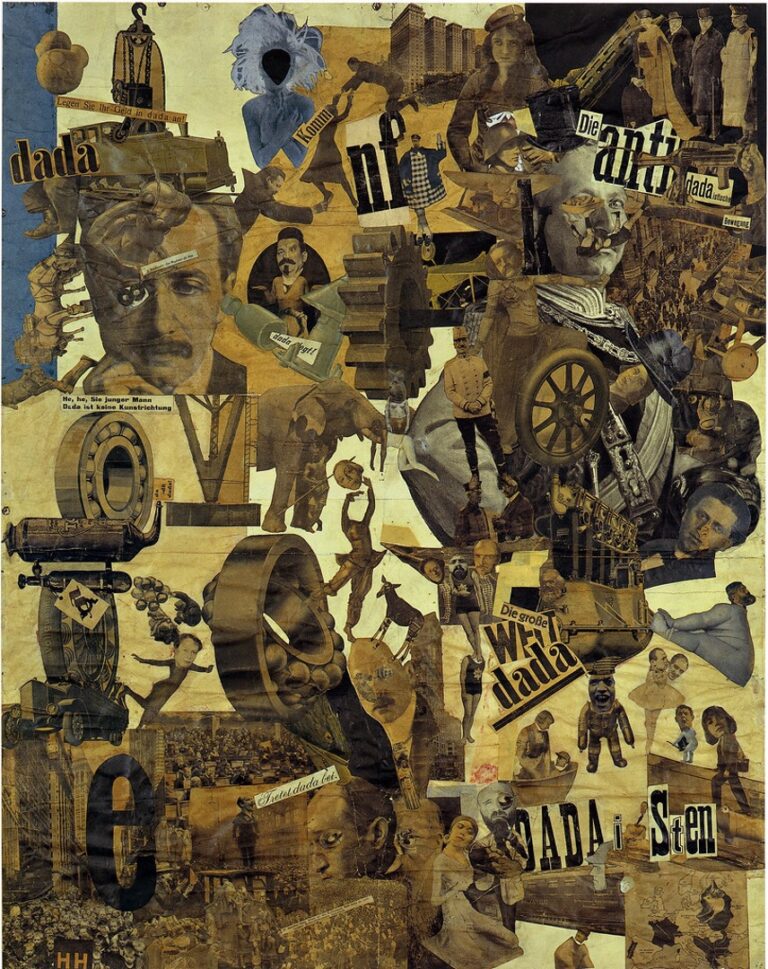
The full title reads: Cut with the Kitchen Knife. Dada Through the Last Weimar Beer-Belly Cultural Epoch of Germany, and it already tells us something about the technique and the subject. The complex image shows cut-out newspaper pictures and text and combines major, contemporary figures from politics and culture with depictions of science, industry, the military, and revolution.
In the top half of the image, Höch shows technical progress, science, and warlike politics. A giant insect sits on Albert Einstein’s forehead, and the infinity symbol appears in his right eye. In the upper right anti-Dada corner of the collage, the abdicated Kaiser Wilhelm II gets two wrestling bodies glued onto his face as a mustache substitute. Paul von Hindenburg’s head sits on the body of a dancer.

At the center of the chaotic-looking image, the head of artist Käthe Kollwitz floats above the headless body of a dancer. Franz Kafka appears at the right edge of the picture.
The bottom half of the image forms the pro-Dada zone, where the Dadaists appear in playful and comic poses. Raoul Hausmann’s head is out of proportion, too large for the body mounted beneath it, while fellow Dadaists George Grosz and Wielande Herzfeld have to share one ballerina’s body. Niddy Impekoven, a well-known dancer and actress at the time, bathes Dadaist John Heartfield as he lies in the tub. Communist leader Karl Radek, Dadaist Johannes Baader, and Lenin form a trio of heads sharing a single woman’s body. Karl Marx’s head is mounted on the bow of a ship, like an icebreaker. It shows the Dadaists’ political stance. Karl Liebknecht appears too, demanding: “Join Dada.”
You can read more on Dada here: Der Die dADa – Unordnung der Geschlechter

The head of writer and art critic Theodor Däubler is glued onto the giant baby at the right edge, turned 180 degrees to look backward. Hannah Höch placed herself in the lower right too: her head is glued to the left edge of a map of Europe, where the countries with women’s suffrage are shaded dark.
All the figures are woven into the mechanisms of industrial production. Gears, ball bearings, and motors act as connecting elements. Houses, streetscapes, and animals round out the photomontage.
Dadaism
Dadaism emerged in Europe during World War I and spread through the 1920s. It was a reaction to the horrors of the First World War, the November Revolution of 1918/19, strikes and power struggles in the Weimar Republic, and the conventions of the art world at the time. After the perceived collapse of civilization, a collapse of art had to follow.
The Dadaists rejected the traditional art of l’art pour l’art and bourgeois conventions, and they broke with the rules of the day. They created works that were often absurd, provocative, and seemingly senseless. Dadaism was an avant-garde, programmatic movement that rebelled against the ideas of reason, order, and authority and emphasized imagination and chance instead: a rejection of all logic. It saw itself as an anti-art movement, less a movement than an attitude, as the members put it in their sociopolitical manifesto. A change in social and political conditions was to be achieved by questioning everything. And: they were against everything. Shocking people at any cost, as a means to an end. In Zurich, Berlin, Paris, and later New York, Dadaism helped erase the line between life and art.
Marcel Duchamp, who declared a urinal art, belonged to the Dadaist group too, but more on that in another article.
Hannah Höch’s Eventful Life
Hannah Höch (1889–1978) was born in Gotha and moved to Berlin to study art. There she met Raoul Hausmann, and the two carried on a romantic and working relationship for seven years. You can see this clearly in both their artistic work, since the technique of photomontage and the motifs resemble each other.
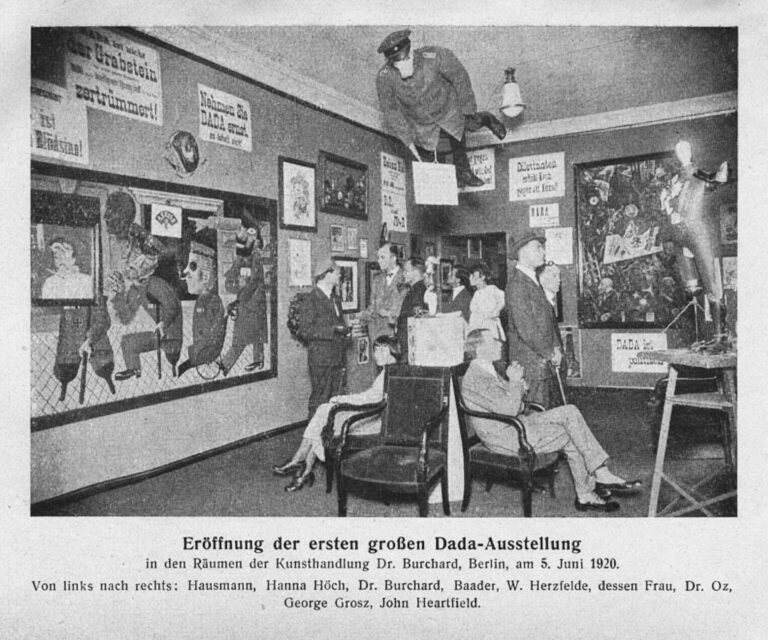
Legend has it that Höch invented the principle of the collage technique almost by accident, on a Baltic Sea vacation with her lover Hausmann, and so shaped the art of the Dadaists. Later, Hausmann, also known as the “old warhorse of Dada polemics,” would repeatedly claim the technique as his achievement alone. Höch was the only woman among the Dadaists, and her male colleagues kept overlooking her. Still, she managed to take part in the first International Dada Fair in 1920 and showed her collage Cut with the Kitchen Knife there. She made her living working at the Ullstein publishing house.
After her relationship with Hausmann ended, she lived for several years with Dutch writer Til Brugmann, a liaison the supposedly so free-spirited artist circles viewed with suspicion.
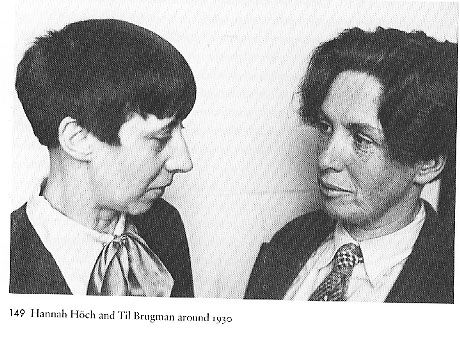
She traveled to Paris, the Soviet Union, and the United States and kept getting chances to exhibit. Condemned by the Nazis, Höch withdrew to Berlin-Heiligensee and was branded a degenerate artist from 1933 to 1945. She kept making art until her death, collaging her socially critical work. The role of women remained a recurring theme throughout. Still, she never matched her prewar success again.
“To this day I keep trying to make consistent use of the photograph. I use it like paint, or like the poet uses words.”(Hannah Höch, 1959)
_Hannah_Anna_Therese_Johanna_H%C3%B6ch.JPG "The Avant-Garde Art of Hannah Höch: Collage as the Language of Dadaism | Art Matters")
Conclusion
Hannah Höch’s Cut with the Kitchen Knife is one of the most important works of Dadaism, and of modern art in general. It was a groundbreaking collage that questioned traditional artistic conventions and produced new forms of artistic expression. It contributed to the development of collage art and inspired countless artists in the decades that followed.
The image still feels remarkably modern more than 100 years after it was made. One more reason to visit the Neue Nationalgalerie in Berlin. And definitely a reason to appreciate the importance and influence of Hannah Höch, woman and artist, in art history!
The article on Dada gives more insight: Der Die dADa – Unordnung der Geschlechter
Take a look, too, at some other terrific women in art.
The Avant-Garde Art of Hannah Höch: Collage as the Language of Dadaism – britta kadolsky
“`
Diesen Beitrag teilen:
Newsletter
Wenn ihr keinen Beitrag verpassen und über neue Artikel informiert werden möchtet, abonniert meinen Newsletter.
"Was kann Kunst" ist auch auf:
Wie Jenny Saville den Blick auf Frauenkörper sprengt
am 12.8.2026
Brancusi, der moderne Bildhauer
britta kadolsky am 13.7.2026
Venice: A Short Guide for Art Lovers
britta kadolsky am 23.6.2026
Venice Biennale 2026: My Five Favorite Pavilions
am 11.6.2026
Günther Uecker: Nagelkünstler, Weltreisender, stiller Poet
britta kadolsky am 10.5.2026
Yayoi Kusama: Dots That Never Stop
am 19.4.2026
Why Art Matters: The Political Power of Art and the Russian Pavilion Everyone Is Fighting Over
britta kadolsky am 30.3.2026
Thomas Bayrle erfindet das Große im Kleinen
britta kadolsky am 9.3.2026
Xenia Hausner: Schafft eine Bühne für selbstbestimmte Frauen
britta kadolsky am 16.2.2026
Ikonen der Kunstgeschichte
Saskia Wolf am 21.1.2026
Papier in der Kunst: Papier inspiriert Kunst über Jahrhunderte
britta kadolsky am 22.12.2025
Warum belebt Ophelia Kunst und Popkultur?
britta kadolsky am 17.11.2025
Fünf Graphic Novels, die Kunst neu erzählen
britta kadolsky am 3.11.2025
5 berühmte Künstlerpaare der Kunstgeschichte - Zwischen Passion und Untreue
Saskia Wolf am 18.10.2025
Max Liebermann – Maler des Lichts und des Lebens
britta kadolsky am 26.9.2025
Chaos, Körper, Farben: Die Kunst von Pipilotti Rist
britta kadolsky am 27.8.2025
CIA, Kunst und Kalter Krieg: Die documenta II 1959
britta kadolsky am 17.7.2025
Kunst beim Spazierengehen: 10 Skulpturen in Frankfurt
britta kadolsky am 2.7.2025
David Hockney - Zwischen Licht und Linie
britta kadolsky am 25.5.2025
Im Innern des Papiers – Skulpturen von Angela Glajcar
britta kadolsky am 7.5.2025
April, April: Die Kunst des Täuschens
britta kadolsky am 13.4.2025
Andreas Mühe – Im Banne des Zorns
britta kadolsky am 16.3.2025
Martin Kippenberger - Ein Künstler, der Wettsaufen und Punkmusik liebte
britta kadolsky am 18.2.2025
Die Zahl 100 in der Kunst: Symbolik und Bedeutung
britta kadolsky am 23.1.2025
Frauenpower: Künstlerinnen und Erfinderinnen
Saskia Wolf am 16.12.2024
Hans Haacke: Politische Kunst mit Tiefgang
britta kadolsky am 2.12.2024
Kunst unter Bäumen – der Internationale Waldkunstpfad in Darmstadt
Ruth Fühner am 10.11.2024
Blut, Fleisch, Kot: Ungewöhnliche Materialien in der Kunst:
britta kadolsky am 28.10.2024
Kunst und Kamera: Die vergessene Geschichte der Fotografinnen
britta kadolsky am 1.10.2024
Der Die dADa – Unordnung der Geschlechter
britta kadolsky am 5.9.2024