Venice Biennale 2026: My Five Favorite Pavilions
61st Venice Biennale
Koyo Kouoh never got to see this Biennale. The curator died in May 2025, and her team carried out her concept without changes. The jury resigned as a group after announcing it would refuse to award Golden Lions to artists from countries whose governments face charges at the International Criminal Court. The EU Commission pulled a two-million-euro grant because Russia took part again for the first time since 2022. On top of that, protests broke out in front of the Russian and Israeli pavilions during preview days. The 61st Venice Biennale had a rough start in 2026. By the time I arrived, things had calmed down. Perfect conditions for actually looking at art. Here are my five favorite pavilions.
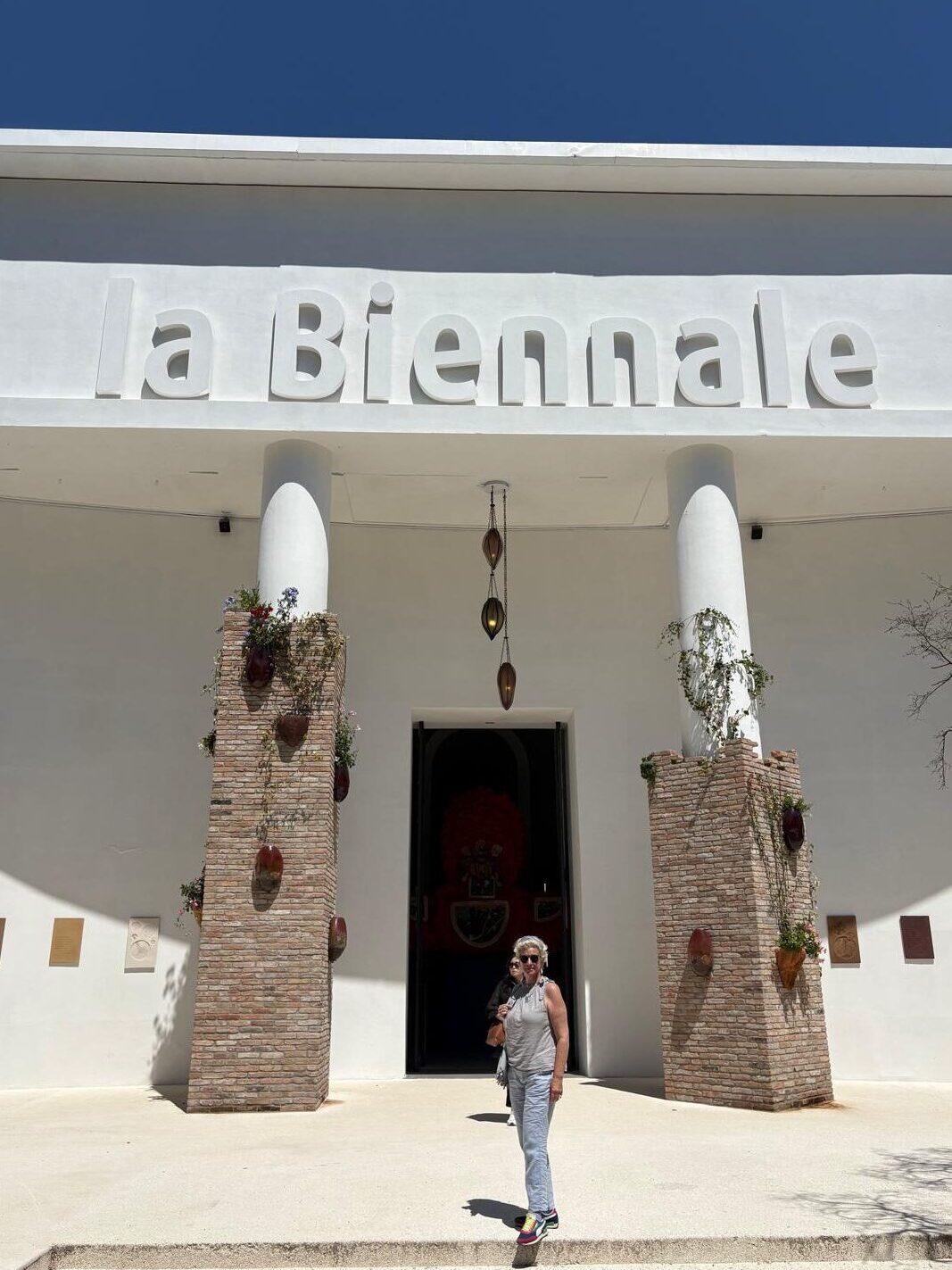
Austria: SEAWORLD VENICE, by Florentina Holzinger,
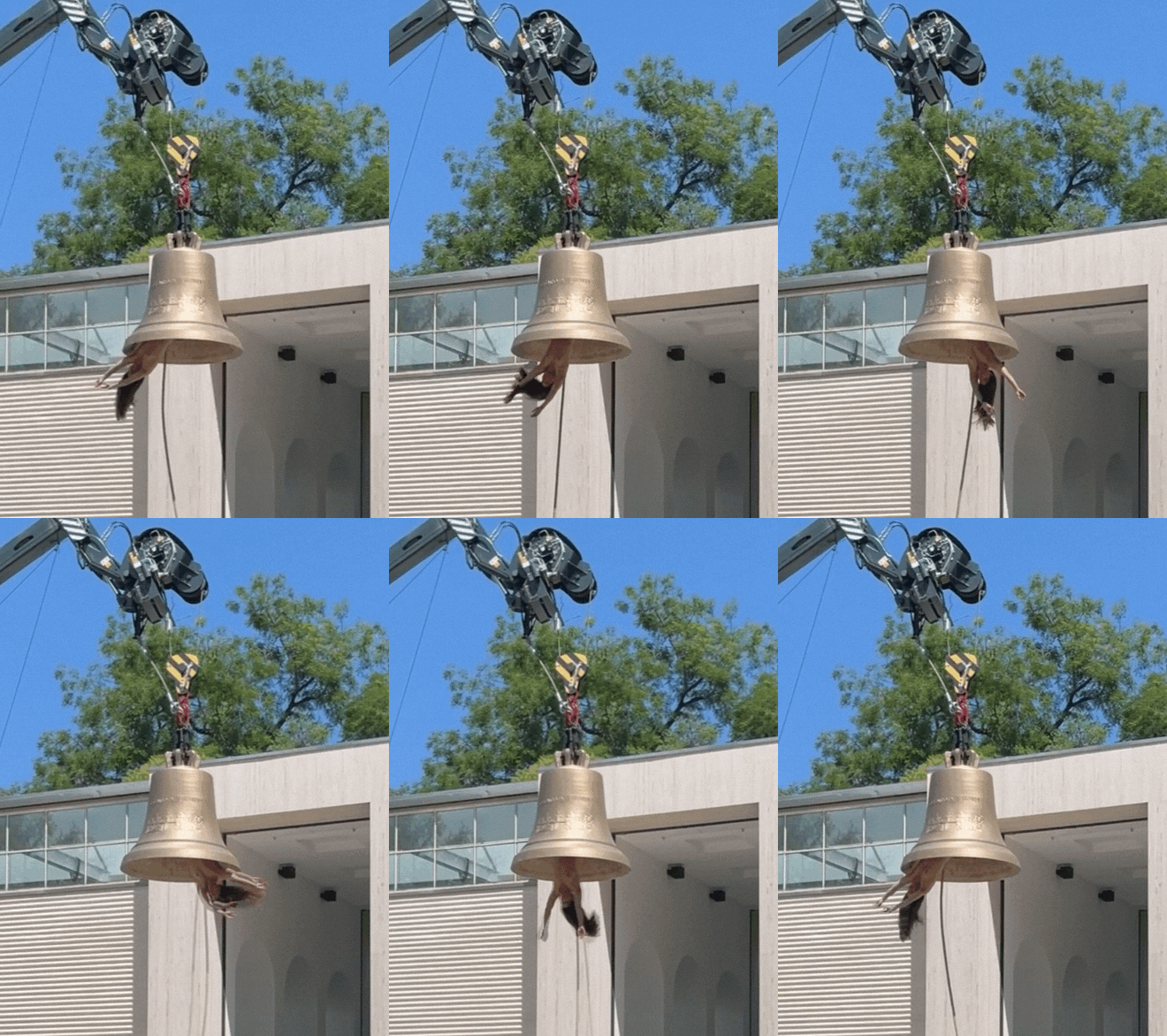
Austria: SEAWORLD VENICE, by Florentina Holzinger
The press had covered this pavilion extensively, and the line outside says it all. We get in line. And as if on cue, the performance starts the moment we make it far enough forward: a woman, naked, hangs upside down by her feet, hair dangling, suspended inside a bell. She swings her body like a living clapper, her shoulders slam into the bell’s wall, and the sound rings out loud and clear. My body reacts before my brain does: a dull pull, a kind of physical empathy. Not pity, but recognition of how relentlessly this woman turns her own body into material and statement.
Then we’re let into the pavilion, both wings flooded with about half a meter of water. On the left, a naked woman races circles on a jet ski through the basin, and it’s loud, unbearably loud. On the right, naked women climb a kind of weathervane pole that reaches to the ceiling. These extreme endurance performances hurt to watch, too. It’s unbelievable what these bodies can take, and what they choose to put themselves through.
Holzinger and her all-female ensemble see this work as self-empowerment. The female body carries a long history of violence, femicide, and being controlled by others. What happens here is a reversal: the women decide for themselves when, how, and why their bodies suffer. No victim status. Full control.
There’s another performance in the back courtyard: a woman with an oxygen tank sits inside a glass water tank, staring back at us as we watch her. Portable toilets stand on either side, where visitors can make a “donation.” A performer tells us the urine gets cleaned and filtered before it ends up back in the tank with the diver.
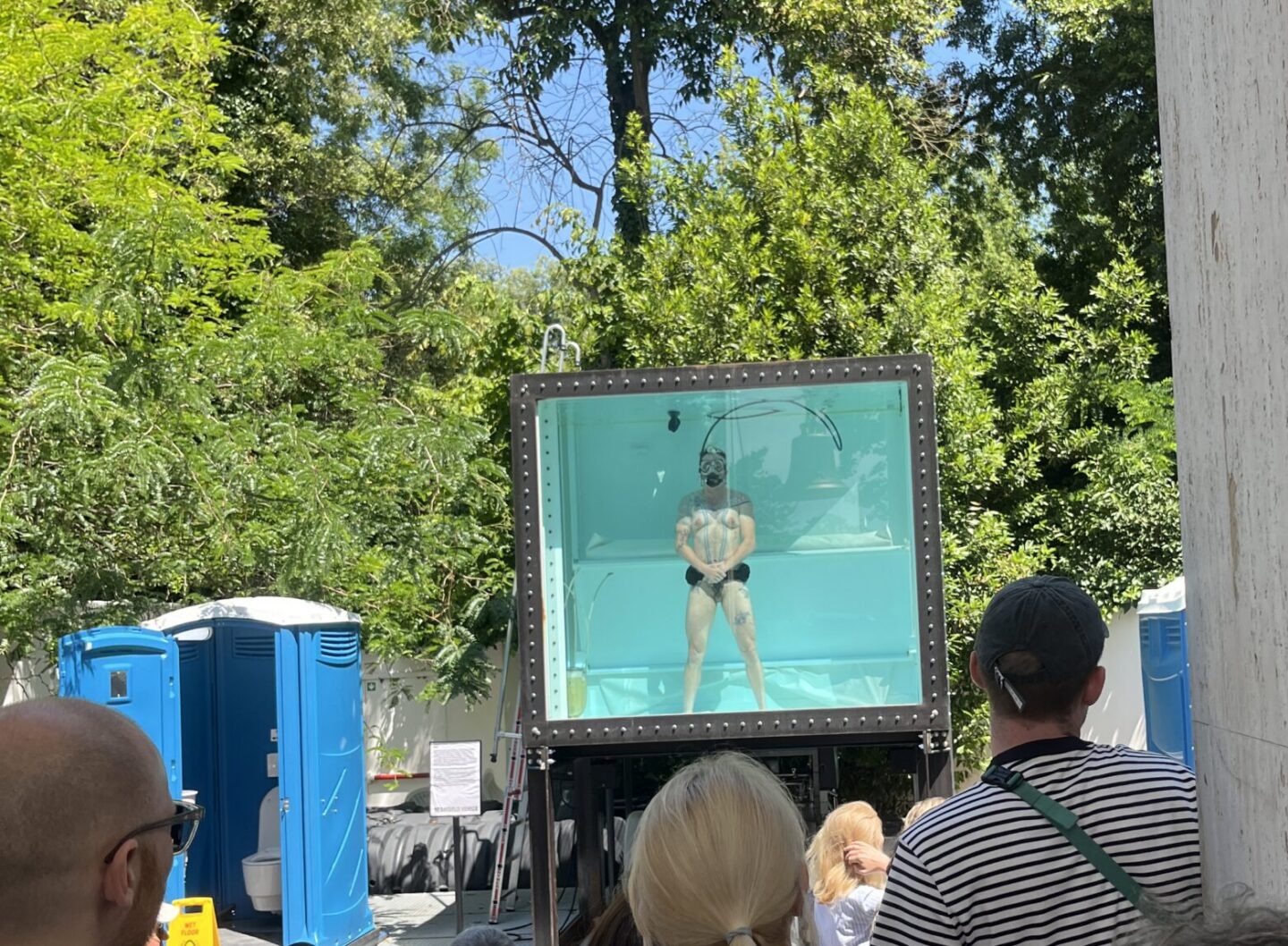
The brass bell carries an engraving of Cicero’s lament about the times and customs: “O tempora, o mores.” How fitting. The tabloids worked themselves up over “fecal performance,” the “piss artist,” and warnings that things would get “unappetizing,” but the performance turns out to be precise commentary on the present. Holzinger takes on the subject of water in Venice and points it straight at the sustainability claims of this massive art show, the Biennale.
SEAWORLD VENICE is no romantic postcard of Venice. It’s a sewage plant. It’s feminist theater. And it’s spectacle. Controversy helps. And so the Austrian Pavilion has become one of the Biennale’s most talked-about pavilions.
Germany: RUIN, Henrike Naumann & Sung Tieu
The German Pavilion’s exterior stops me in my tracks. This time there’s no reckoning with the fascist Nazi architecture from 1938, but instead a reckoning with the former GDR in the form of a socialist prefab apartment block.
Sung Tieu covered the facade in roughly three million tiny mosaic tiles: a pixelated image of the Gehrenseestraße housing complex in Berlin-Hohenschönhausen, where she herself lived as a child. Before reunification, the building was one of the GDR’s largest housing complexes for Vietnamese contract workers. After reunification, it became a ghetto. Today it’s a neglected ruin.
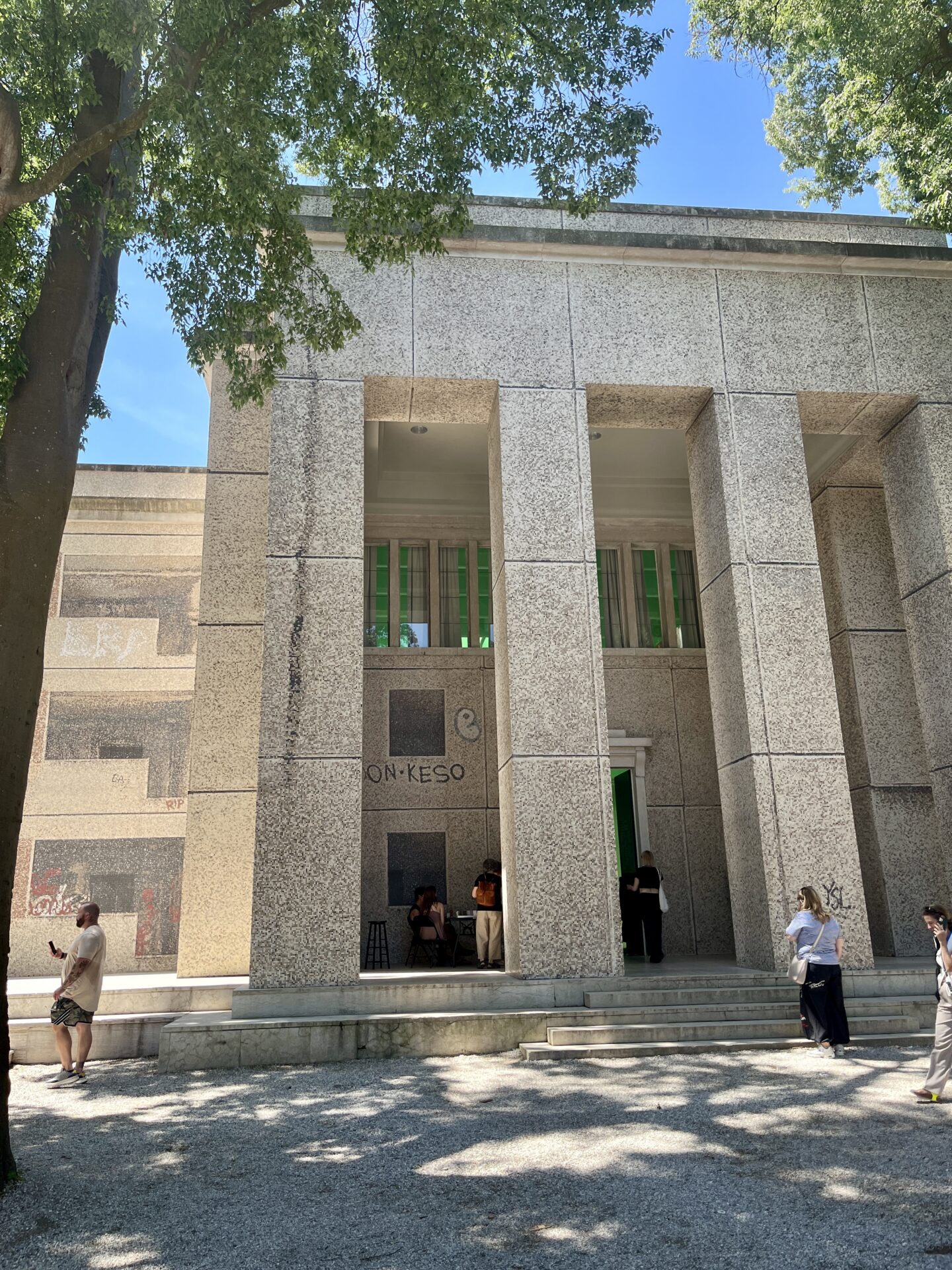
Tieu knows this history firsthand. Her father came to the GDR for work, and she followed with her mother in the early 1990s. Her installation turns attention to all the Vietnamese contract workers who fell through the cracks of post-reunification Germany, caught between arbitrary bureaucracy and a society that met them with racism. The facade also recalls the Sonnenblumenhaus in Rostock-Lichtenhagen, where a right-wing mob carried out the first pogrom in Germany since World War II, in 1992.
In the pavilion’s side wings, Sung Tieu turns to her mother. She took her mother’s measurements and had her arms and legs cast in glass. Minimalist, abstract objects also evoke a pillory and the racist body measurements of the colonial era. But the idea of using her mother’s story to draw attention to this important, neglected subject gets somewhat lost in the spare aesthetic.
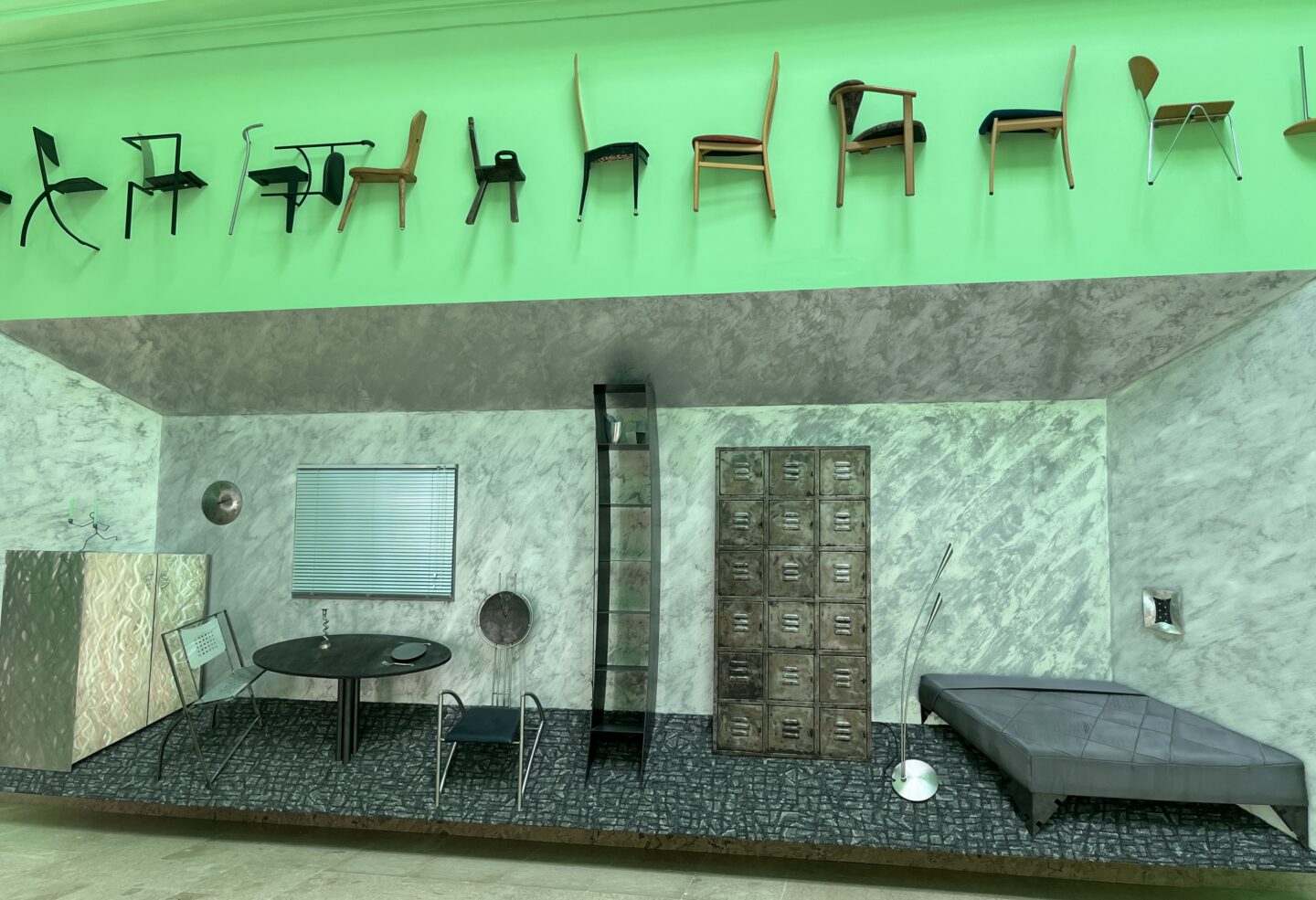
Henrike Naumann designed the main room. The artist died of cancer in February 2026 at age 41, and only her husband and her team could finish the exhibition. The walls are painted mint green, the color of former Soviet barracks in the GDR. A relief of chairs sliced in half runs along the long walls, tracing a chronology of German design history across the 20th and 21st centuries. These chairs aren’t GDR nostalgia props. They trace a shift in taste and everyday aesthetics across East and West.
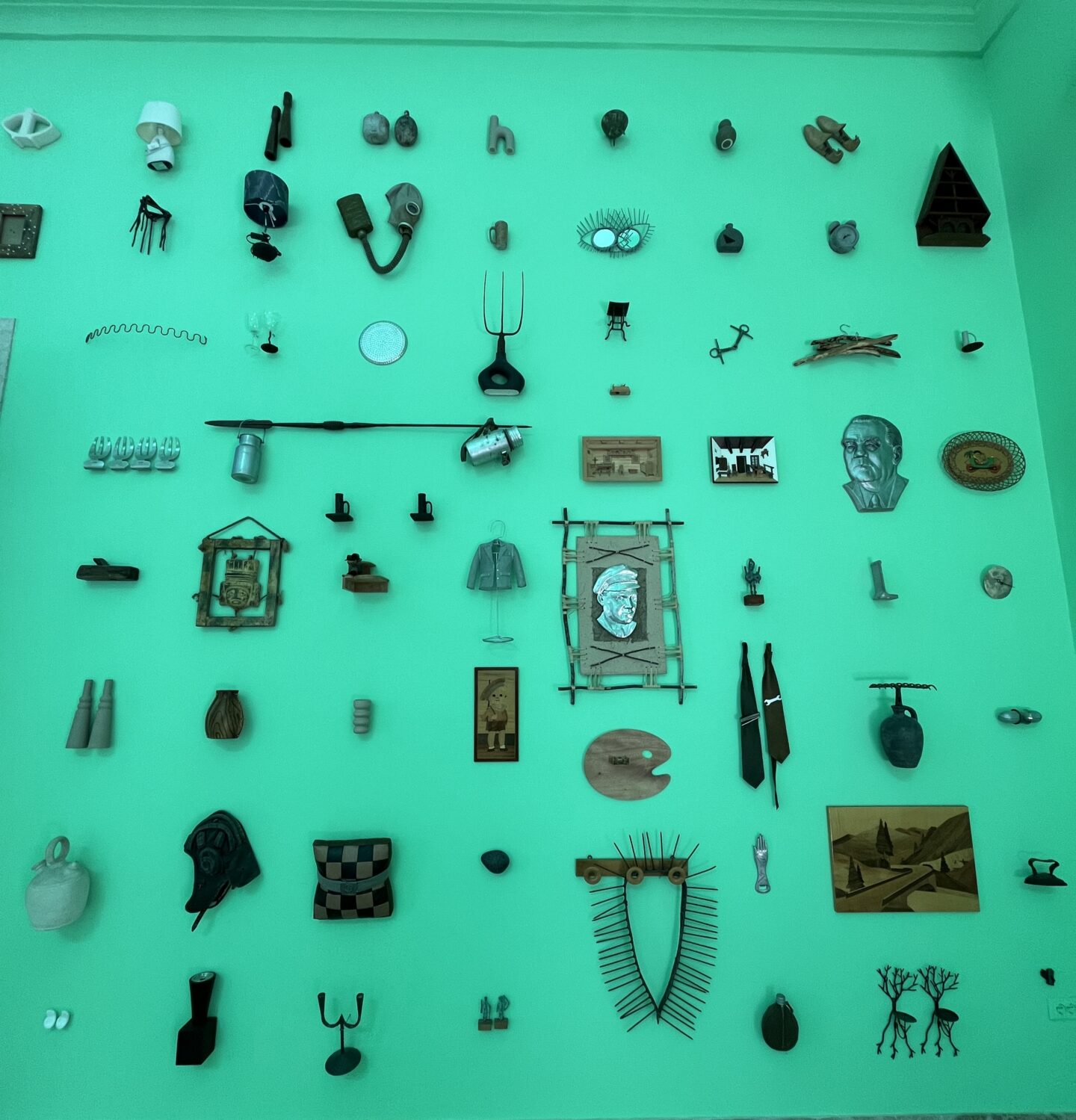
Objects that don’t seem to belong together at first glance cover the entrance wall: wooden pictures, vases, milk cans, sickles, a gas mask, an axe, a portrait of Thälmann, a pitchfork, a chunk of the Wall, and more. Naumann calls them “hieroglyphs” of German history and ideology. QR codes unlock the connections. A seemingly harmless spiral ornament turns out to be the recognition symbol of a neo-Nazi network. The milk cans point to agricultural expropriations in the GDR. Naumann calls it an “archaeological prehistory of the present.”
In her earlier work, Naumann arranged ordinary living-room furniture, couches, cabinets, rugs, into imagined interiors, showing that far-right extremists live in perfectly normal apartments. The NSU killers, for instance, radicalized in modest rental units. Her point: extremism doesn’t happen in some foreign, threatening environment. It happens in familiar, middle-class living rooms that look no different from any other German household.
The whole pavilion becomes a path through German history, but it’s a path you have to work for. Nothing here is self-explanatory or intuitive.
UK: Predicting History: Testing Translation – Lubaina Himid
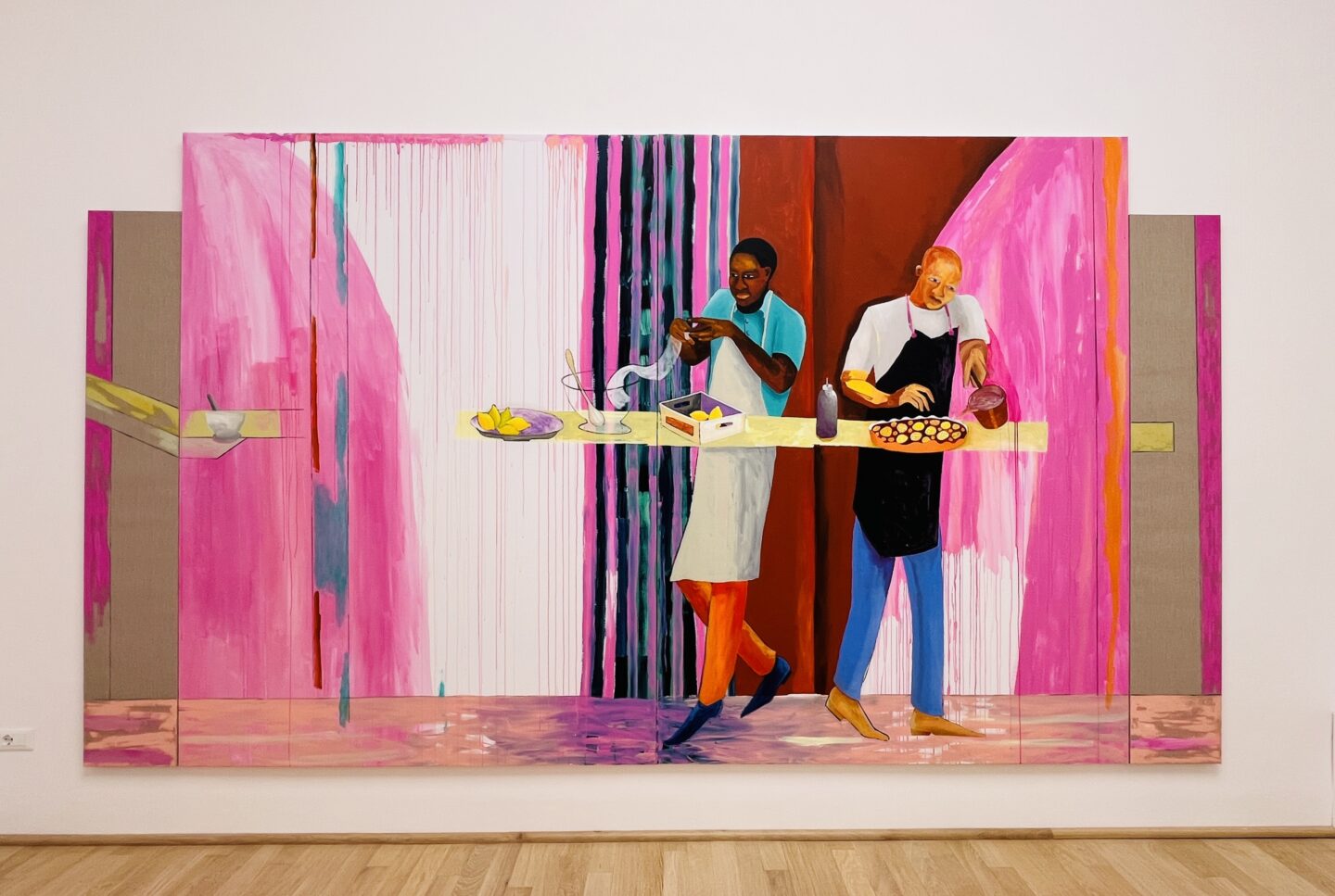
The tailors exchange sideways glances. The architects stand next to plans for a mosque, a church, a factory, and look at each other as if asking: what are we actually doing here? Lubaina Himid doesn’t paint answers. She paints the unease itself.
Five monumental, multi-panel paintings form the heart of the exhibition. All of them run horizontal and combine different sections: abstract patterns on the left, figurative scenes on the right, always showing two people communicating with each other. Only on close inspection do I notice that the abstract patterns on the left reappear inside the figurative scenes on the right.
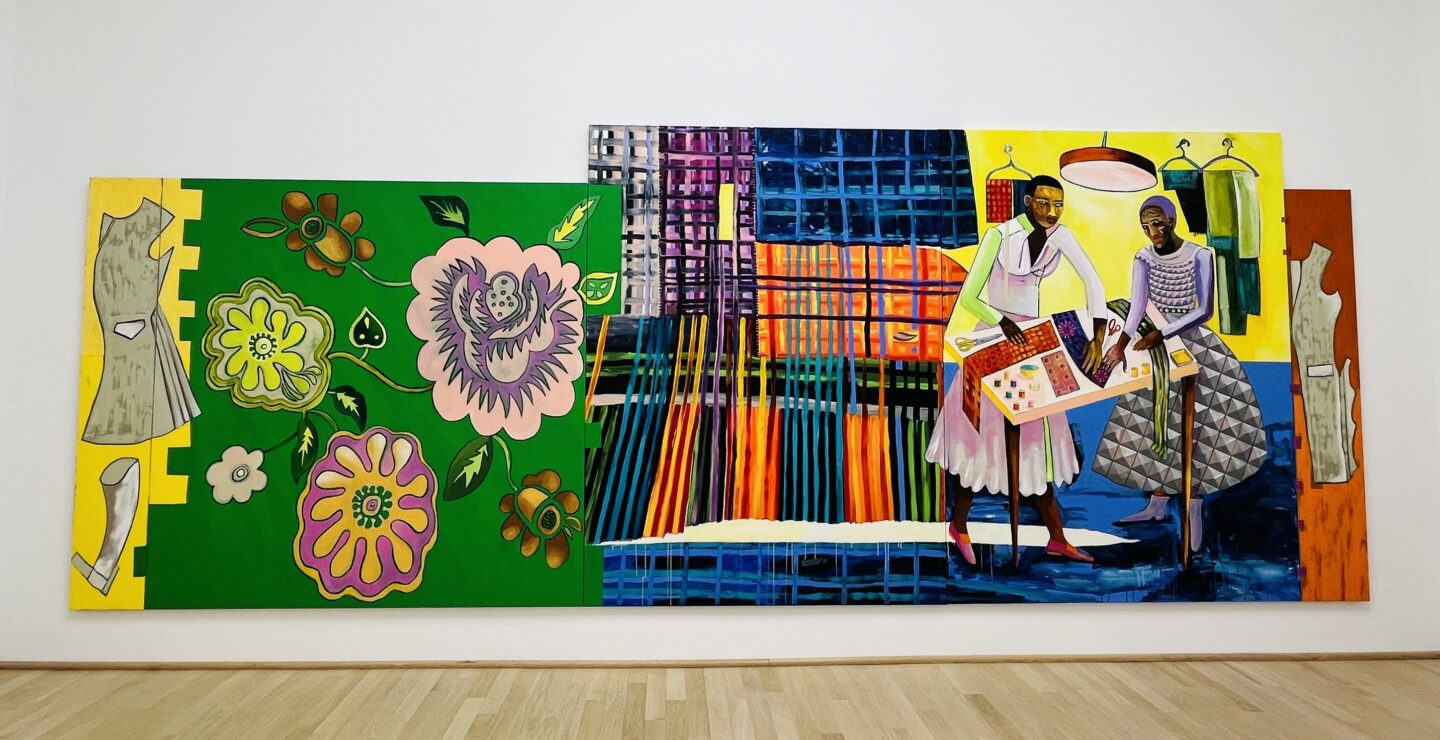
I find the color in her paintings stunning. But the Black people at the center of each image don’t look at ease. Dressed in bright clothing against colorful backgrounds, they’re shown doing everyday jobs: sewing, cooking, building boats, designing buildings, gardening. People who keep a country running and still never quite belong.
The 26 questions on the wall fit right in, among them: Do you want to go back to the old place? What reminds you of home? Where do you belong?
Himid was born in Zanzibar, emigrated to Britain as a child, and became a founding figure of the Black British Art Movement in the 1980s. In 2017, at 63, she won the Turner Prize as its oldest recipient to date. Her subjects are race, history, feminism, and cultural memory. Her art works toward making visible the contributions of Black people that Western history has erased.
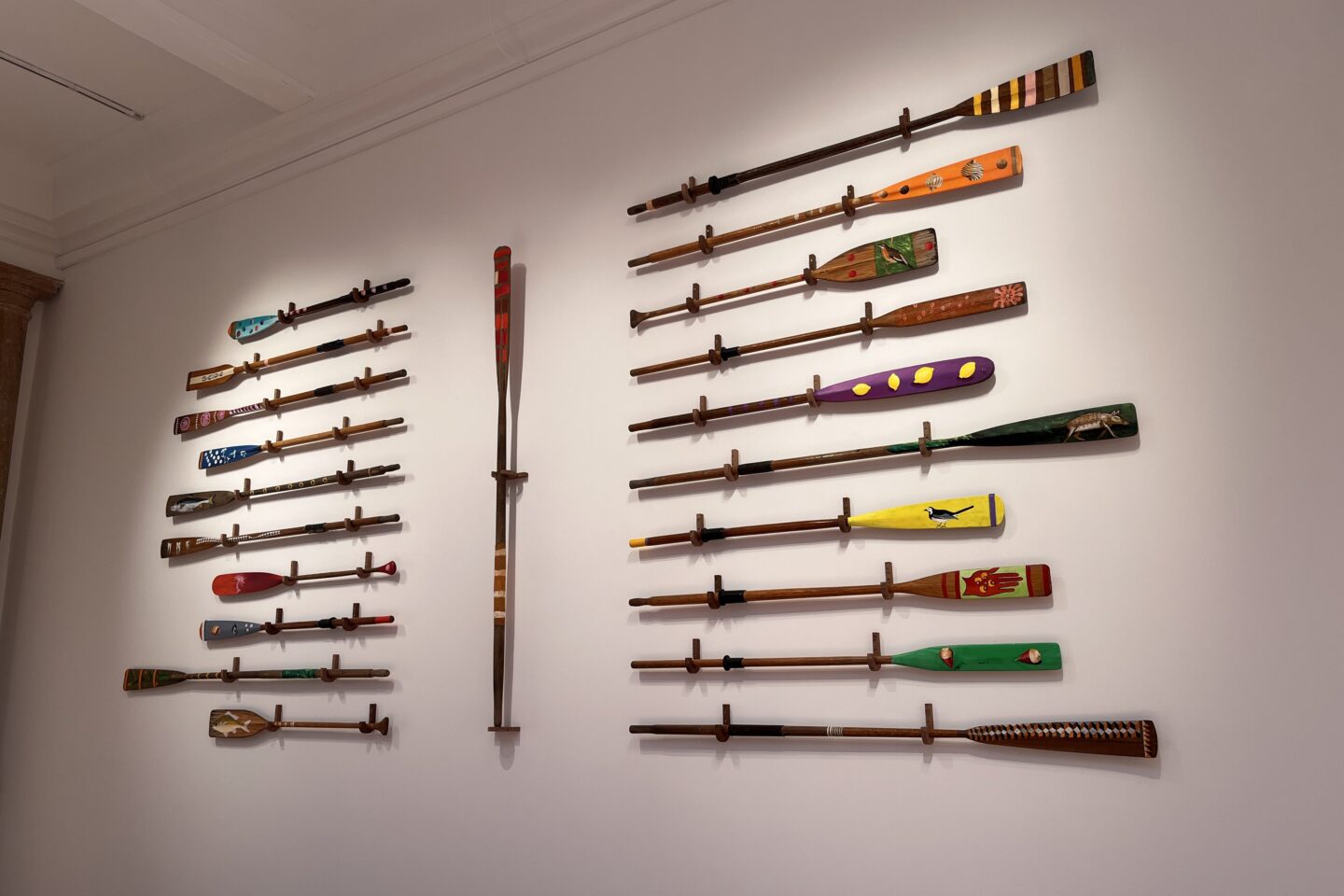
A separate room holds painted oars that Himid found in the Venetian lagoon. Where did they come from? Where were these people headed, and did they make it? Himid asks the questions and leaves them open.
The title Predicting History: Testing Translation is really a contradiction in itself: predicting history is absurd, and testing translation sounds just as illogical. Himid explores what home means when your own roots lie somewhere else.
Japan: Grass Babies, Moon Babies, by Ei Arakawa-Nash
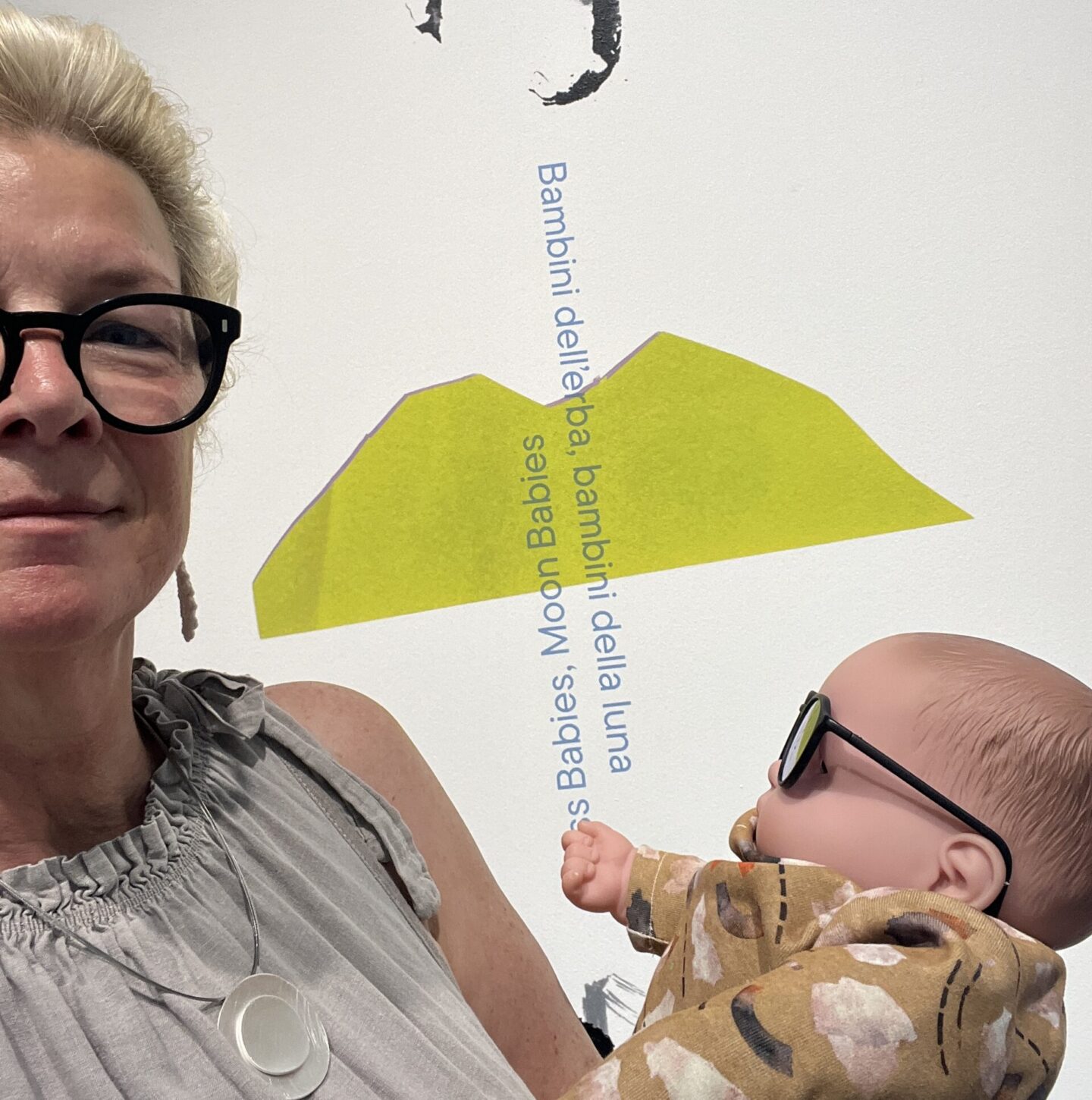
Yes, I’m holding a baby. Years after doing this with my own child, it still feels completely natural. The infant is pretty heavy. I carry it on my right hip through the Japanese Pavilion, past baby bottles, pacifiers, and strollers. I cradle its head and notice, a little unsettled, that I can see my own reflection in the baby’s sunglasses. Why does it even have sunglasses on? The baby is rendered with real fidelity: size, weight, proportions, but the sunglasses put a strange distance between me and it.
The second floor has changing stations. I pull off the baby’s underwear and unbutton its onesie. There’s a QR code tucked inside the diaper. I scan it and receive a poem, sent straight to my phone.
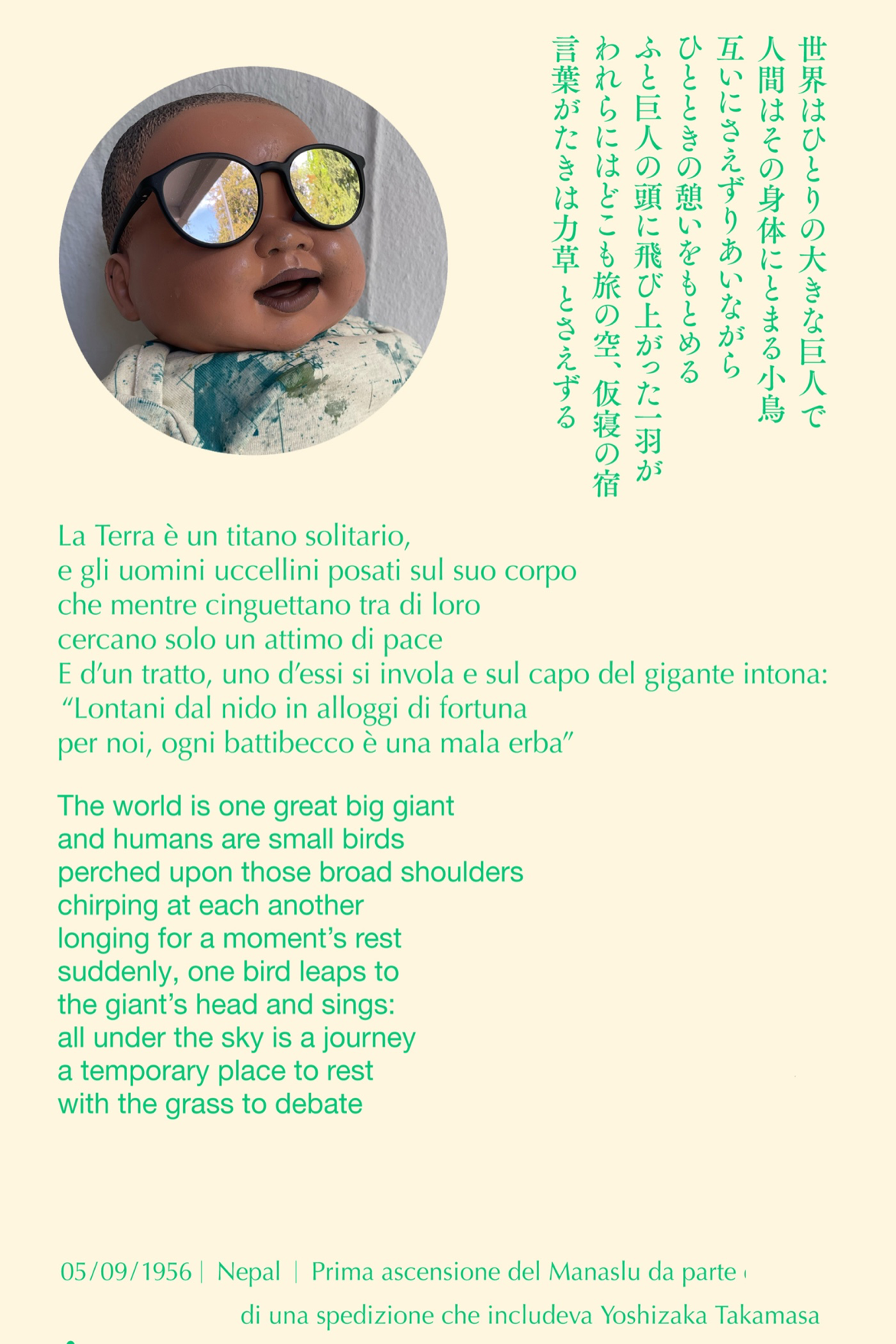
Ei Arakawa-Nash built this participatory work for the Japanese Pavilion out of his own perspective as a queer parent. He’s been a father since 2024. He invites visitors to carry one of over 200 handmade baby dolls through the garden, through the interior rooms, and temporarily step into the role of a caregiver. Care is labor. Unpaid, invisible, and historically women’s work. So who’s actually carrying the babies through the pavilion? Almost only women. Of course.
I have to smile at this piece. Millions of women do the same thing every day: become mothers. Physically, painfully, with bodies that change forever, exhausting, sleep-deprived, taken for granted, and without a pavilion. It is striking that caregiving, long regarded as ordinary women’s work, suddenly becomes museum-worthy when framed through the experience of fatherhood. That says more about our society than about this pavilion. But art gets to do that. And besides: art that pulls me in has never left me cold.
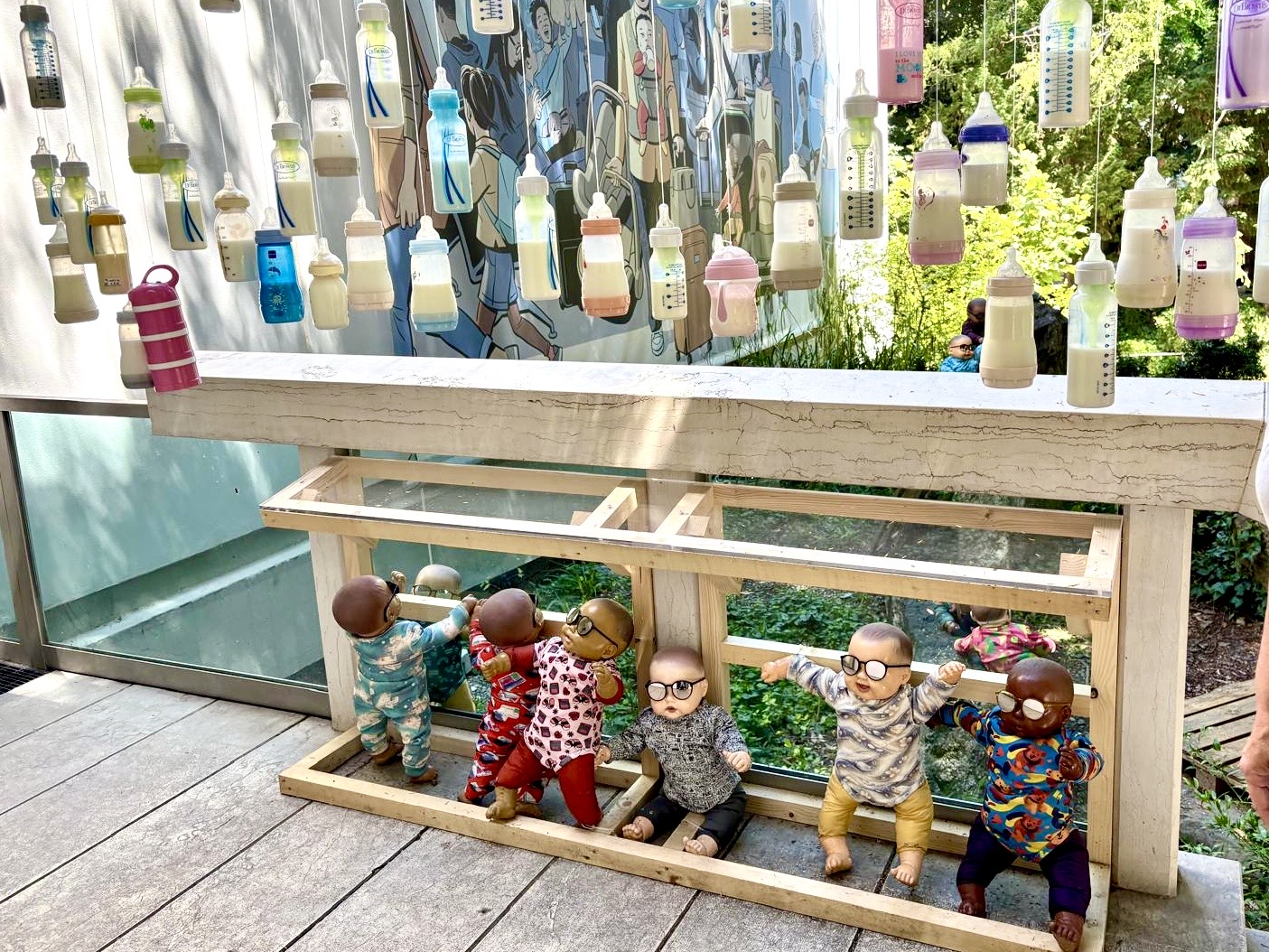
Arakawa-Nash has spent years exploring collective performance and queer kinship. With Grass Babies, Moon Babies, parenthood and care join his list of themes. After Venice, the exhibition travels to Hannover and Tokyo.
Spain: Los Restos, by Oriol Vilanova
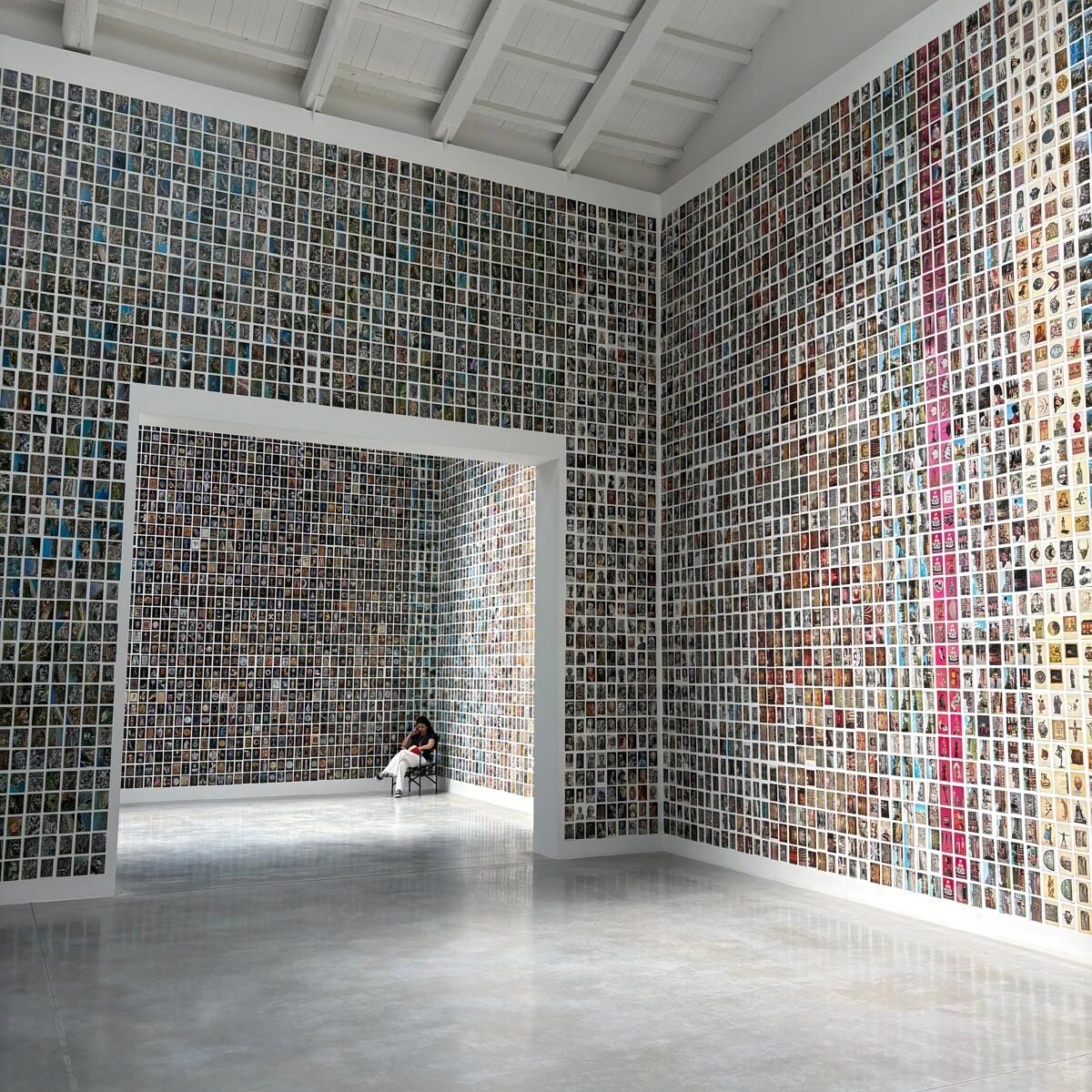
I’ve always loved postcards, writing them and receiving them. That small, almost anachronistic format: one image, a few lines, a trip in miniature. Oriol Vilanova lives and works in Brussels and has spent two decades collecting at flea markets and secondhand shops. His exhibition in the Spanish Pavilion is called Los Restos, the remains, and the title didn’t prepare me for what’s inside: over 50,000 old and newer postcards cover the walls. Not an inch of empty space left.
Walking into the otherwise empty pavilion, the sheer mass of images on the walls hits you at once. From ceiling to floor, in rows side by side and stacked on top of each other, these former fragments of everyday communication cling to the walls. Vilanova has rescued them from being forgotten.
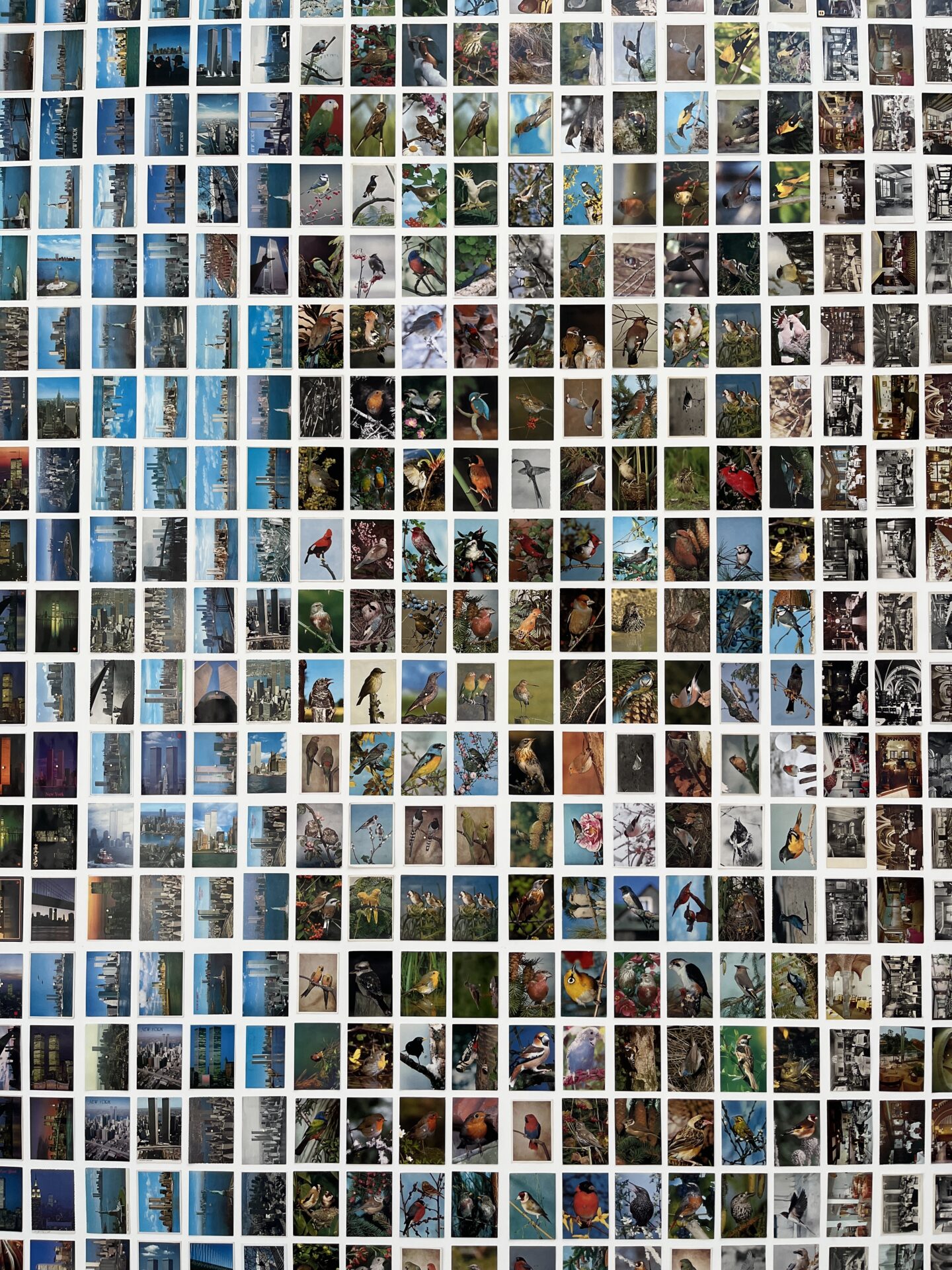
The postcards follow a strict grid. All of them hang upright, sometimes sorted by color, always sorted by motif. Vilanova has grouped the images into categories: bridges, boats, circus tents, coats of arms, monuments of famous cities, markets, artworks, cats, birds, aerial views, statues of famous men and women on their pedestals, and countless other themes. No spatial limits, no time limits: the collages span the whole world and nearly two thousand years.
This isn’t a jumble. It’s an atlas. An atlas of forgetting that asks: what do we preserve? What do we let disappear? And whose memories even count?
Conclusion
At first glance, these five pavilions might not have much in common, but a common thread runs through all of them: each speaks from personal experience. Sung Tieu reconstructs the facade of her own childhood. Arakawa-Nash works through his recent experience of becoming a parent. Vilanova has collected postcard after postcard for twenty years. Naumann rebuilds the rooms a whole generation grew up in. Himid paints her own experience of not belonging. Holzinger uses the female body as a political statement, and that body isn’t a metaphor, it’s lived reality. The personal here is never just self-reflection. It’s always political too. None of them could be rushed.
I didn’t just walk through. I stood in line and waited for the bell. I carried a baby up two floors and changed its diaper. I lost myself in 50,000 postcards. I stared at Himid’s paintings until individual connections clicked into place. I studied chairs, mosaic tiles, and strange objects. These pavilions don’t open up at first glance. But after a while, each one leaves me with the same feeling: an insight I wasn’t looking for, and one that hits me anyway.
I also just wrote a piece on Venice: a short travel guide from an art lover, a look at Venice beyond the Biennale, between the lagoon, the palazzi, and art history.
By the way: I’ve written about the German Pavilion in past years too, 2024 and 2022. You can read there how Germany has presented itself in Venice.
Venice Biennale 2026: My Five Favorite Pavilions, by Britta Kadolsky
Diesen Beitrag teilen:
Newsletter
Wenn ihr keinen Beitrag verpassen und über neue Artikel informiert werden möchtet, abonniert meinen Newsletter.
"Was kann Kunst" ist auch auf:
Glasstress 2026: An Art Star Lineup at Berengo That Nobody Sees
am 3.10.2026
Felix Gonzalez-Torres schreibt Liebe in Alltagsdinge ein
britta kadolsky am 14.9.2026
Wie Jenny Saville den Blick auf Frauenkörper sprengt
am 12.8.2026
Brancusi, der moderne Bildhauer
britta kadolsky am 13.7.2026
Venice: A Short Guide for Art Lovers
britta kadolsky am 23.6.2026
Günther Uecker: Nagelkünstler, Weltreisender, stiller Poet
britta kadolsky am 10.5.2026
Yayoi Kusama: Dots That Never Stop
am 19.4.2026
Why Art Matters: The Political Power of Art and the Russian Pavilion Everyone Is Fighting Over
britta kadolsky am 30.3.2026
Thomas Bayrle erfindet das Große im Kleinen
britta kadolsky am 9.3.2026
Xenia Hausner: Schafft eine Bühne für selbstbestimmte Frauen
britta kadolsky am 16.2.2026
Ikonen der Kunstgeschichte
Saskia Wolf am 21.1.2026
Papier in der Kunst: Papier inspiriert Kunst über Jahrhunderte
britta kadolsky am 22.12.2025
Warum belebt Ophelia Kunst und Popkultur?
britta kadolsky am 17.11.2025
Fünf Graphic Novels, die Kunst neu erzählen
britta kadolsky am 3.11.2025
5 berühmte Künstlerpaare der Kunstgeschichte - Zwischen Passion und Untreue
Saskia Wolf am 18.10.2025
Max Liebermann – Maler des Lichts und des Lebens
britta kadolsky am 26.9.2025
Chaos, Körper, Farben: Die Kunst von Pipilotti Rist
britta kadolsky am 27.8.2025
CIA, Kunst und Kalter Krieg: Die documenta II 1959
britta kadolsky am 17.7.2025
Kunst beim Spazierengehen: 10 Skulpturen in Frankfurt
britta kadolsky am 2.7.2025
David Hockney - Zwischen Licht und Linie
britta kadolsky am 25.5.2025
Im Innern des Papiers – Skulpturen von Angela Glajcar
britta kadolsky am 7.5.2025
April, April: Die Kunst des Täuschens
britta kadolsky am 13.4.2025
Andreas Mühe – Im Banne des Zorns
britta kadolsky am 16.3.2025
Martin Kippenberger - Ein Künstler, der Wettsaufen und Punkmusik liebte
britta kadolsky am 18.2.2025
Die Zahl 100 in der Kunst: Symbolik und Bedeutung
britta kadolsky am 23.1.2025
Frauenpower: Künstlerinnen und Erfinderinnen
Saskia Wolf am 16.12.2024
Hans Haacke: Politische Kunst mit Tiefgang
britta kadolsky am 2.12.2024
Kunst unter Bäumen – der Internationale Waldkunstpfad in Darmstadt
Ruth Fühner am 10.11.2024
Blut, Fleisch, Kot: Ungewöhnliche Materialien in der Kunst:
britta kadolsky am 28.10.2024
Kunst und Kamera: Die vergessene Geschichte der Fotografinnen
britta kadolsky am 1.10.2024