Glasstress 2026: An Art Star Lineup at Berengo That Nobody Sees
Glasstress 2026 in Murano: Rust, Soot and Rapture
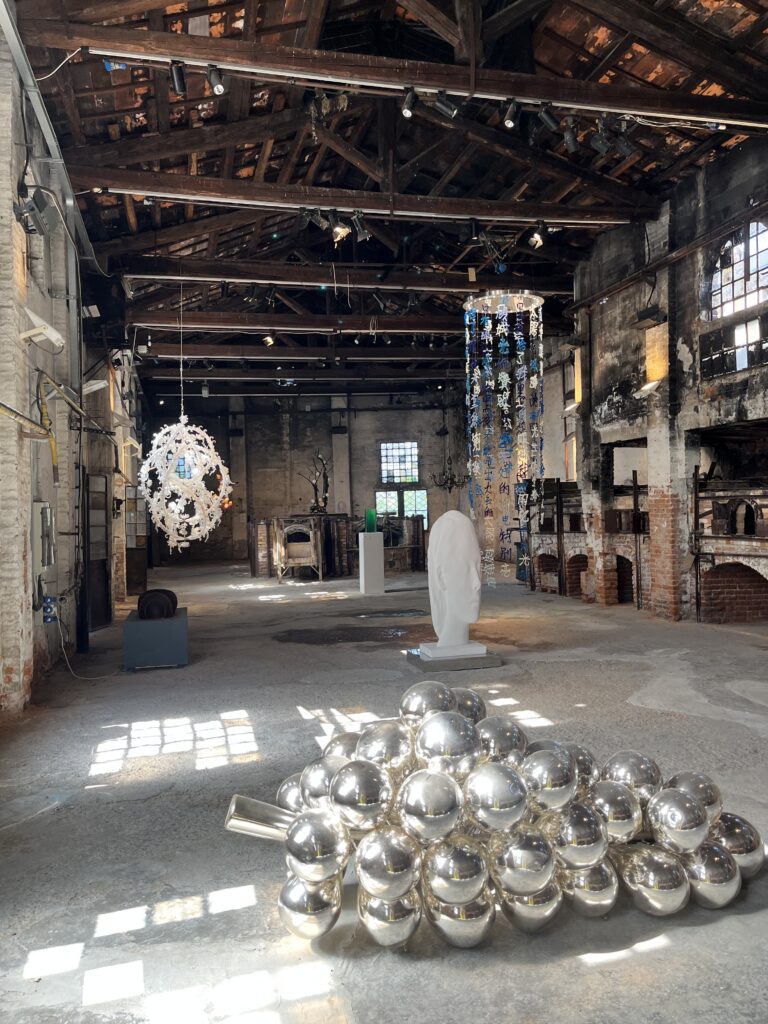
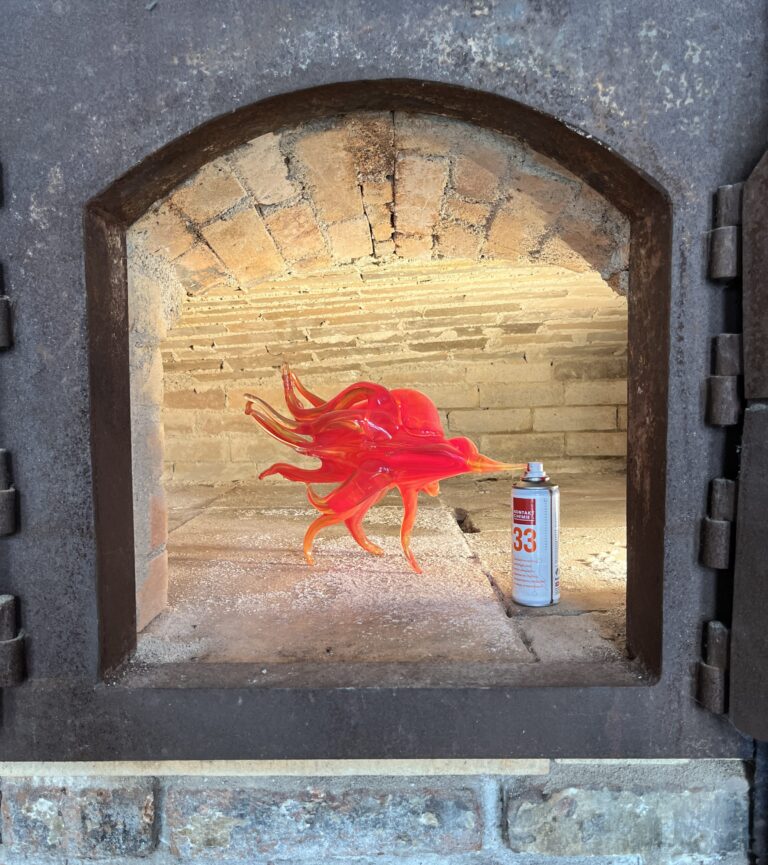
It still smells like a factory. Smoky, metallic, like a place where glass has been melted for decades. The old glassblowing factory on Murano, where the Fondazione Berengo presents its Glasstress 2026 exhibition, is a work of art in itself. Soot has eaten into the windows and blackened parts of the brown brick walls. Above it all rises an open wooden roof, the beams darkened with soot here and there. The furnaces still stand at the edge of the room, black as well. Only a few spotlights pull the generously spaced artworks out of the dark.
Nobody has produced anything in these rooms for a long time. The Fondazione uses the former factory hall purely as an exhibition space, and the dead furnaces stay as relics: not a stage set, but real history. If you want to watch Murano glass actually being made, walk a few alleys down to Berengo Studio, the still-active glass manufactory where master glassblowers work for the artists.
I have been to Berengo twice before and still have to hunt for the exhibition hall. That’s how hard it is to find.
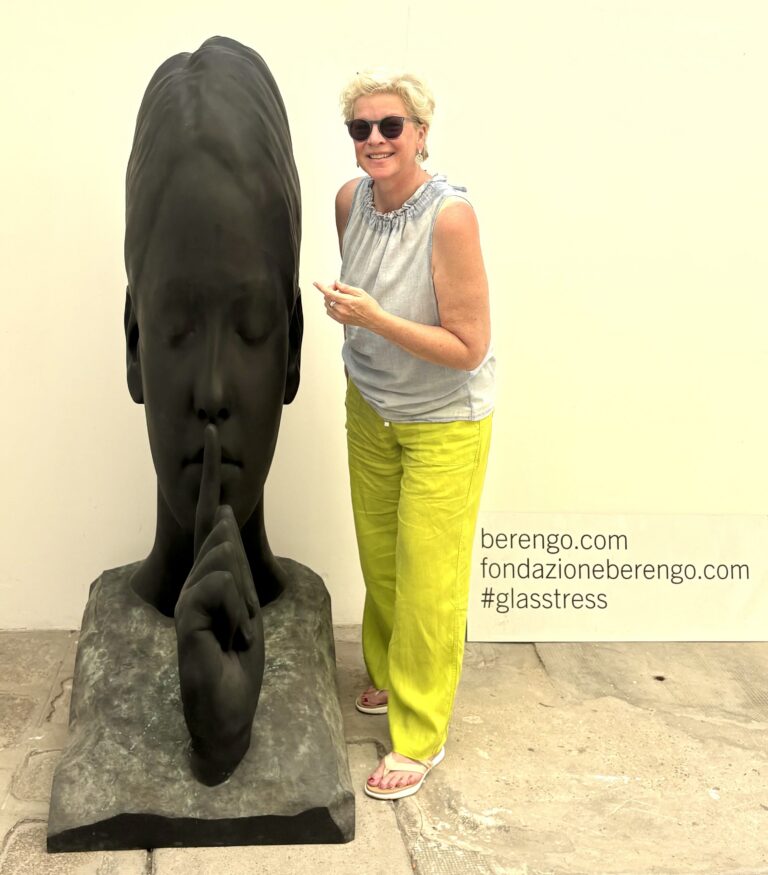
Once inside, one of Jaume Plensa‘s iconic girl heads greets me. Nearly life-size, it has stretched, distorted features. The Spanish artist scans real models, mostly young girls, and rebuilds their heads at this gigantic scale. The faces lose their childlike features and look more mature. The sculpture is black and matte, without any shine, so at first it doesn’t look like glass at all. The right hand stands separately on the flat stone plinth; the index finger rests in front of the mouth. Not a rude ‘shush’, more an invitation to silence in a loud world.
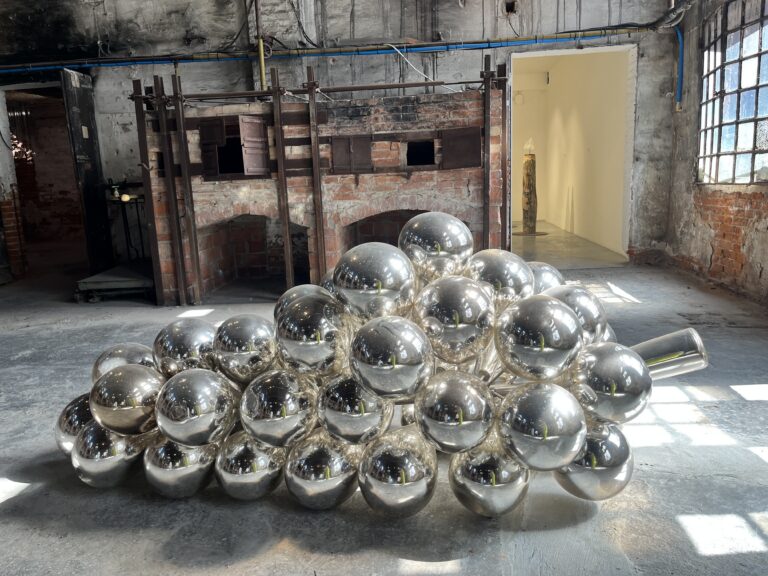
My reflection appears in every single grape of the huge silver bunch on the floor, together with the light from the partly sooty windows and the reflections of the other glass spheres. They mirror each other like soap bubbles. It looks banal, a bit too polished, too chic, too pretty, but there is more behind it: Sun Yitian blows up an everyday fruit to monumental size in Dionysus’s Obsessions IV and turns it into an emblem of Dionysus, the god of intoxication. In the mirrored glass spheres, your own gaze breaks, distorted and multiplied: like the swaying view after too much wine.
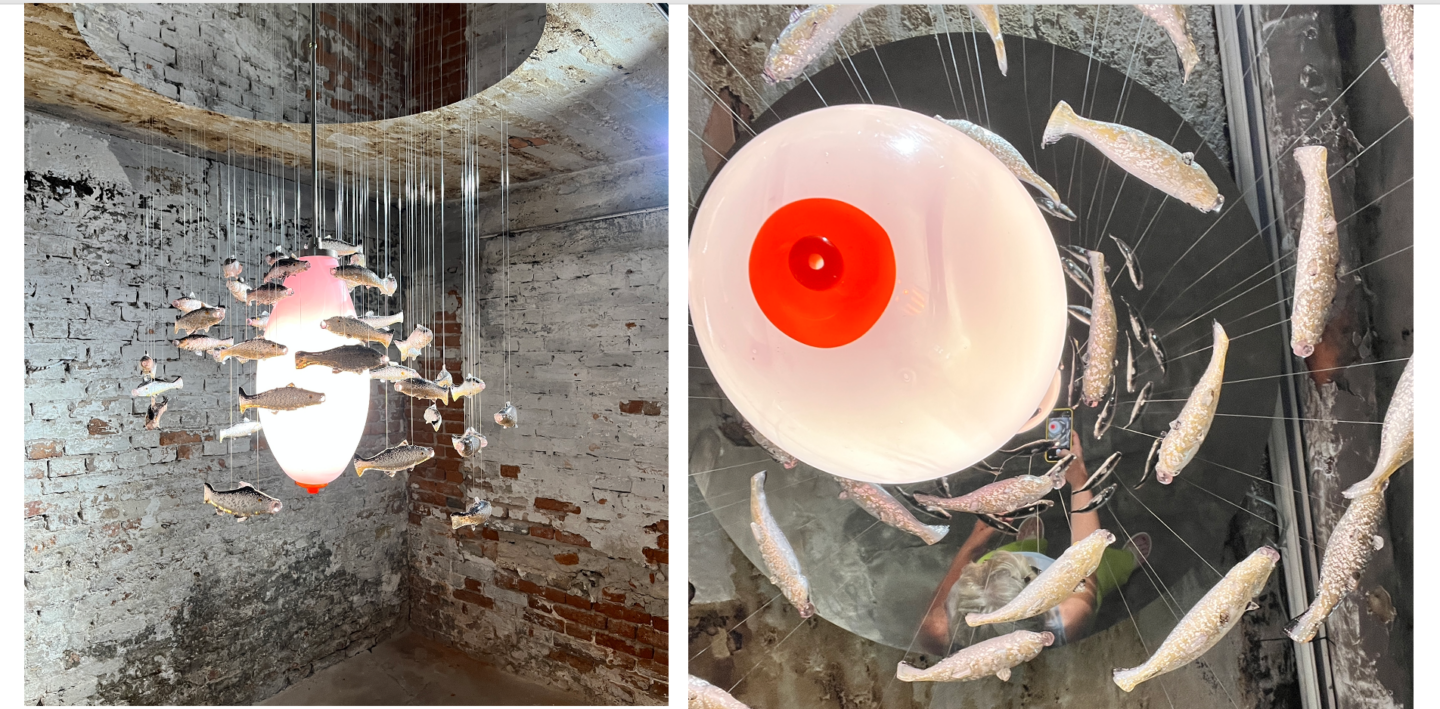
A large drop hangs from the ceiling like a mobile, ringed by a swarm of glittering silver fish. Only when I bend down do I see that the drop is a breast; the red nipple gives it away. Breasts are a recurring motif for Laure Prouvost.
The work is called Mère We Sea, a pun on mother and sea that sounds like the French merci. She made it with Murano’s glassblowers and Studio Berengo. It first appeared in 2025/26 on a huge scale in the chapel of the Vieille Charité in Marseille, where the swarm of glass fish circled the glowing breast as if protecting it. The French artist filled the French Pavilion at the Biennale in 2019 with her surreal, poetic imagery; now her poetic art meets Murano’s traditional glass craft. To me, it feels magical. I like fish anyway.
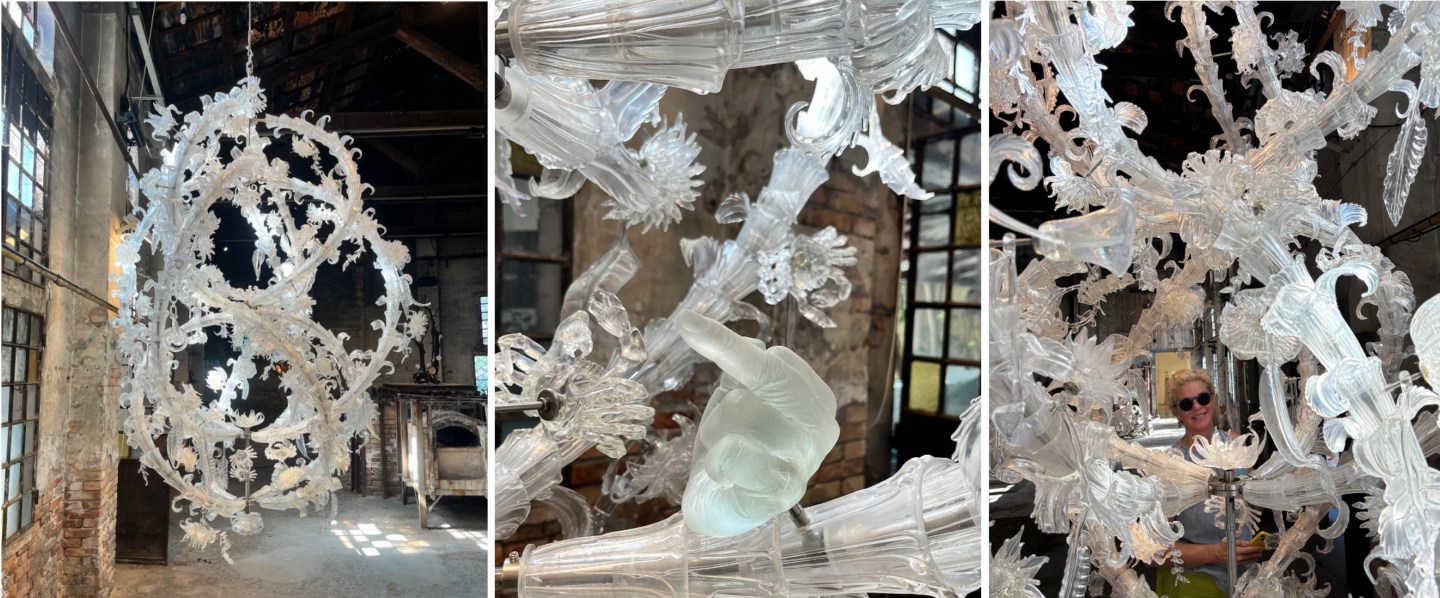
Ai Weiwei‘s white, transparent chandelier has no function and no light bulbs. It still looks like a traditional Murano chandelier: mouth-blown, goblet-shaped glass sleeves, called bossoli, are threaded onto the metal rod one after another like pearls until the metal disappears completely inside the glass. Ai Weiwei adds connecting pieces to the arms of the chandelier: his famous middle finger and handcuffs that recall his arrest in Beijing. The chandelier resembles the monumental black chandelier, nearly nine meters long, that he showed in 2022 in the church of San Giorgio Maggiore. Link to my article
Next to the sooty factory rooms, the grounds also hold classic white-cube spaces, sober and neutral, almost a reminder that despite all the morbid patina, you are still in a professional art institution. Here I meet more familiar names from the international art scene:
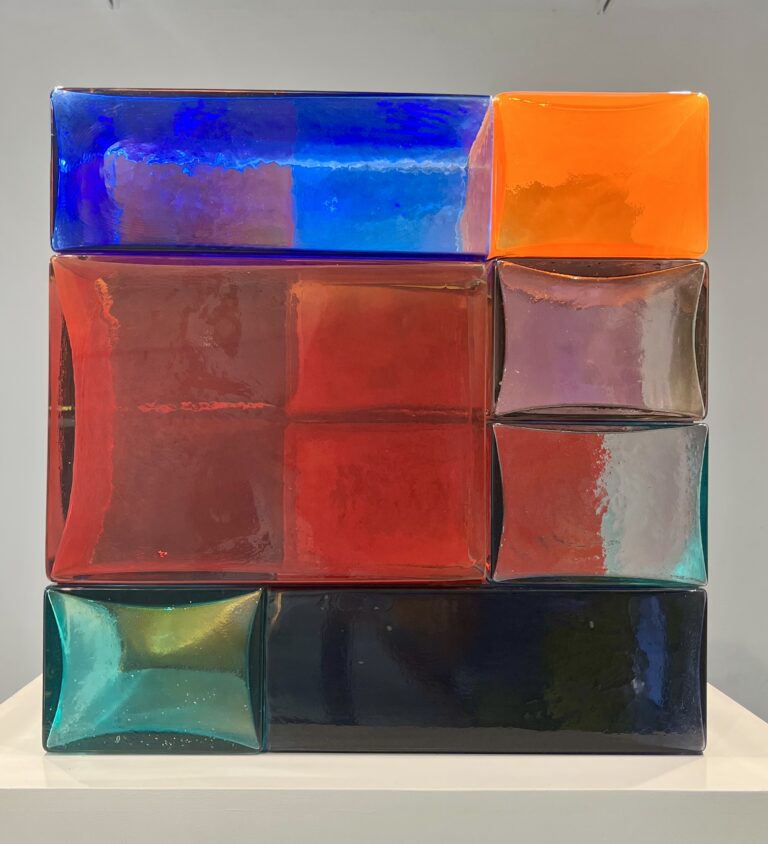
Sean Scully appears as rectangular and colorful as ever.. This time, though, the color doesn’t come layer over layer, as it usually does. A cube about 60 centimeters on each side is built from colored blocks of different sizes, luminous, some opaque, some translucent. Orange, blue, yellow and clear glass alternate: Gorgeous.
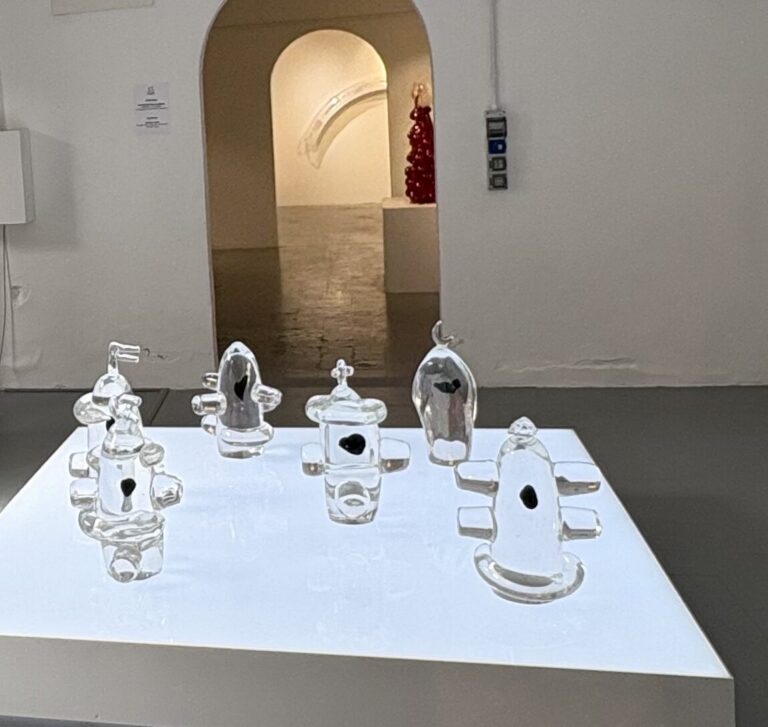
Tony Cragg‘s six figures of solid, transparent glass stand just under half a meter tall on a low pedestal, quirky as little towers. Each wears a cross, a crescent or a flag at its top, which recalls religious buildings. Thick protrusions like little arms grow out of the bodies. And in the middle, visible through the transparency of the glass, each figure carries a black heart.
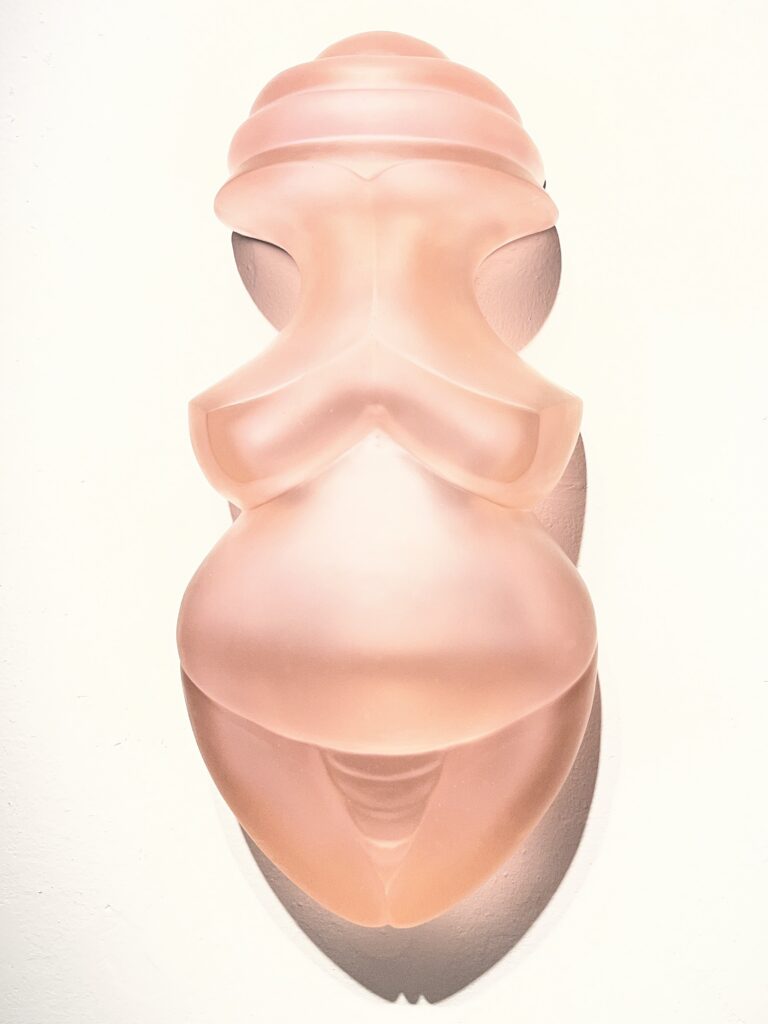
Judy Chicago‘s Glass Goddess, a pink female form made of cloudy cast glass of clouded cast glass, won me over at first sight. In form, the figure vaguely recalls the Venus of Willendorf: full bust, round belly, round hips. But there is no head. Between the shortened thighs, a triangular gap remains that hints at the body’s form in the abstract. The sculpture feels artificial, because it is symmetrical and polished smooth, yet also very soft, thanks to the satin surface and the curves.
This is not Chicago’s first collaboration with Berengo Studio, and for about twenty years she has increasingly experimented with glass as a material. In an interview, she explained that the material fits the themes that occupy her: impermanence, environmental collapse, extinction, the power of the human spirit. Glass lets her show fragility and strength at once.
How the Literature Scholar Berengo Conquered Glass and Art
Adriano Berengo studied comparative literature in Venice and New York, not glass art or design. He does not come from a glassblowing family, and he did not grow up on Murano. It was in New York, of all places, that glass grabbed him. Crazy, right?
Born in Venice in 1947, he moved to Murano in 1989 and founded Berengo Studio. Peggy Guggenheim inspired him: she introduced artists like Picasso and Max Ernst to glass. More precisely, it was her collaboration with Egidio Costantini that inspired him. In the 1960s, Egidio Costantini founded the Fucina degli Angeli on Murano, literally the Forge of the Angels, a workshop where master glassblowers worked with international artists like Picasso, Chagall and Lucio Fontana and translated their designs into glass. This idea of bringing big names of contemporary art together with the old craft remains Berengo’s program to this day. In 2009, Berengo launched Glasstress as a companion exhibition to the Biennale.
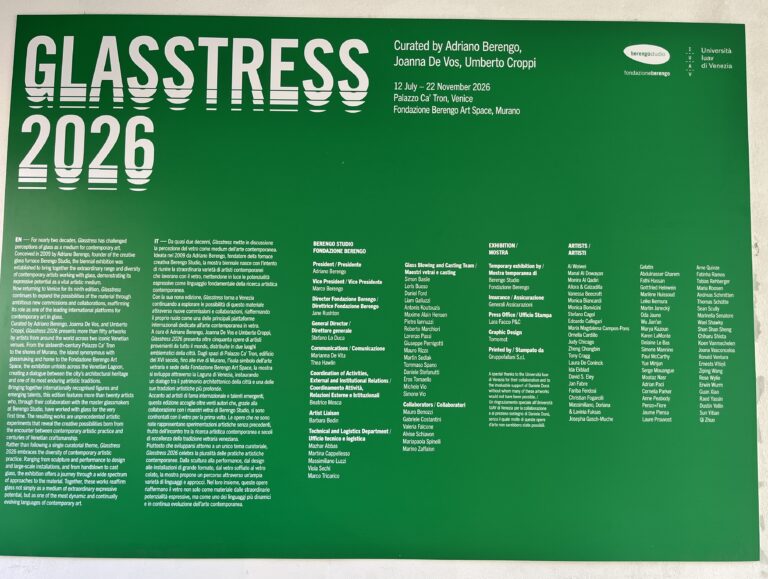
For over 30 years, Berengo has worked with international artists. This network explains why names like Ai Weiwei, Judy Chicago and Tony Cragg come together at Glasstress 2026. It is a pity that hardly any art tourist finds his wonderful exhibition.
Glasstress 2026 in Venice: Beautiful Palazzo, Pale Concept
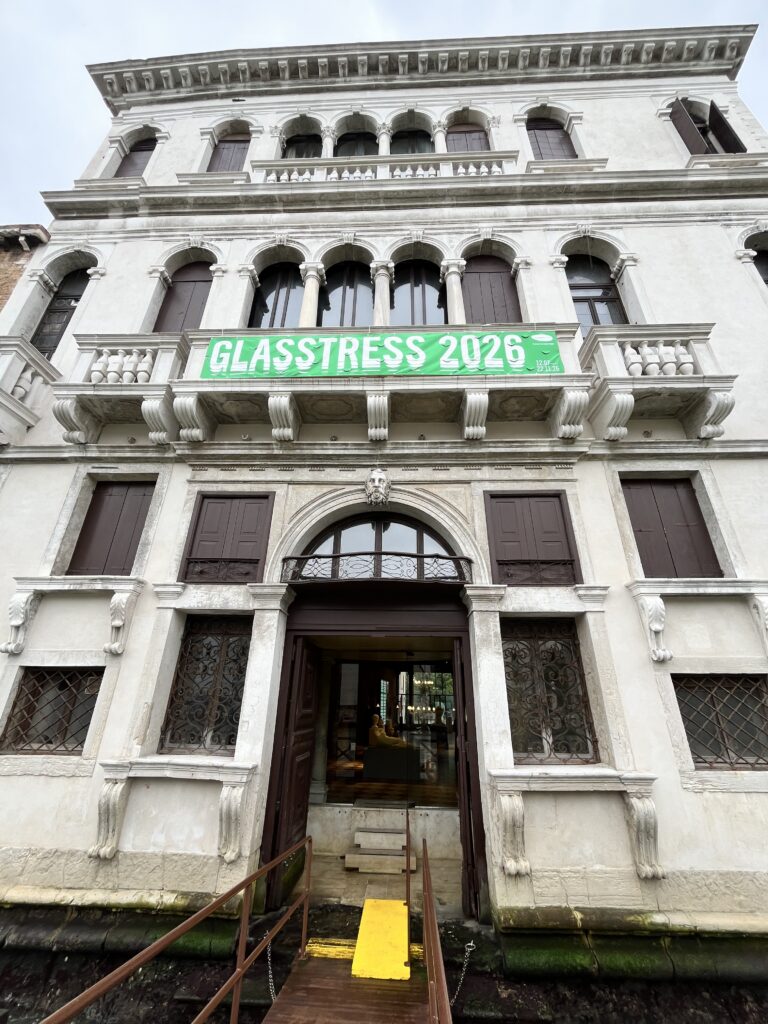
In Venice too, you have to hunt for the venue: no sign of the exhibition until you’re just a few meters from Palazzo Ca’ Tron. Unless you already know that the Fondazione Berengo, an important institution in contemporary glass art, is currently staging an exhibition here, you simply walk past. Only from the Grand Canal is it clearly visible. Most visitors, however, arrive on foot.
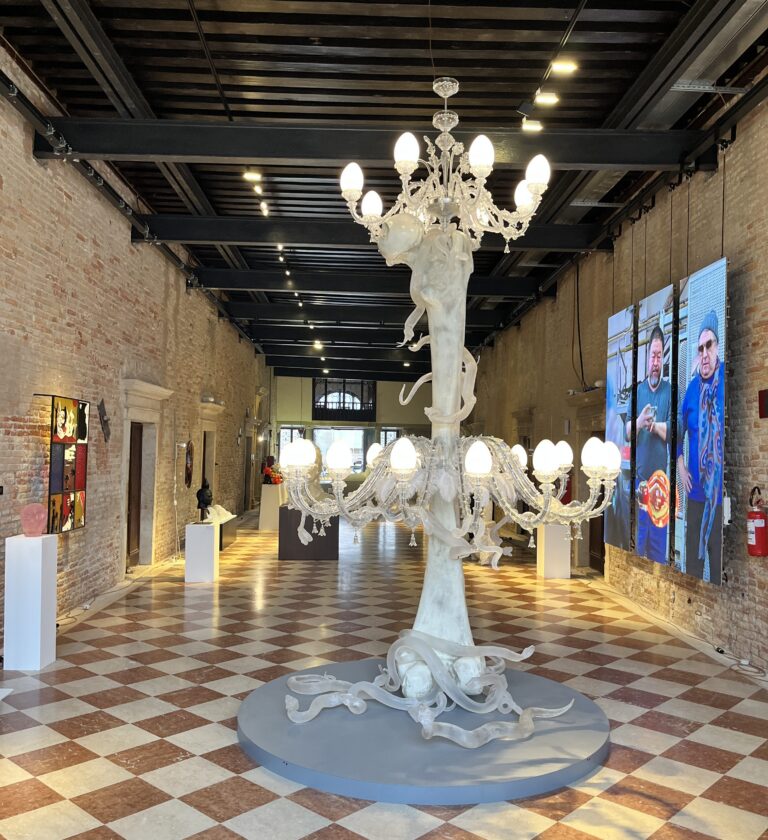
Inside, the contrast with Murano is immediate: no soot, no dead furnaces, but a palazzo just as you imagine one. The terrazzo floor gleams, above it a magnificent wooden ceiling, the rooms are generously proportioned, and the windows look out on the Grand Canal. Beautiful, no question, but less surprising than the factory on Murano. One thing is clear: Glasstress draws its strength from contrast, not pure elegance. The artworks all stand on white plinths, and the curation lacks inspiration: hardly any relationship between the works and the rooms emerges.
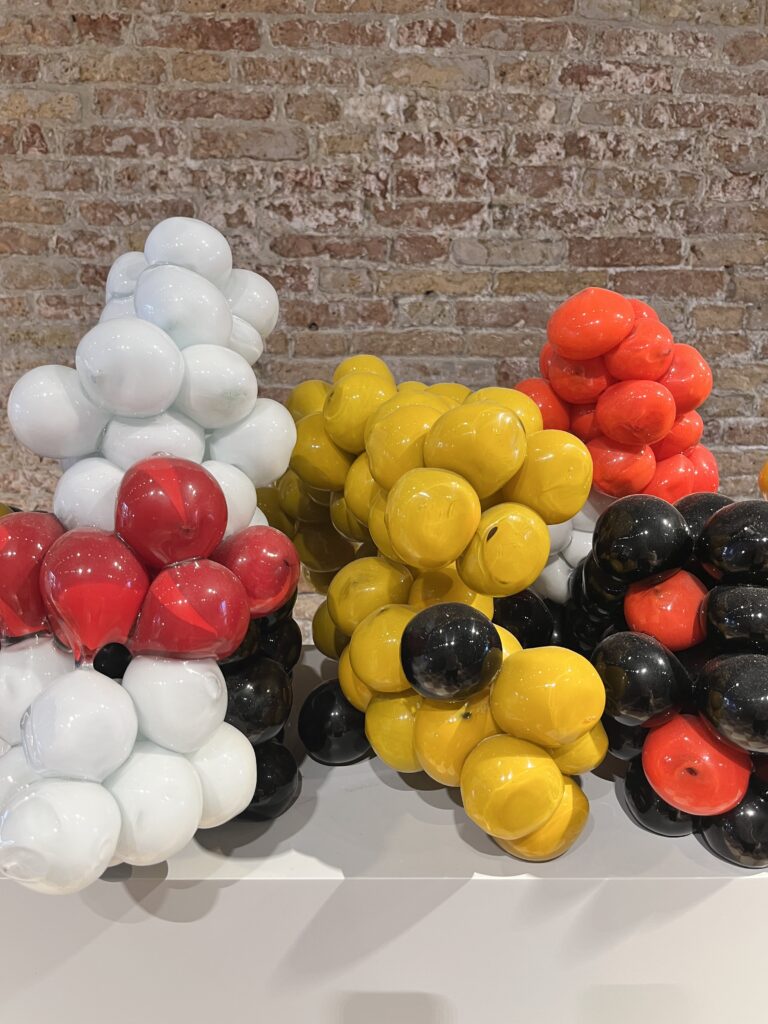
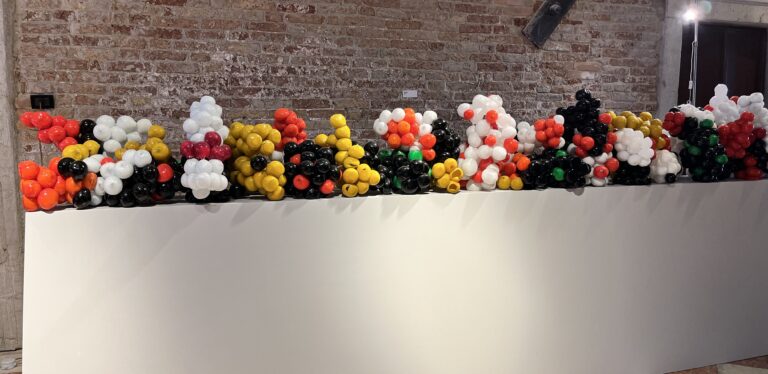
A two-meter-long highboard serves as the plinth for Tony Cragg. On it lie tennis-ball-sized spheres in white, yellow, red, black and occasionally green, clumped together like organic matter, like spawn or roe. The title Elements points to the basic material building blocks of everything around us, from particles and molecules to biological structures. The work explores the fundamental inner structures of the things we encounter every day.
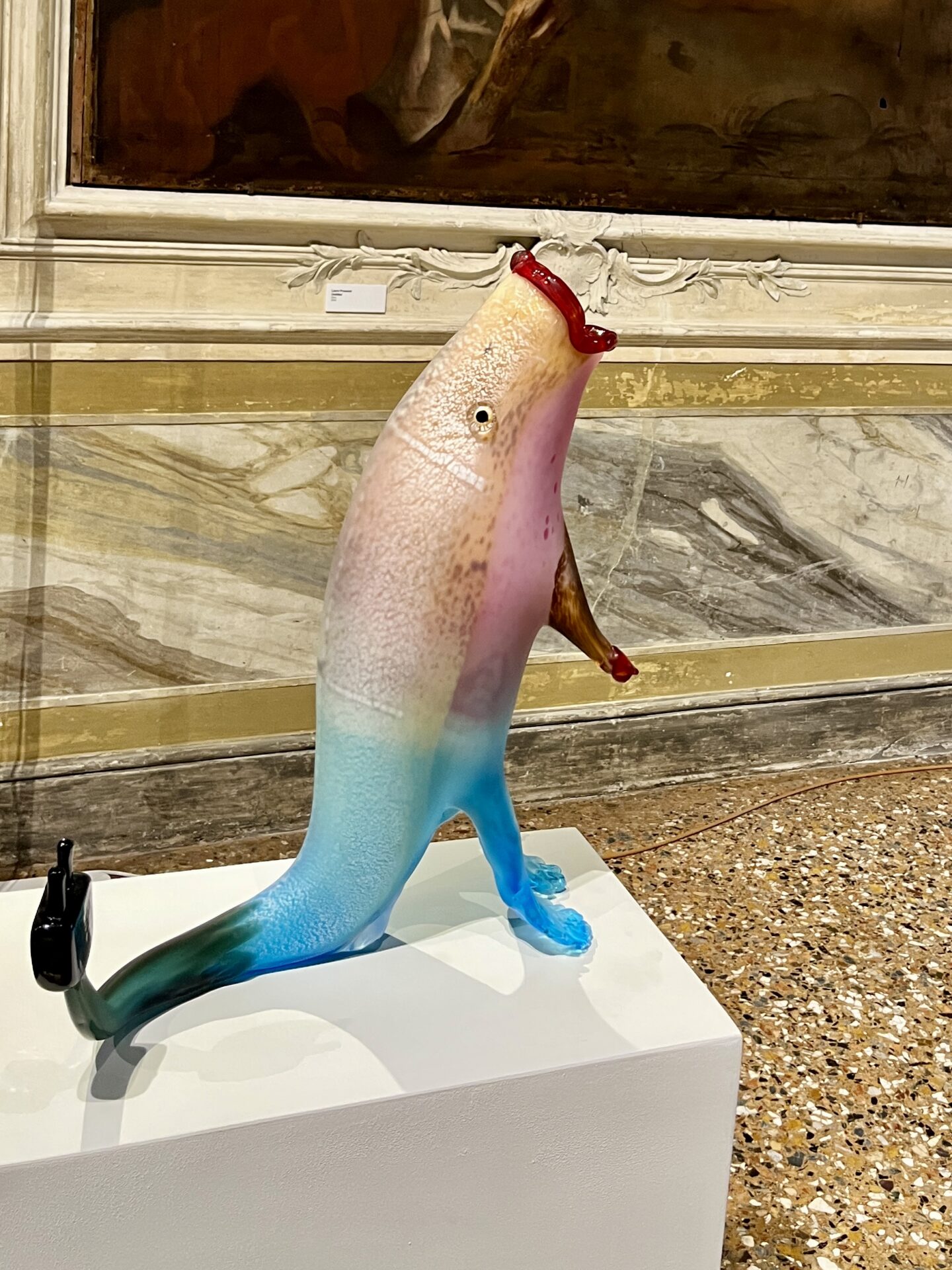
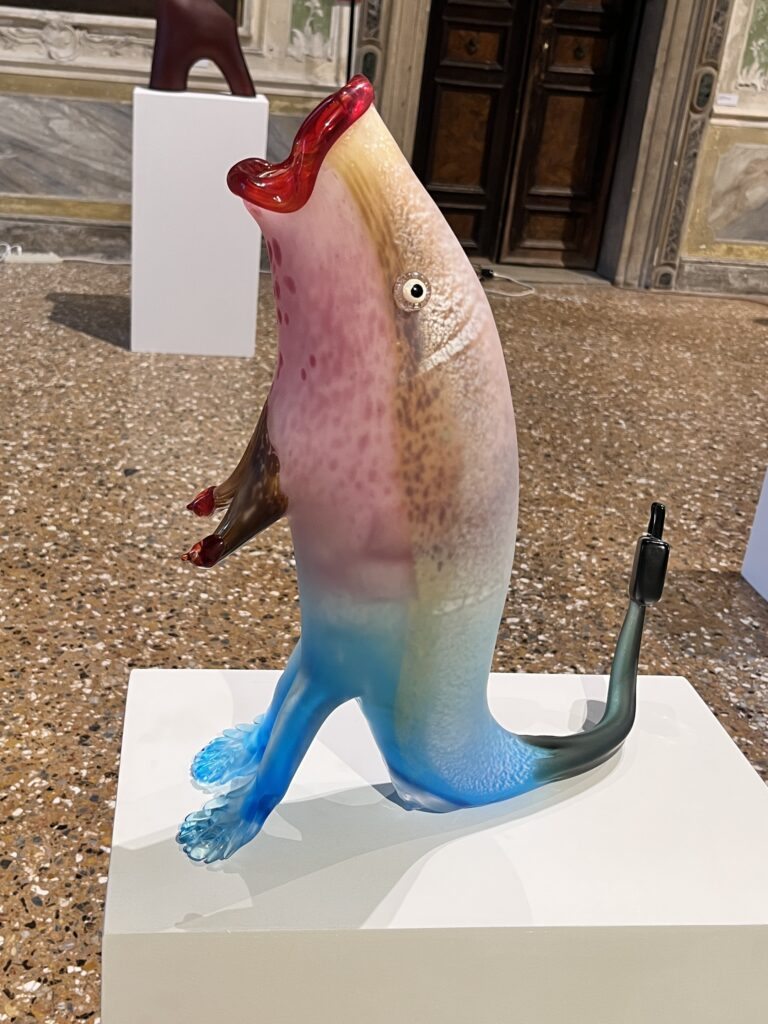
Here too, Laure Prouvost shows a fish. It stands on two hind legs that replace its fins. It looks upward, mouth wide open as if gasping for air, lips red. Between short little arms that it stretches forward, small breasts with nipples sit at the ends: there it is again, the breast theme.
The fish’s upper body sparkles gold, the lower part is pink. The fish’s rear glows blue and passes into a green tail that bears no fin but ends in a thick black cable with a plug. One possible poetic reading, for me: the organic meets the digital in a short circuit. The work is titled Untitled: so it remains deliberately vague.
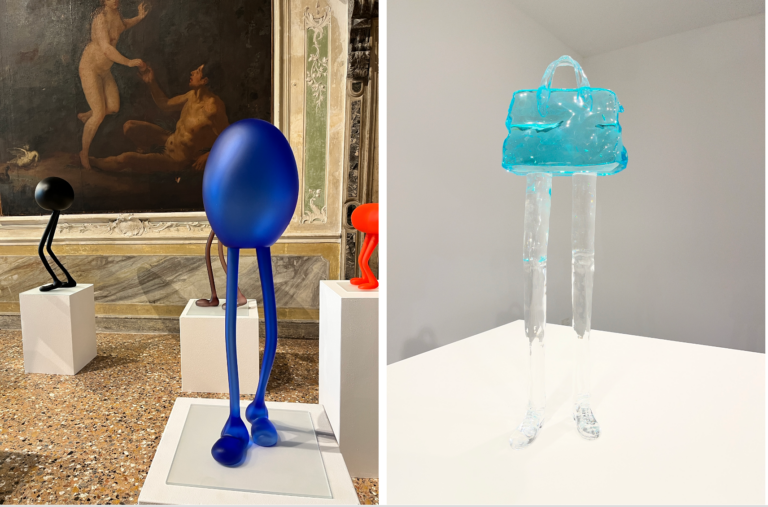
Erwin Wurm, who became known for his One-Minute Sculptures, designed cartoonish little men with long legs for his series Mind Bubbles. The upper body is just an egg-shaped torso; head and arms are missing. This is Wurm’s translation of the comic thought bubble into a three-dimensional figure. In the exhibition they stand side by side in black, blue, red, brown and transparent. One brown figure lies on its back.
The Austrian artist wants to make the invisible, our thoughts, ideas and psychological processes, visible in a three-dimensional sculpture. The absurd is Wurm’s principle: bizarre at first glance, with an allusion whose meaning doesn’t reveal itself right away. On Murano he shows a variant of the sculpture with transparent legs, where the torso comes as a chic ladies’ handbag with a handle: consumer object meets cartoon body.
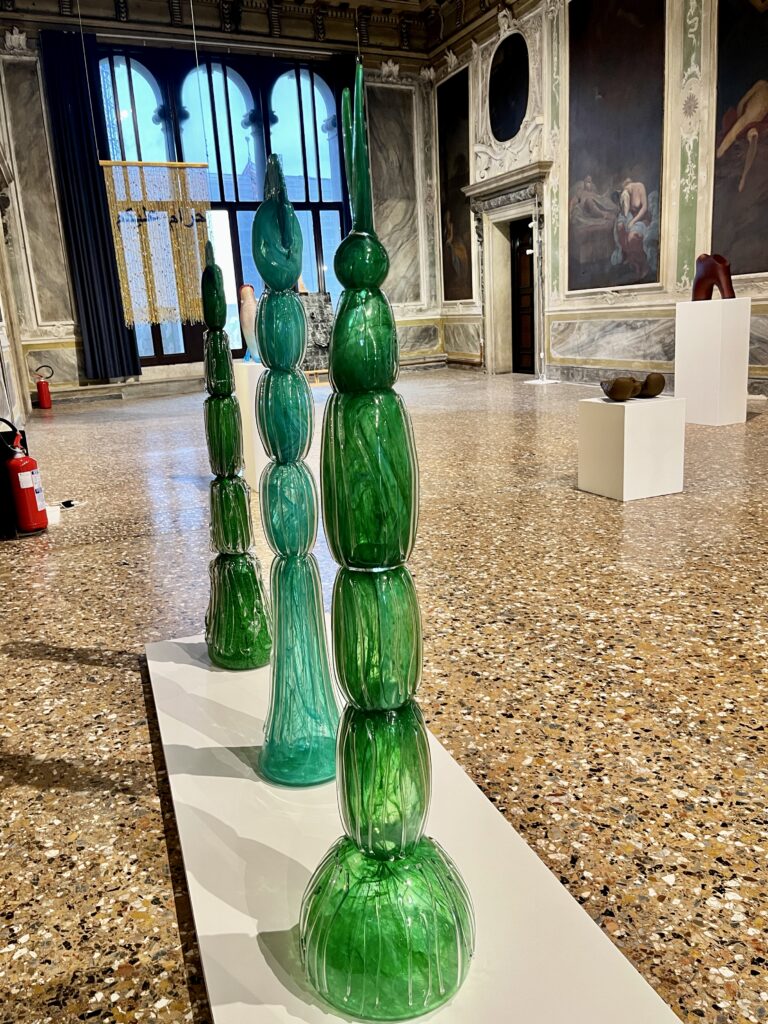
Leiko Ikemura shows three green glass columns, about one meter tall, body-like, composed of several oval shapes. At the top end, as a kind of head, once the typical Ikemura little hare head with long ears, twice a round form that recalls a head with an elaborate updo. The hare motif has recurred in Ikemura’s work since 2011. In the context of Ikemura’s work, the motif became associated with grief and resilience after the Fukushima nuclear disaster. Hybrid beings between human and animal are a central theme for her anyway.
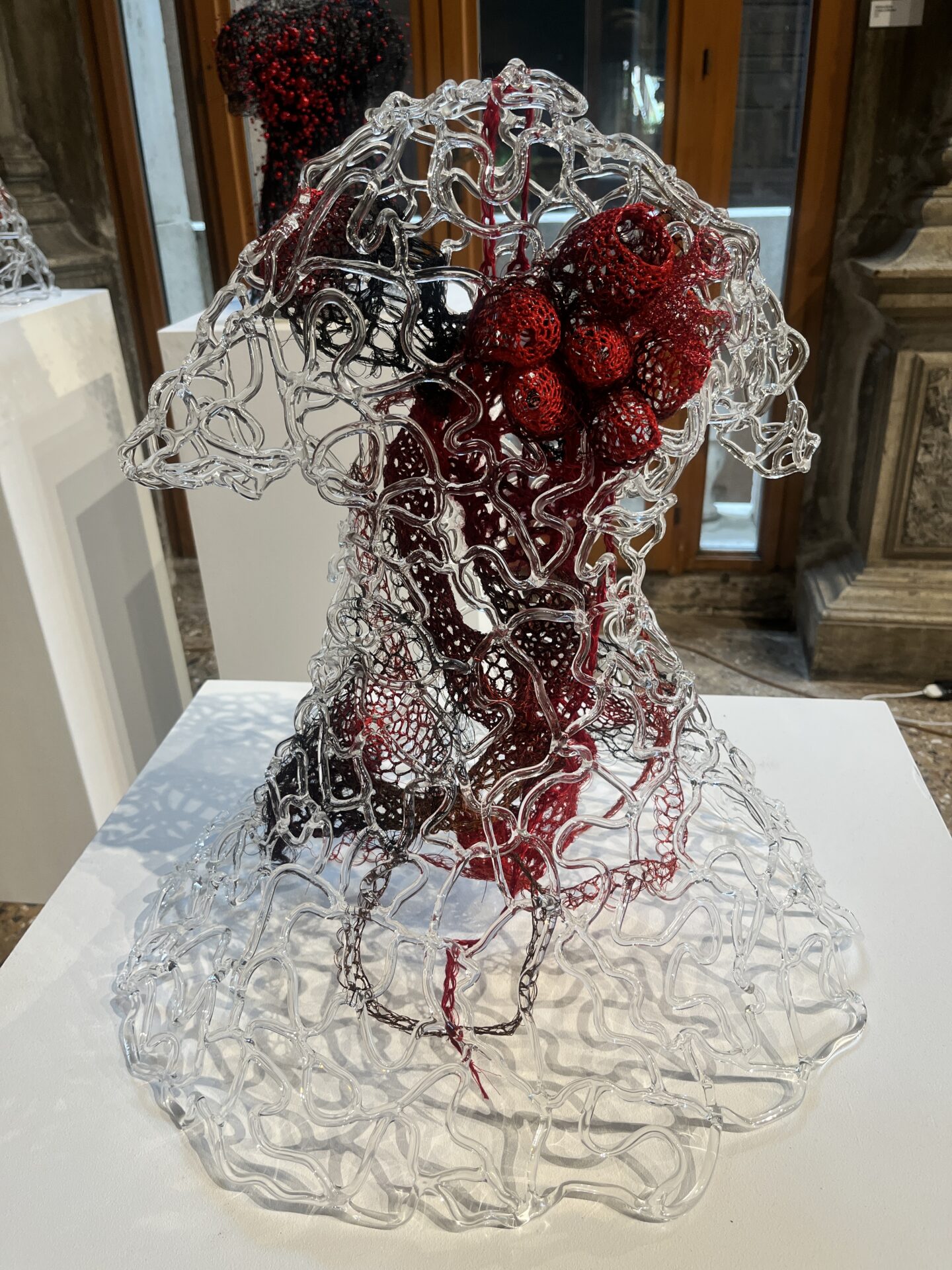
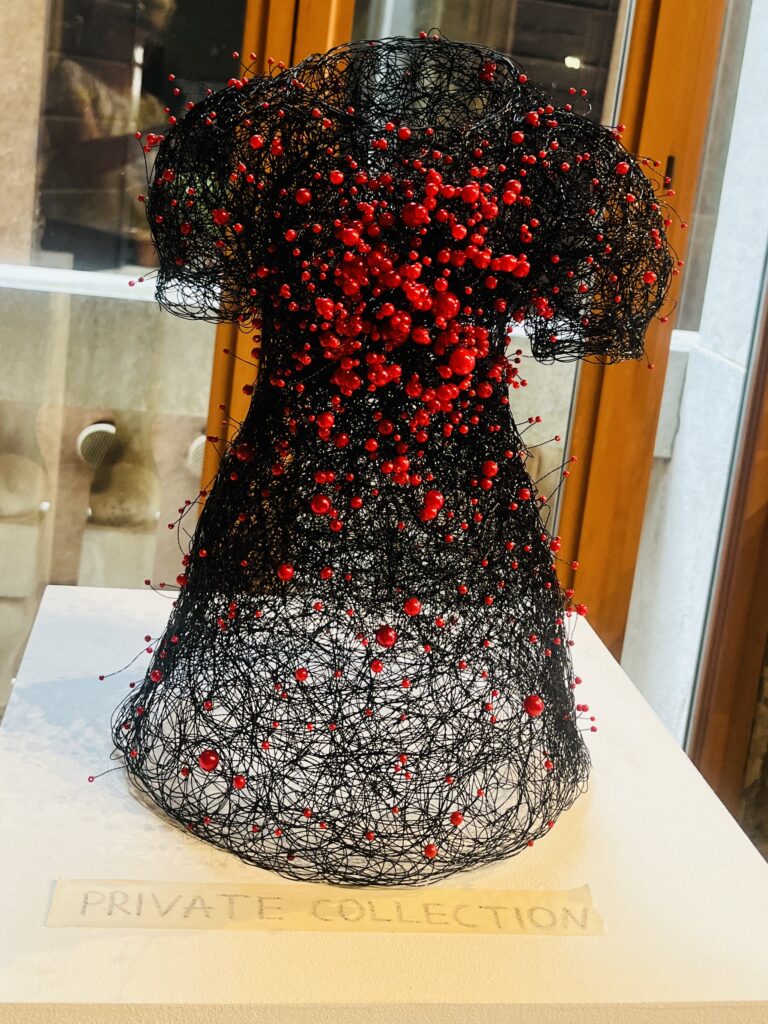
Chiharu Shiota is represented with three small glass sculptures in total. The Japanese artist was already well known by 2015, when she designed. when she designed the Japanese Pavilion at the Biennale with The Key in the Hand: a room-filling web of red threads, keys and old wooden boats. I have written before about her installation in Frankfurt’s WINX Tower.
Two of her glass pieces consist of a transparent tangle of glass whose structure looks as if made of thick threads. The two transparent pieces take the form of a short-sleeved dress with a flared skirt. Inside sits a very fine tangle of threads, as if crocheted or woven, in red and black, that looks as if made of wire. I find it hard to believe that glass can be woven that finely, but the wall label named only glass as the material. Parts of the red webs look like cocoons and emerge from the bodice of the dress, exactly where the heart would be. The third small sculpture is made of black wire mesh with red glass beads and looks very delicate.
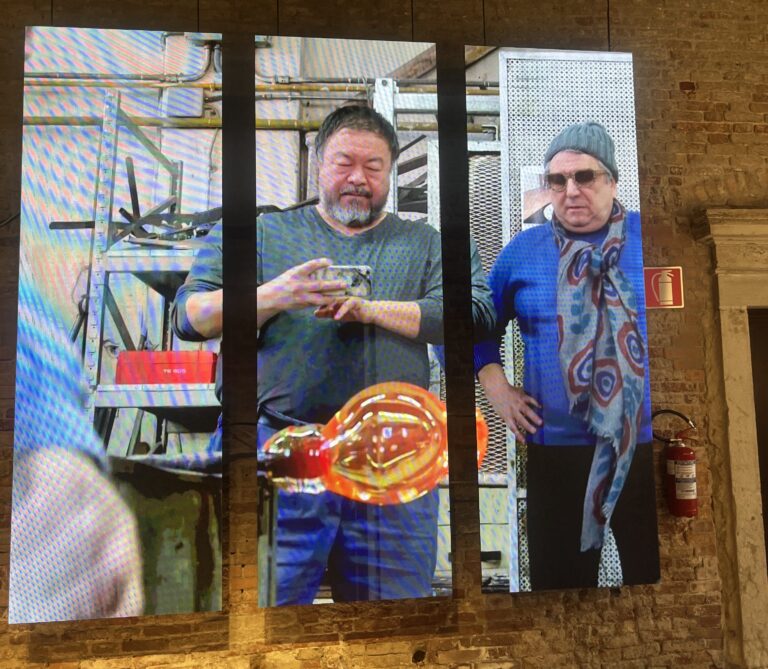
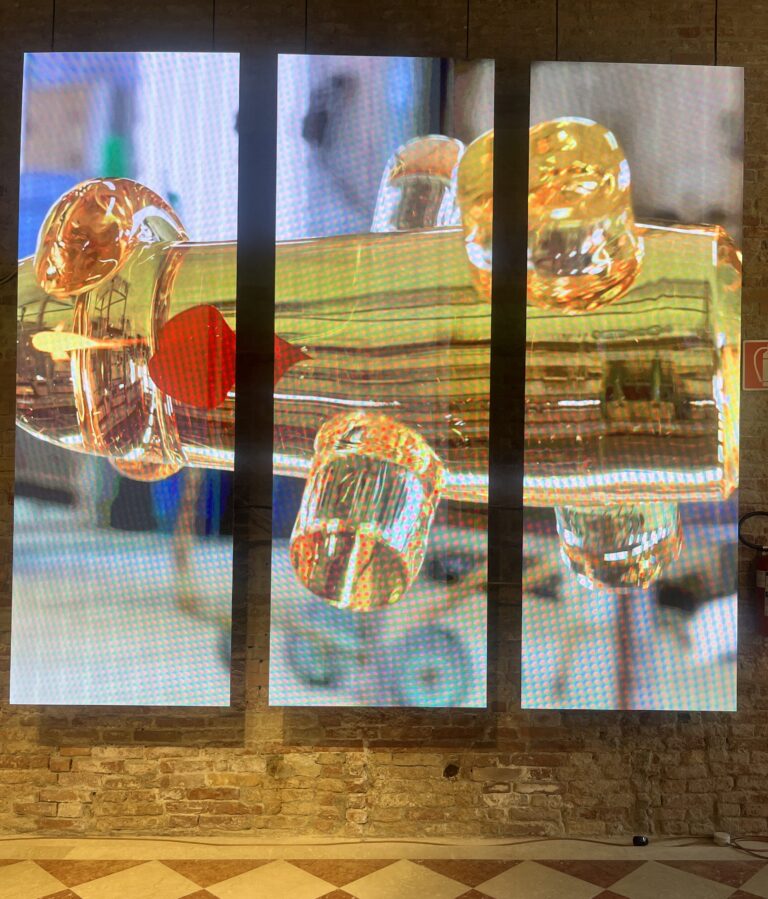
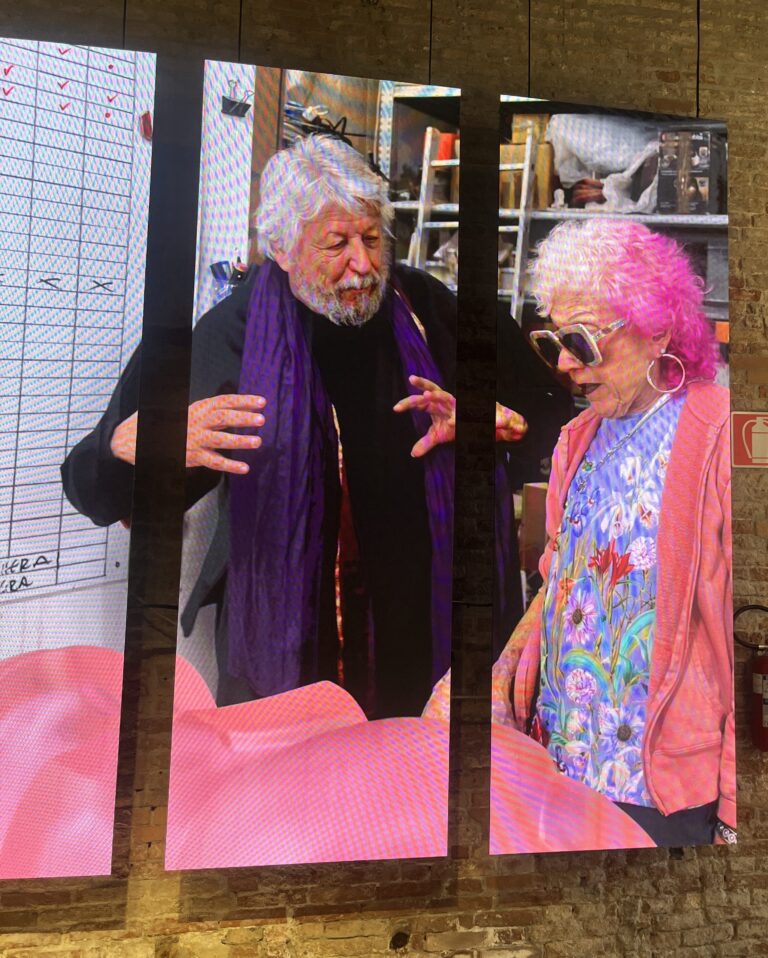
The three-part screen is well done. It shows Berengo in conversation with various artists: for example Ai Weiwei, who watches closely as a master glassblower makes something for him, or Berengo and Judy Chicago chatting in a familiar, friendly way in front of the pink Glass Goddess in the background, and finally a massive, large-format Cragg sculpture that turns slowly.
Conclusion
Glasstress 2026 is a wonderful exhibition, an insider tip and one of my secret favorites in Venice. Still, the fascinating works, the two completely different but equally strong venues, and one of the best-known institutions for contemporary glass receive far too little attention. International names, hardly any audience.
Admission is free, too. So my wholehearted recommendation: go before November 22, 2026, while the Biennale runs.
Glasstress 2026: An Art Star Lineup at Berengo That Nobody Sees – britta kadolsky
Diesen Beitrag teilen:
Newsletter
Wenn ihr keinen Beitrag verpassen und über neue Artikel informiert werden möchtet, abonniert meinen Newsletter.
"Was kann Kunst" ist auch auf:
Felix Gonzalez-Torres schreibt Liebe in Alltagsdinge ein
britta kadolsky am 14.9.2026
Wie Jenny Saville den Blick auf Frauenkörper sprengt
am 12.8.2026
Brancusi, der moderne Bildhauer
britta kadolsky am 13.7.2026
Venice: A Short Guide for Art Lovers
britta kadolsky am 23.6.2026
Venice Biennale 2026: My Five Favorite Pavilions
am 11.6.2026
Günther Uecker: Nagelkünstler, Weltreisender, stiller Poet
britta kadolsky am 10.5.2026
Yayoi Kusama: Dots That Never Stop
am 19.4.2026
Why Art Matters: The Political Power of Art and the Russian Pavilion Everyone Is Fighting Over
britta kadolsky am 30.3.2026
Thomas Bayrle erfindet das Große im Kleinen
britta kadolsky am 9.3.2026
Xenia Hausner: Schafft eine Bühne für selbstbestimmte Frauen
britta kadolsky am 16.2.2026
Ikonen der Kunstgeschichte
Saskia Wolf am 21.1.2026
Papier in der Kunst: Papier inspiriert Kunst über Jahrhunderte
britta kadolsky am 22.12.2025
Warum belebt Ophelia Kunst und Popkultur?
britta kadolsky am 17.11.2025
Fünf Graphic Novels, die Kunst neu erzählen
britta kadolsky am 3.11.2025
5 berühmte Künstlerpaare der Kunstgeschichte - Zwischen Passion und Untreue
Saskia Wolf am 18.10.2025
Max Liebermann – Maler des Lichts und des Lebens
britta kadolsky am 26.9.2025
Chaos, Körper, Farben: Die Kunst von Pipilotti Rist
britta kadolsky am 27.8.2025
CIA, Kunst und Kalter Krieg: Die documenta II 1959
britta kadolsky am 17.7.2025
Kunst beim Spazierengehen: 10 Skulpturen in Frankfurt
britta kadolsky am 2.7.2025
David Hockney - Zwischen Licht und Linie
britta kadolsky am 25.5.2025
Im Innern des Papiers – Skulpturen von Angela Glajcar
britta kadolsky am 7.5.2025
April, April: Die Kunst des Täuschens
britta kadolsky am 13.4.2025
Andreas Mühe – Im Banne des Zorns
britta kadolsky am 16.3.2025
Martin Kippenberger - Ein Künstler, der Wettsaufen und Punkmusik liebte
britta kadolsky am 18.2.2025
Die Zahl 100 in der Kunst: Symbolik und Bedeutung
britta kadolsky am 23.1.2025
Frauenpower: Künstlerinnen und Erfinderinnen
Saskia Wolf am 16.12.2024
Hans Haacke: Politische Kunst mit Tiefgang
britta kadolsky am 2.12.2024
Kunst unter Bäumen – der Internationale Waldkunstpfad in Darmstadt
Ruth Fühner am 10.11.2024
Blut, Fleisch, Kot: Ungewöhnliche Materialien in der Kunst:
britta kadolsky am 28.10.2024
Kunst und Kamera: Die vergessene Geschichte der Fotografinnen
britta kadolsky am 1.10.2024