How Jenny Saville challenges the way we look at women's bodies
Jenny Saville Paints the Body No One Wants to See
Saville’s paintings are raw and monumental. I stand in front of them, and up close, their subject matter and composition really knock me off my feet. The women she paints are larger than life and unsettling: so much flesh, soft and full, with dimples and colors that resemble veins. Somehow, these bodies look both misshapen and utterly real, because women’s bodies simply don’t come in standard sizes. They rarely, if ever, conform to male or media-driven ideals of beauty. The low viewing angle only intensifies this effect.
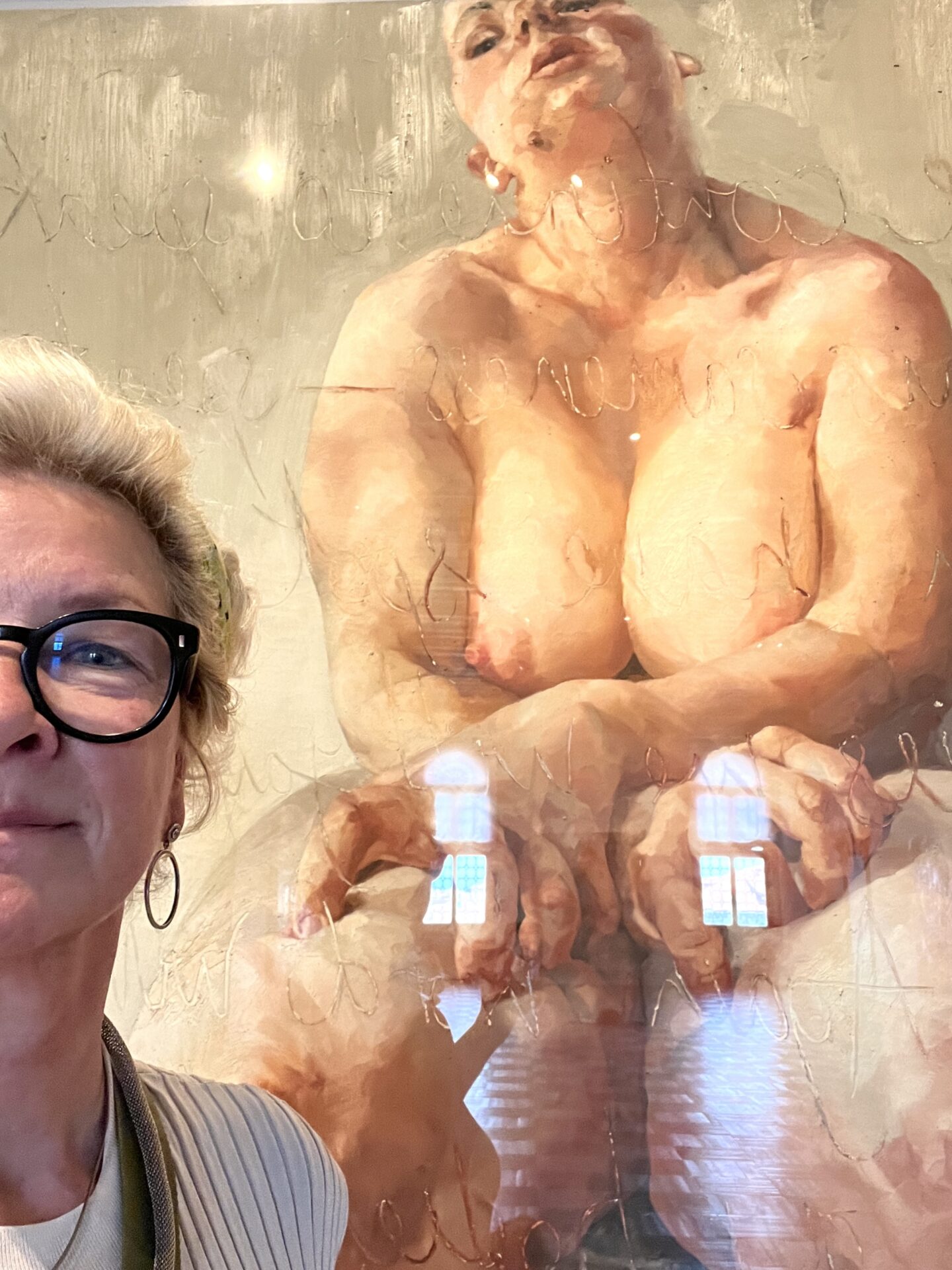
And yet, in the galleries of the Baroque Palazzo Ca’ Pesaro, with their high wooden-beamed ceilings, parquet floors, and the museum’s own monumental scale, these paintings suddenly feel right at home. Perhaps the space even takes a little of their force away.
Naked, But Not in the Way We’re Used To
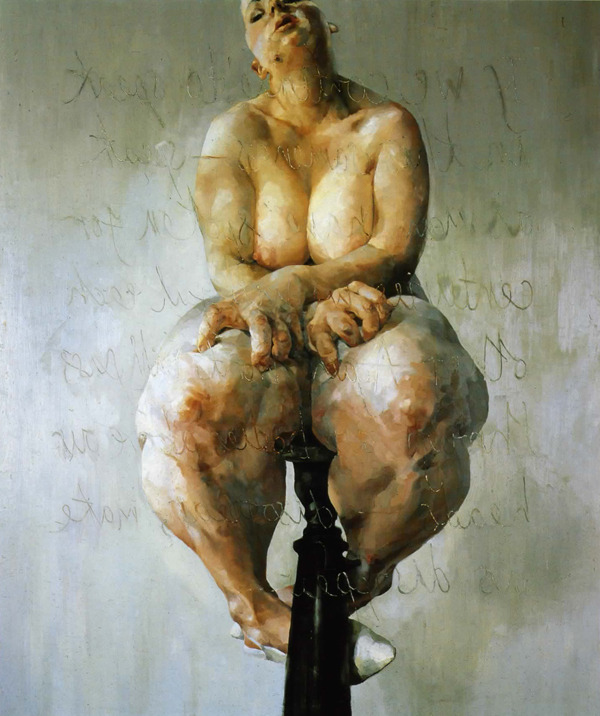
Few artists make it as clear as Jenny Saville that nudity doesn’t automatically cater to our familiar ways of looking at the female body. Her early landmark painting Propped makes this especially clear. It was her degree show painting at the Glasgow School of Art and is also a self-portrait. Painted from below, the thighs look enormous, filling almost the entire lower half of the canvas. Her hands rest on the flesh of her thighs, right in the center of the composition, while her head appears small and slightly cropped at the top edge. Her upper arms press her breasts together, revealing soft, fleshy skin and pink nipples just above the crooks of her elbows. Saville sits on a narrow sewing-machine stool, her feet hooked around its base, wearing white slingback pumps. And across the entire canvas, almost invisible at first glance, runs a line of mirrored writing that cannot be read: a quotation from feminist philosopher Luce Irigaray, who argued that women lose themselves as long as they speak the language of men instead of developing their own.
The anatomical precision is no coincidence. In 1994, Saville was allowed to observe a plastic surgeon at work in New York, photographing the operations as she watched over his shoulder. She also spent hours in forensic medicine departments and studied animals, meat, and classical and Renaissance sculpture. Her understanding of imperfection, of what bodies actually look like rather than what advertising says they should look like, comes through in every painting.
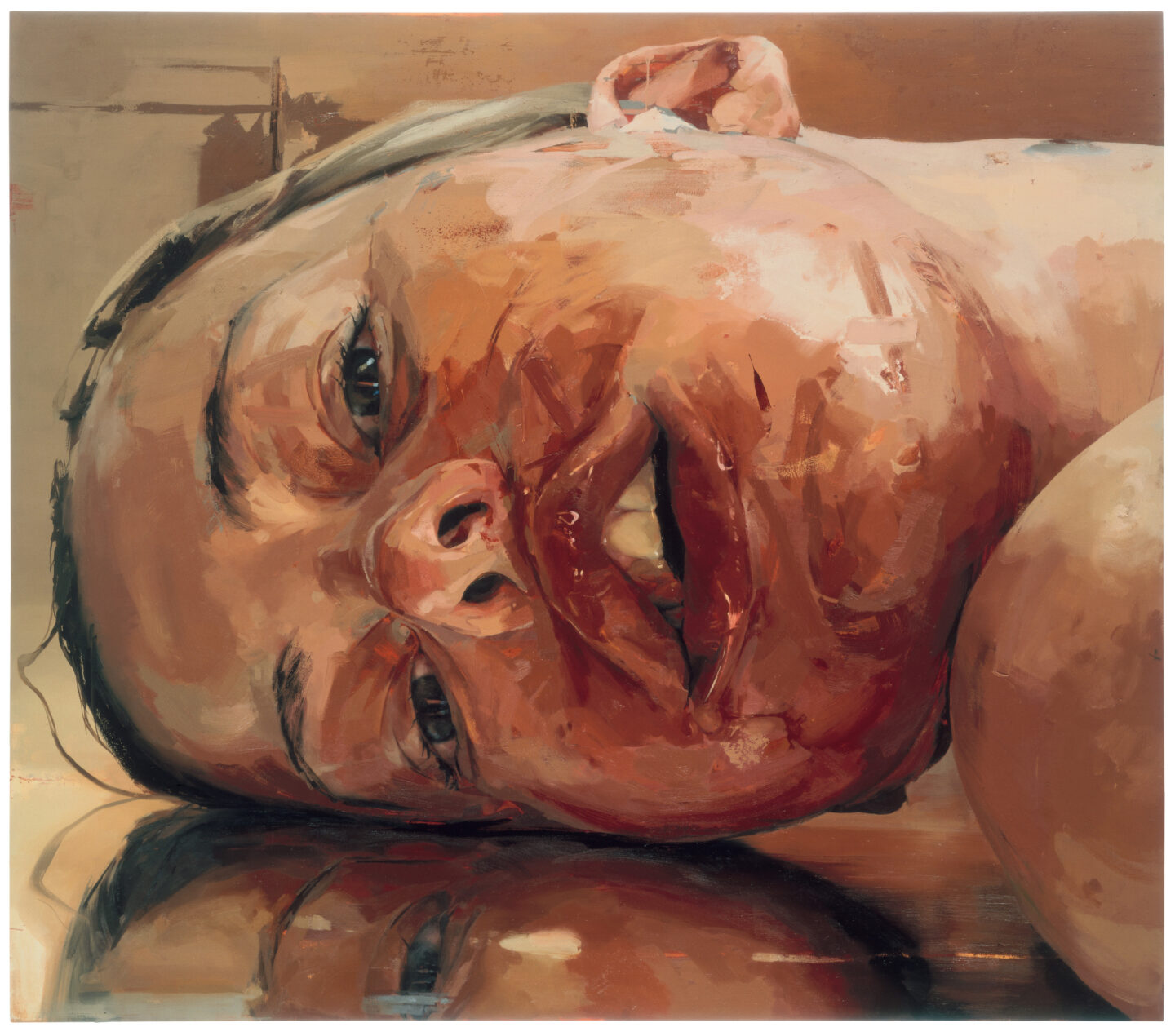
Take Reverse, for example. This enormous horizontal painting shows only a head, with the neck and shoulder cut off by the right edge of the canvas. The head lies on the floor, and the face is reflected along the bottom edge. The eyes are open, the mouth slightly parted. She looks at me, but her gaze is empty, giving nothing back.
Between Expressionism and Surgical Precision
The painting technique itself is the second major source of unease. Saville works with quick, expressive brushstrokes and colors that seem all wrong for depicting flesh: green, blue, purple, turquoise, and red in places where you’d expect skin tones. The flesh becomes a landscape of its own, almost abstract.
And right in the middle of all this dissolution sit the eyes and mouth, almost always painted with astonishing precision and realism. This contrast is what makes the paintings so unsettling. The gaze remains the one fixed point you can hold on to while the rest of the body dissolves into color.
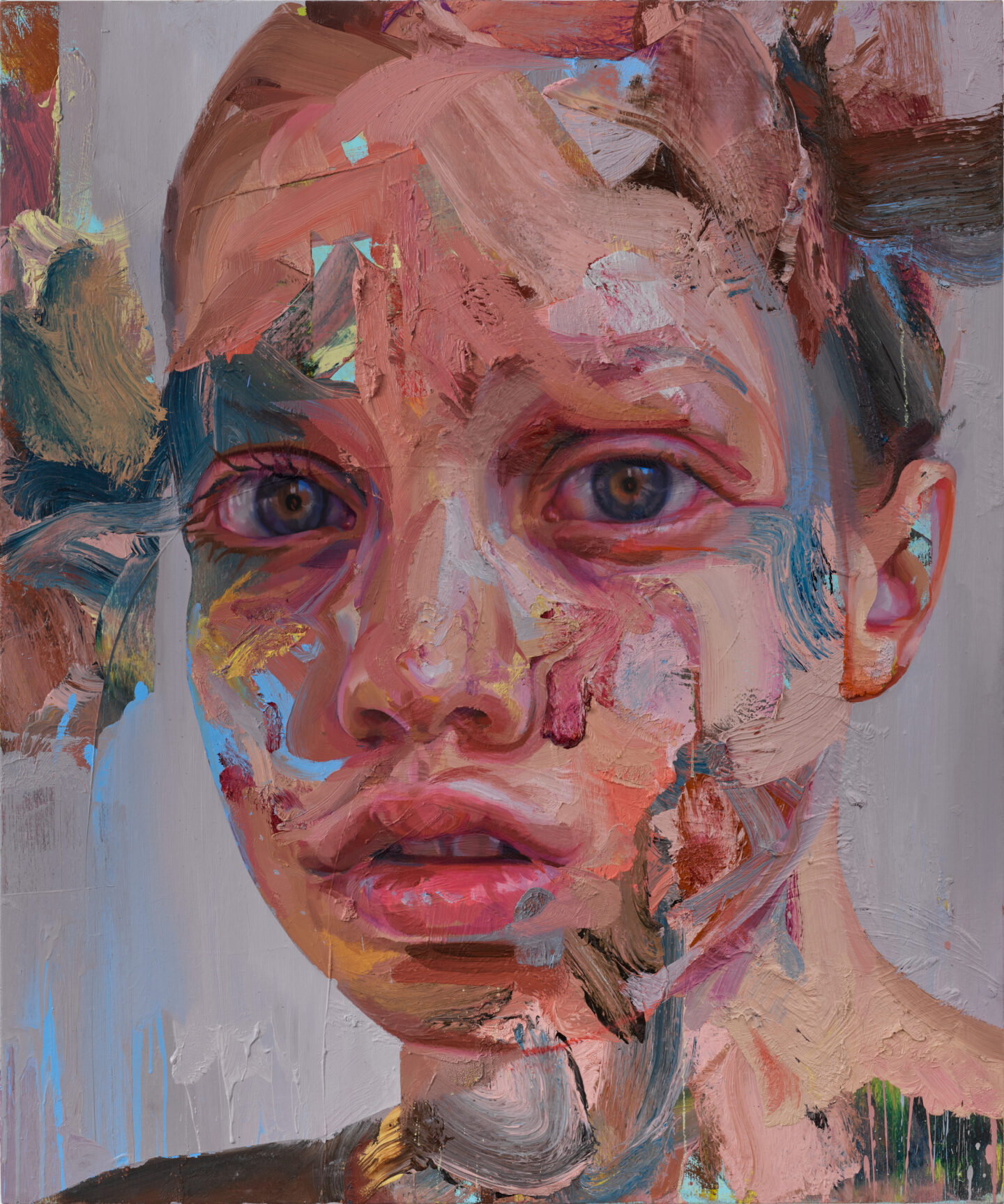
I stand in front of Focus, an enormous face, and move as close as the museum’s floor markings allow so I can study it carefully. Some areas are completely abstract, with wild brushstrokes reminiscent of the American Abstract Expressionists. The colors have nothing left to do with actual skin tones. And right in the middle, finely rendered and realistic, is the eye: iris, pupil, eyelashes, even the tear duct, all painted with precision.
There’s a reason for this. Saville paints eyes in the morning, when her concentration is at its sharpest, and leaves the riskier, freer brushwork for the evening, when she’s tired, as she revealed in an interview.
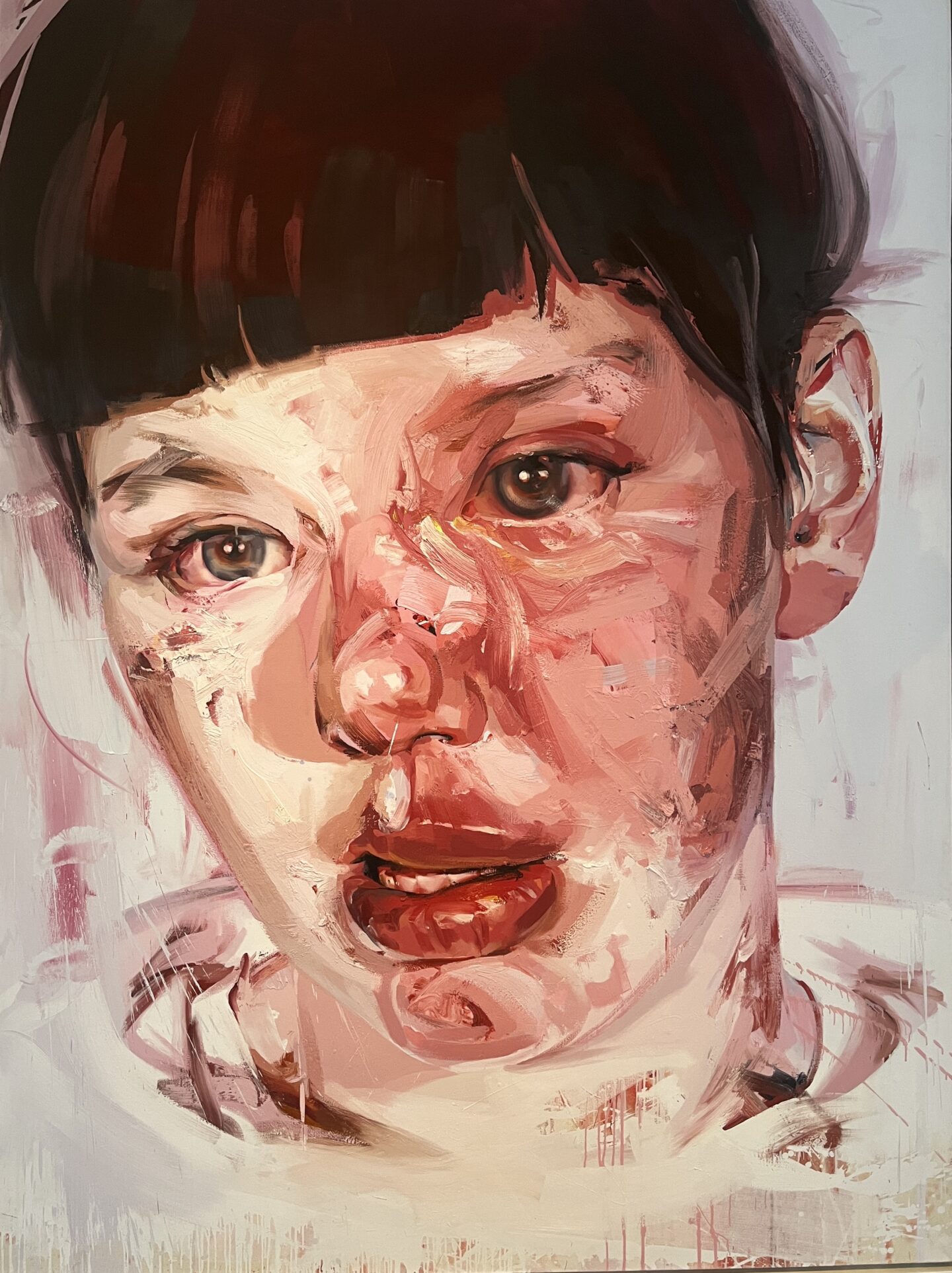
Red Stare Head IV is similarly unsettling. It belongs to a whole series of portraits based on a single small photograph in a medical textbook. The subject is a young woman with a port-wine stain on her face. Her gaze is blank, her mouth slightly open, her upper lip oddly raised, almost as if in contempt.
Here, too, the eyes and mouth, including a few visible teeth, are painted with great precision. The right half of the face, by contrast, is covered with thick, heavily textured white brushstrokes that frame the right eye and extend across the cheek to the mouth. The white paint continues down the neck and merges seamlessly into a loosely suggested top. Then there’s the hairstyle: a dark, sharply cut short haircut with bangs that stands out against the light background.
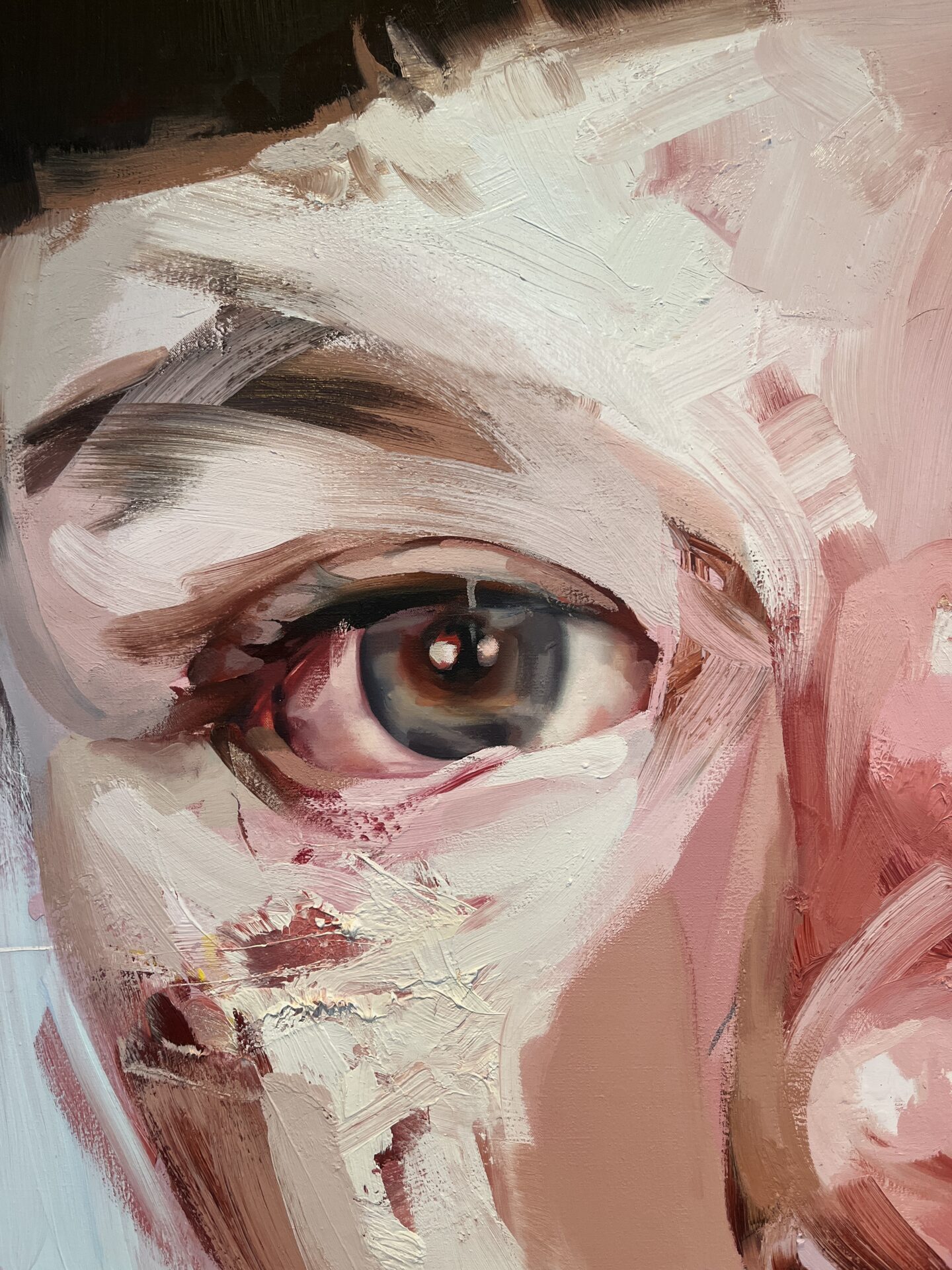
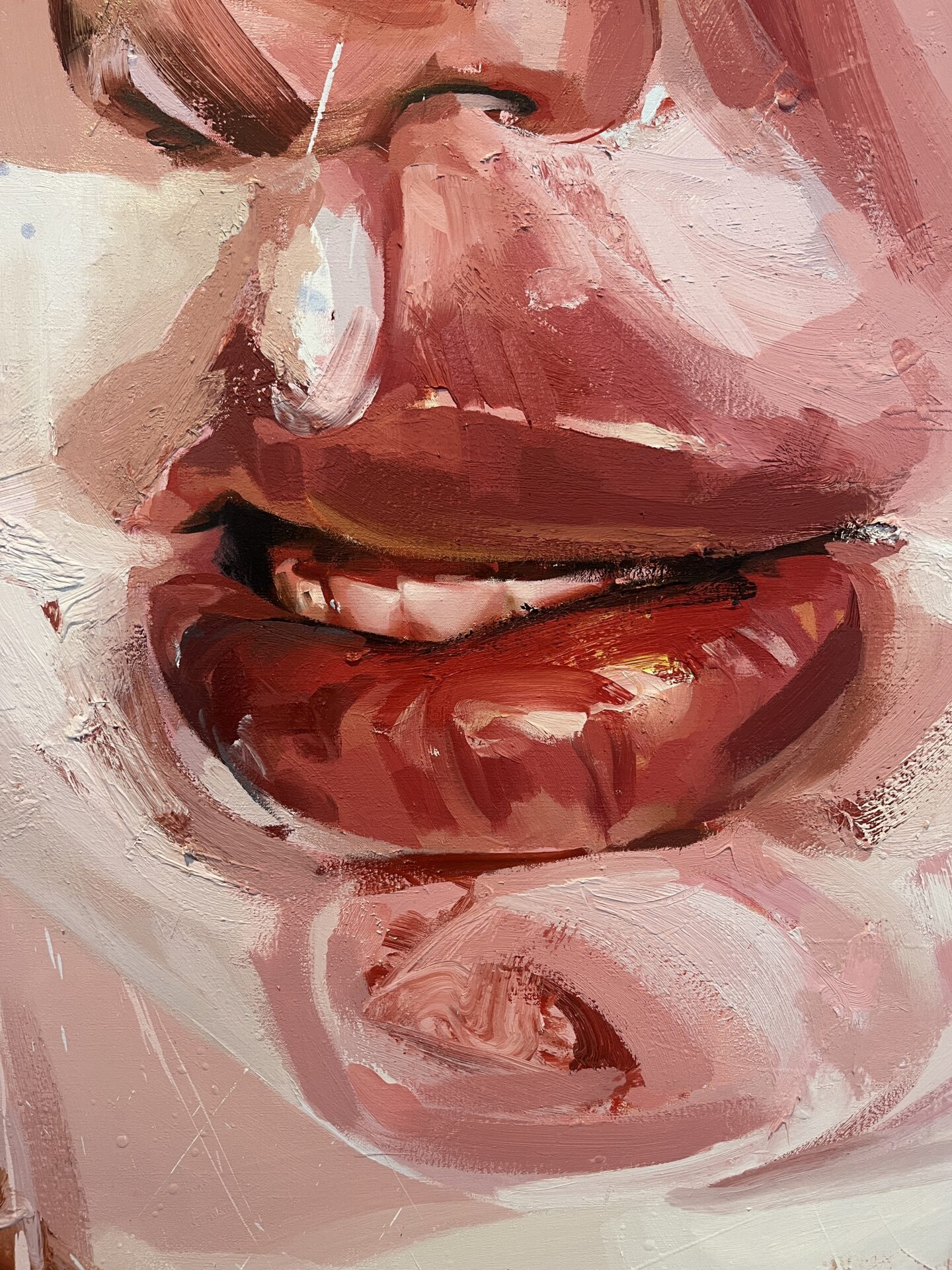
Art historian Linda Nochlin put it succinctly in 2003: the power of Saville’s paintings comes not only from their scale and almost sculptural surfaces, but above all from the ambiguity of their subjects. Her figures are both imposing and commanding, yet painted without any attempt to idealize them. That’s exactly what stays with you when you stand in front of Propped, Reverse, Focus, or Red Stare Head IV.
A Painter Who Has Never Allowed Herself to Be Boxed In
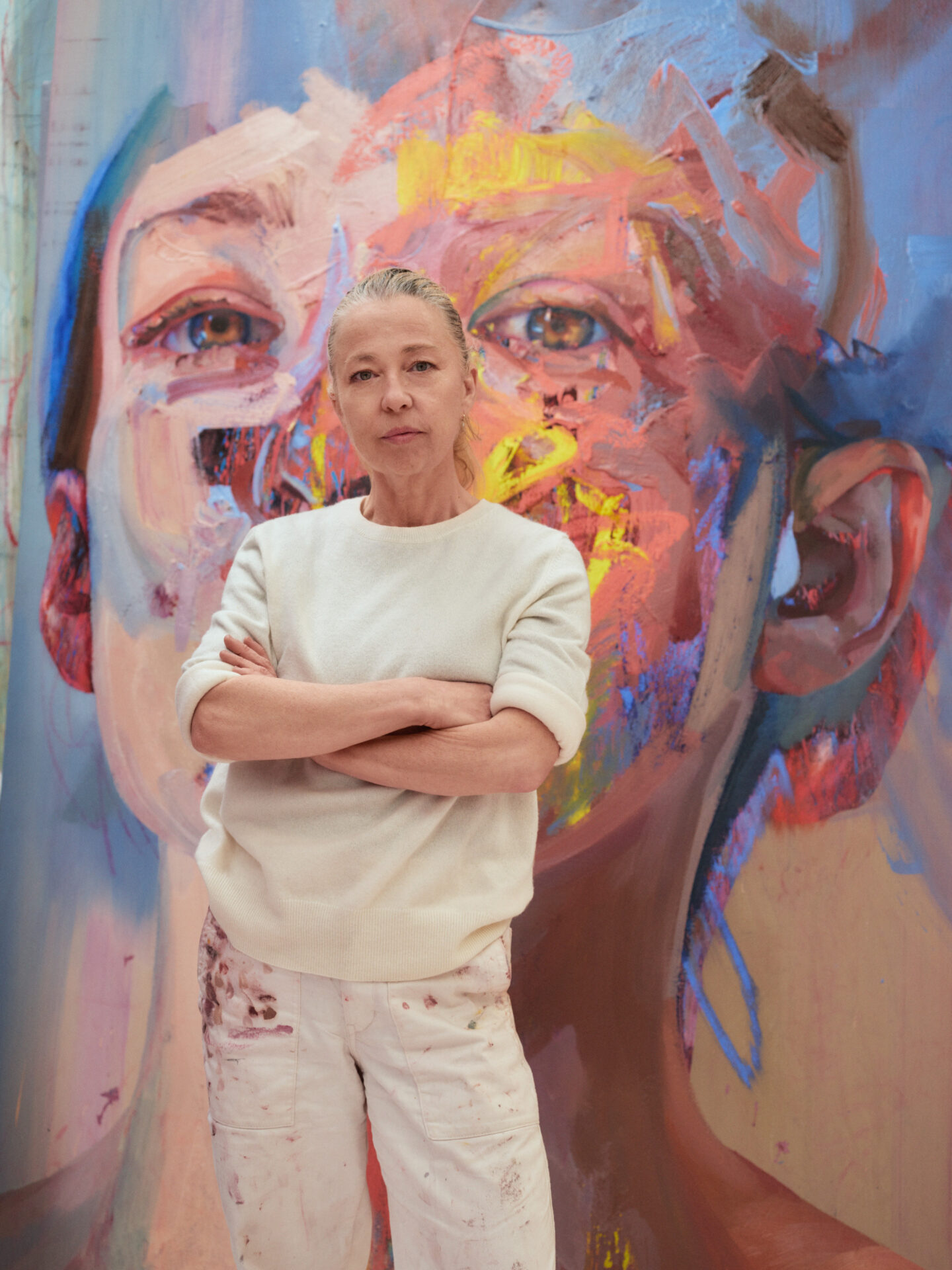
Saville, born in Cambridge in 1970, studied at the Glasgow School of Art from 1988 to 1992. She belongs to the generation of Young British Artists, or YBAs, a group of British artists who rose to prominence in the late 1980s with provocative works that often broke taboos. Damien Hirst and Tracey Emin are among the best-known names. Saville was the only painter in the famous 1997 exhibition Sensation at the Royal Academy, surrounded by conceptual art and multimedia works. From 2003 to 2009, she lived in Palermo, where she immersed herself in the Old Masters, particularly Titian and Tintoretto. That engagement is exactly what we can now see in Venice.
In 2018, Propped sold at Sotheby’s for the equivalent of $12.4 million, making Saville the most expensive living female artist at the time. (That record now belongs to South African artist Marlene Dumas, whose painting Miss January changed hands for $13.6 million in 2025.) It’s a telling sign of just how interested the art market has become in work that initially feels so uncomfortable.
A Dialogue with Titian: Venus and Adonis and Danaë
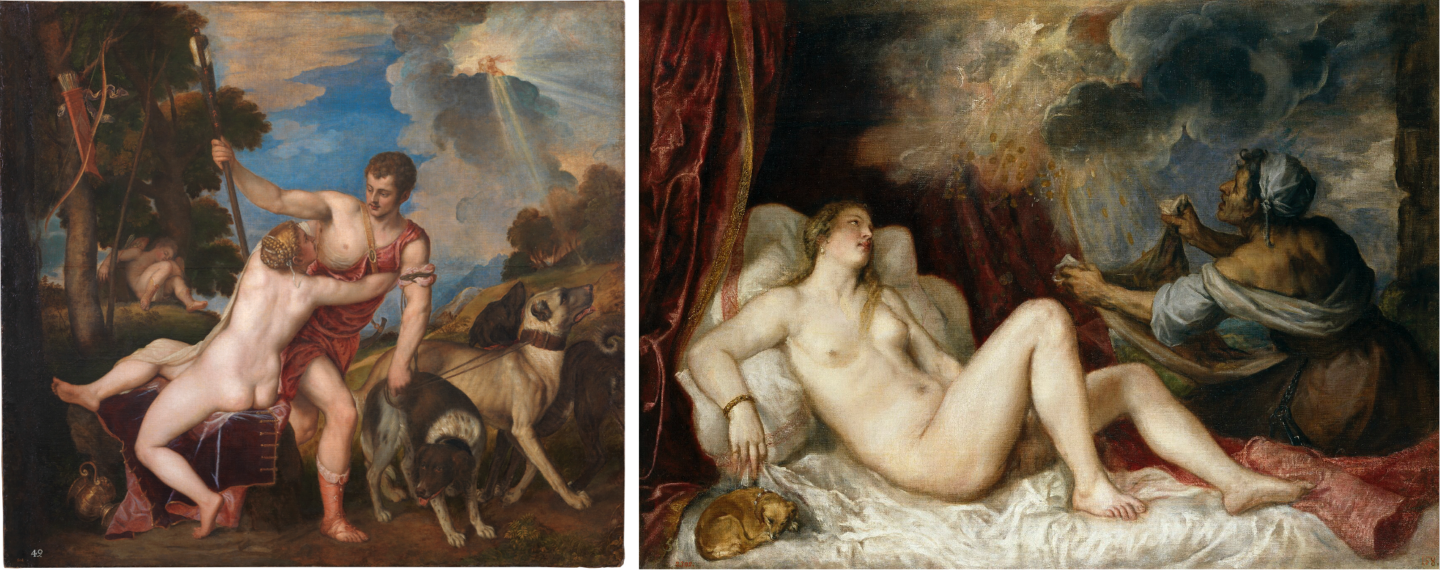
Titian’s work is deeply rooted in Venice. His paintings hang in many of the city’s churches, where visitors can see them at any time. Right at the end of the exhibition, Saville’s engagement with the Renaissance painter becomes tangible once again. The final two paintings, Venus and Adonis and Danaë, were created specifically for this exhibition and pay direct homage to Titian.
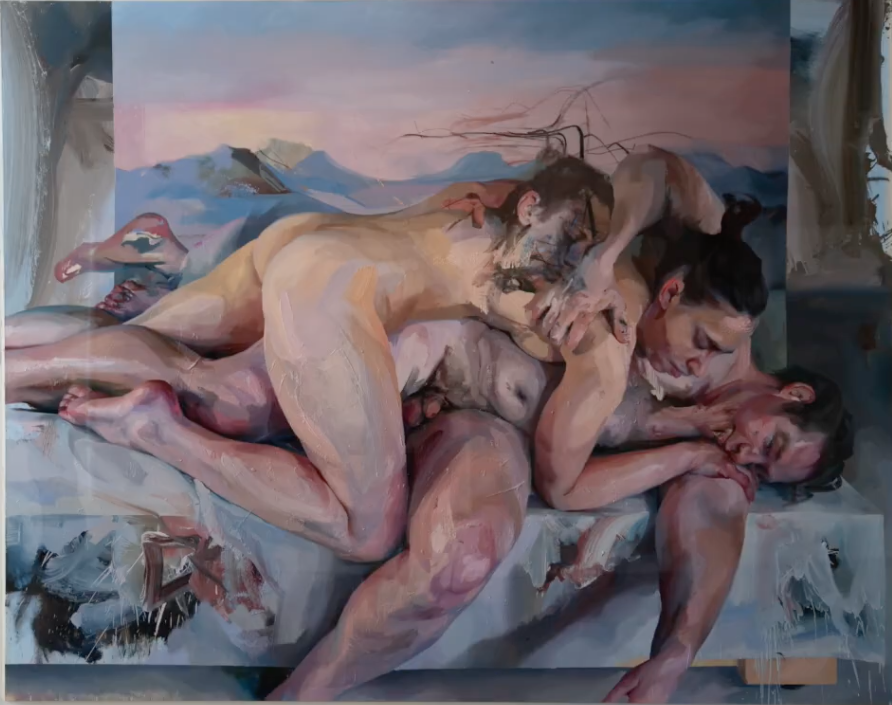
In Venus and Adonis, Saville paints two intertwined bodies, with the mountains of the Cadore region in the background, the very region where Titian himself was born. In Titian’s painting, the two figures stand facing each other in such a way that we see three legs altogether. At first glance, it’s unclear who the leftmost leg belongs to. Saville takes this game even further: here, three figures lie on top of one another, and in several places, the boundaries between body parts disappear. It’s impossible to tell whose foot or hand is whose.
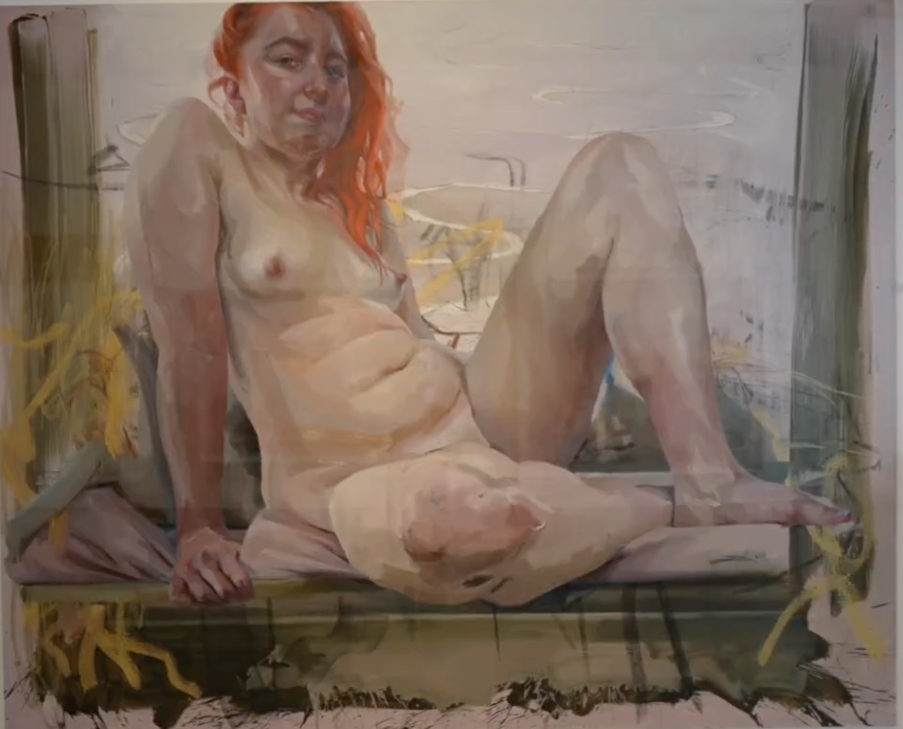
Danaë tells the story of the king’s daughter, whom her father, Acrisius, locks inside a bronze tower after an oracle predicts that his own grandson will one day kill him. As so often when Zeus desires a woman, he transforms himself to gain access to her. This time, he becomes a shower of gold and reaches her that way. What we would now unequivocally call rape was painted for centuries as an erotic seduction scene. In Saville’s painting, the woman’s red hair alludes to the bronze tower itself, while thick, scribbly golden strokes sweep across the entire canvas, echoing the shower of gold.
Final Thoughts
Jenny Saville has been one of the painters whose work I keep coming back to for years, and now, in Venice, I finally got to see a major exhibition of her work. Her paintings, with their monumental scale and disturbing depictions of bodies that defy everything we’re used to seeing, have incredible force. Saville makes you keep looking until your initial discomfort turns into genuine understanding. If you’re in Venice, don’t miss this exhibition.
The Ca’ Pesaro is hosting the first comprehensive exhibition of Saville’s work in Venice through November 22, 2026. It features more than 30 paintings and drawings, from her early work in the 1990s to her most recent pieces.
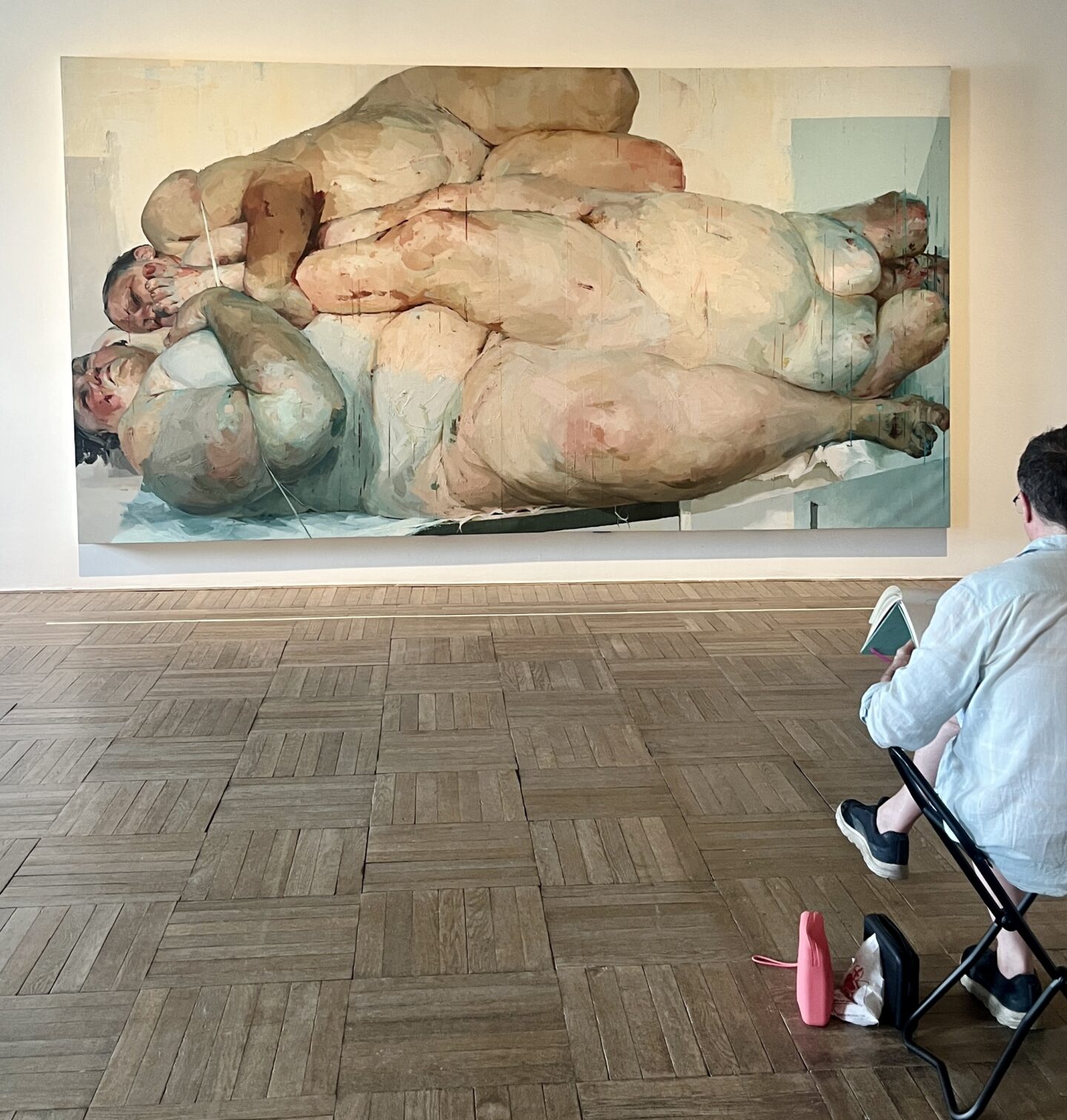
How Jenny Saville challenges the way we look at women’s bodies – Britta Kadolsky
More articles about Venice 2026: Venice Biennale: My Five Favorite Pavilions and A Short Guide to Venice for Art Lovers.
Diesen Beitrag teilen:
Newsletter
Wenn ihr keinen Beitrag verpassen und über neue Artikel informiert werden möchtet, abonniert meinen Newsletter.
"Was kann Kunst" ist auch auf:
Glasstress 2026: An Art Star Lineup at Berengo That Nobody Sees
am 3.10.2026
Felix Gonzalez-Torres writes love into everyday things
am 14.9.2026
Brancusi, the modern sculptor
am 13.7.2026
Venice: A Short Guide for Art Lovers
britta kadolsky am 23.6.2026
Venice Biennale 2026: My Five Favorite Pavilions
am 11.6.2026
Günther Uecker: Nagelkünstler, Weltreisender, stiller Poet
britta kadolsky am 10.5.2026
Yayoi Kusama: Dots That Never Stop
am 19.4.2026
Why Art Matters: The Political Power of Art and the Russian Pavilion Everyone Is Fighting Over
britta kadolsky am 30.3.2026
Thomas Bayrle erfindet das Große im Kleinen
britta kadolsky am 9.3.2026
Xenia Hausner: Schafft eine Bühne für selbstbestimmte Frauen
britta kadolsky am 16.2.2026
Ikonen der Kunstgeschichte
Saskia Wolf am 21.1.2026
Papier in der Kunst: Papier inspiriert Kunst über Jahrhunderte
britta kadolsky am 22.12.2025
Warum belebt Ophelia Kunst und Popkultur?
britta kadolsky am 17.11.2025
Fünf Graphic Novels, die Kunst neu erzählen
britta kadolsky am 3.11.2025
5 berühmte Künstlerpaare der Kunstgeschichte - Zwischen Passion und Untreue
Saskia Wolf am 18.10.2025
Max Liebermann – Maler des Lichts und des Lebens
britta kadolsky am 26.9.2025
Chaos, Körper, Farben: Die Kunst von Pipilotti Rist
britta kadolsky am 27.8.2025
CIA, Art, and the Cold War: documenta II as a Political Stage
am 17.7.2025
Kunst beim Spazierengehen: 10 Skulpturen in Frankfurt
britta kadolsky am 2.7.2025
David Hockney - Zwischen Licht und Linie
britta kadolsky am 25.5.2025
Im Innern des Papiers – Skulpturen von Angela Glajcar
britta kadolsky am 7.5.2025
April, April: Die Kunst des Täuschens
britta kadolsky am 13.4.2025
Andreas Mühe – Im Banne des Zorns
britta kadolsky am 16.3.2025
Martin Kippenberger - Ein Künstler, der Wettsaufen und Punkmusik liebte
britta kadolsky am 18.2.2025
Die Zahl 100 in der Kunst: Symbolik und Bedeutung
britta kadolsky am 23.1.2025
Frauenpower: Künstlerinnen und Erfinderinnen
Saskia Wolf am 16.12.2024
Hans Haacke: Politische Kunst mit Tiefgang
britta kadolsky am 2.12.2024
Kunst unter Bäumen – der Internationale Waldkunstpfad in Darmstadt
Ruth Fühner am 10.11.2024
Blut, Fleisch, Kot: Ungewöhnliche Materialien in der Kunst:
britta kadolsky am 28.10.2024
Kunst und Kamera: Die vergessene Geschichte der Fotografinnen
britta kadolsky am 1.10.2024