Yayoi Kusama: Dots That Never Stop
Dots, Infinity, and Self-Obliteration
They’re already there at the entrance: silver balls scattered across the floor, casual, as if someone had simply left them behind. Only when I look closer do I realize: there are countless numbers of them. 1,500, to be exact. They reflect my face back at me, smaller than in reality, distorted, and suddenly I’m standing there playing Narcissus, with no one announcing it. That’s the point. That’s Yayoi Kusama. The 1966 work is called Narcissus Garden and I love the story behind it. More on that later.
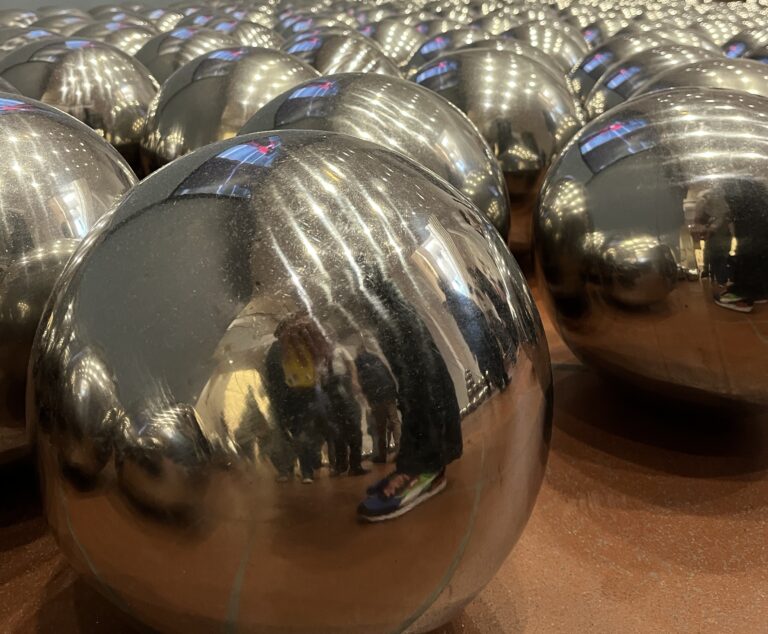
The retrospective at Museum Ludwig in Cologne is the German stop on a European tour that started at the Fondation Beyeler in Riehen and continues afterward at the Stedelijk Museum in Amsterdam. In Riehen, the same balls floated in the pond in front of the building, under the open sky. (links museum)
Early Dots: Childhood Drawings
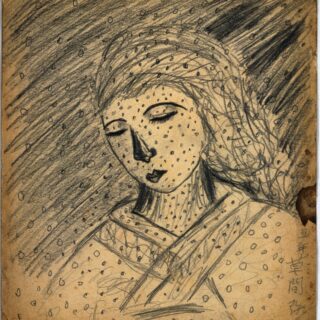
Two small drawings from Kusama’s childhood open the show: a house with four people, made in 1934, and a woman with closed eyes from 1939. Dots cover both sheets. Yayoi was five and ten years old at the time.
Yayoi Kusama was born in 1929 in Matsumoto, Japan, into a middle-class family that had little understanding for her creative streak. She painted because she had no other choice. Since childhood, she’d had frightening hallucinations: flower patterns that spoke to her, nets that spread across her perception, and dots. Art was the antidote. Whenever she painted something, it lost its menace. She covered her images with dots, so-called polka dots, until they stopped scaring her. She later called this principle self-obliteration: the dissolution of the self through repetition, disappearance into pattern. This was closer to therapy than to an aesthetic concept. And it led to one of the most radical artistic positions of the 20th century.
A Letter to New Mexico
In 1955, Kusama found a book of reproductions of Georgia O’Keeffe’s work at a secondhand bookshop in Japan. Impressed, she wrote a letter to the famous American artist and enclosed some of her own watercolors. She had no career to speak of at that point. Nobody expected O’Keeffe to write back. But she did: O’Keeffe encouraged the young Japanese artist to come to America, to New York, where the art world was busy reinventing itself.
In her autobiography Infinity Net, Kusama later wrote that without this letter, she might never have gone. Once Kusama was finally living in New York, O’Keeffe showed up unannounced at her apartment door one day. Sadly, nobody photographed the one meeting between the two of them.
New York, the Avant-Garde, Fabric Penises, and and Who Influenced Whom

In 1958, Kusama moved to New York with no English, no money, but full of determination.
In 1961, she started covering furniture, clothing, walls, and eventually a boat with fabric penises. Her soft sculptures caused a stir. The objects are densely packed with hand-sewn, stuffed phallic shapes made of white fabric, painted over in silver, soft and strangely proliferating. The forms sprout from the objects like tentacles or seaweed. They come across as menacing and funny at the same time.
Kusama herself has explained where this obsession came from: her mother sent her out as a child to spy on her father’s affairs. Sexuality was therefore something threatening and shameful for her from the start.
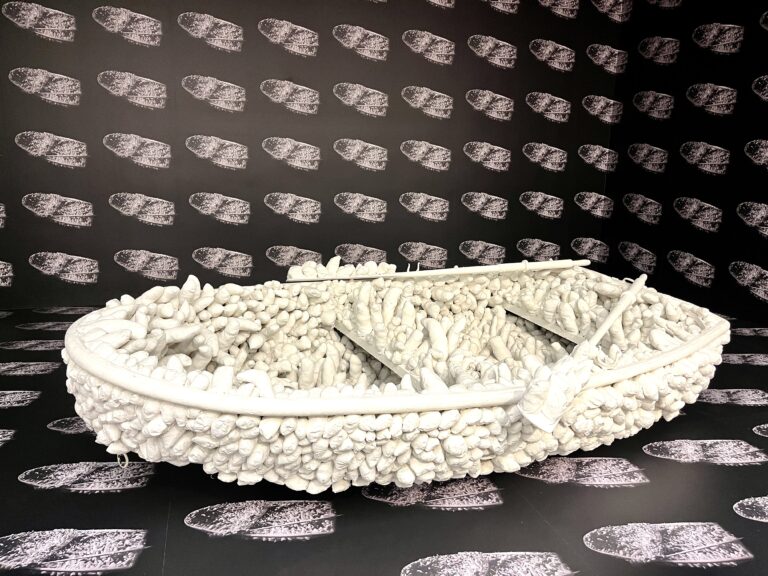
In 1963, for her solo show Aggregation: One Thousand Boats Show, she filled a rowboat completely with fabric penises and surrounded it with wallpaper made from 999 photographs of the boat. A thousand boats, thousands of phallic symbols. Her first immersive installation, with its nearly infinite repetitions, dissolved the boundaries of the room. Museum Ludwig has partially recreated that room for this exhibition.
Her soft sculptures appeared alongside works by Claes Oldenburg, Robert Morris, and Andy Warhol in a show now considered the first Pop Art exhibition in the United States.
Kusama always saw what happened next as an injustice: that same year, Oldenburg debuted his own large-scale soft sculptures. Oldenburg himself never acknowledged where the idea came from. It made him famous. With Warhol, it was subtler but still recognizable: Kusama described how impressed he was by her work with endless repetition. Soon after, his serial silkscreens appeared. Kusama later noted that both Warhol and Oldenburg borrowed motifs from her work. Artistic inspiration, or stolen ideas?
Starting in 1967, Kusama threw herself into New York’s public life with her Naked Happenings: Central Park, the street, in front of the Stock Exchange, in front of the UN building, at the Statue of Liberty, on the Brooklyn Bridge. Her first Anatomic Explosion took place on October 15, 1968, across from the New York Stock Exchange, under the slogan: “The money made on this exchange keeps the Vietnam War going.” Naked dancers with painted dots danced in the streets until the police showed up and the group threw their hippie clothes back on.
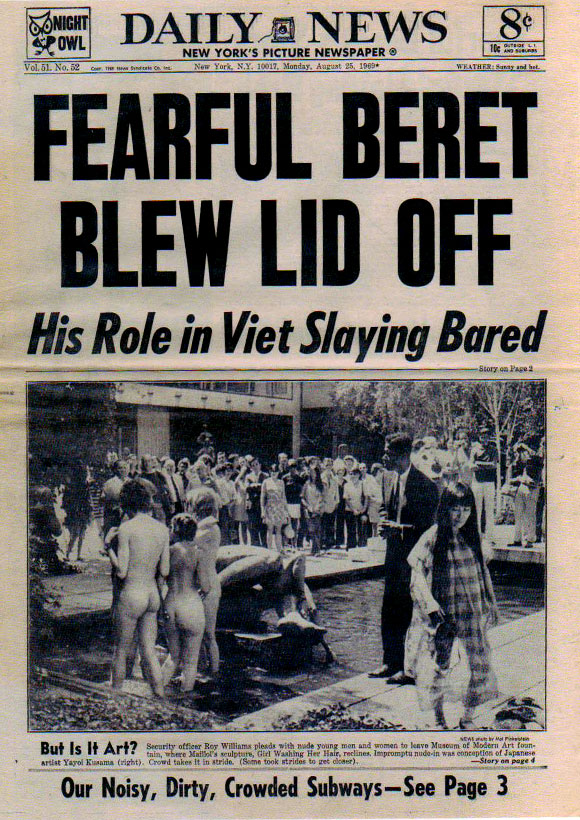
In 1969 came Grand Orgy to Awaken the Dead at MoMA, where eight nude performers posed in a fountain in the museum’s sculpture garden. Kusama called MoMA the “Mausoleum of Modern Art” and wanted to know what exactly was still modern about it. Security took twenty minutes to get the group out of the water. The Daily News ran the story on its front page.
In 1973, weighed down by financial and psychological struggles, Yayoi Kusama returned from New York to Japan. She first entered psychiatric treatment there, and starting in 1977 voluntarily admitted herself to a clinic in Tokyo, where she has continued to work without interruption ever since.
Venice Biennale: Yayoi Kusama’s Balls for Two Dollars
Kusama wasn’t invited to the 33rd Venice Biennale in 1966, but she went anyway: not invited didn’t mean not welcome. According to her autobiography, she had the moral and financial support of Lucio Fontana, plus permission from the chairman of the Biennale committee. She brought 1,500 silver balls with her. She placed them on the lawn in front of the Italian Pavilion and put up two signs: “NARCISSUS GARDEN, KUSAMA” and “YOUR NARCISSISM FOR SALE.” Dressed in a gold kimono, she stood among the balls and sold them for 1,200 lire apiece, roughly two dollars. (I would have bought some on the spot!)
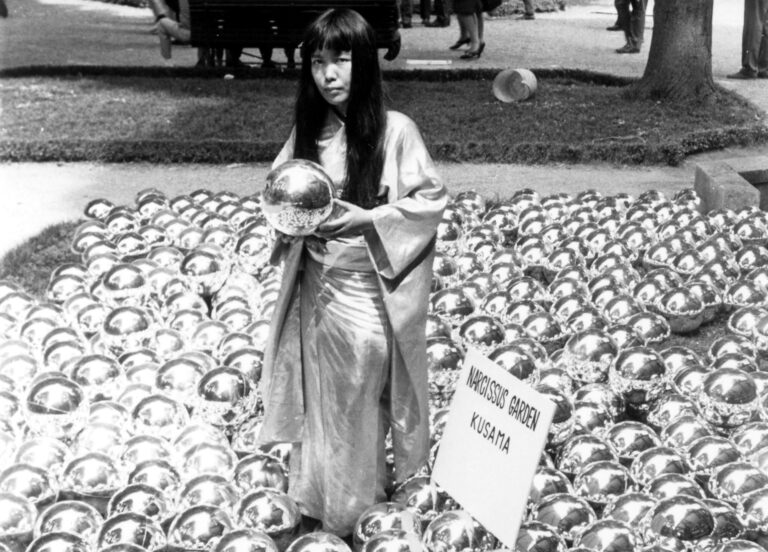
Biennale officials shut the sales down: selling artworks like “hot dogs or ice cream” was inappropriate, they said. The installation itself stayed, though, and has been reinstalled around the world ever since: in the pond at Inhotim Museum in Brazil, in Central Park in New York, in the pond at the Fondation Beyeler, on the floor of Museum Ludwig.
In 1993, Kusama was officially invited to represent Japan at the 45th Biennale: the first solo artist, and the first woman, to represent her country in Venice. The mirrored room with yellow, black-dotted pumpkins reflecting into infinity marked her international breakthrough.
The Pumpkins
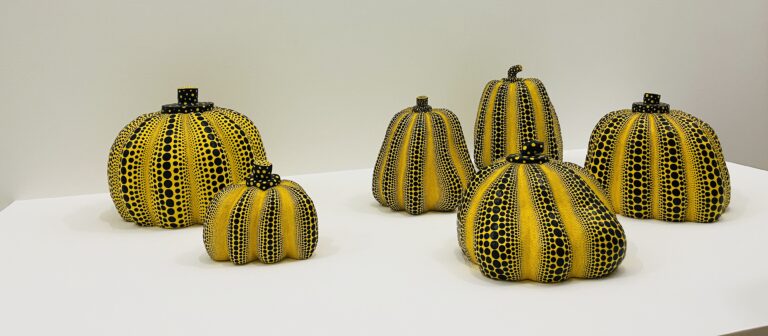
Kusama’s family had run a seed and plant nursery in the countryside for about a hundred years. They traded in seeds, seedlings, and flowers, and Yayoi Kusama spent her childhood surrounded by flower fields. She sketched every day, and she has talked about seeing and picking a pumpkin for the first time as a grade-schooler, at her grandfather’s place.
For Kusama, pumpkins represent solid, steady inner strength. She paints them again and again, partly because it helps her find mental balance. Where the dots and nets of her hallucinations frightened her and threatened to overwhelm her, the pumpkin was the opposite: comfort, companion, friend. In her work, pumpkins often stand in for self-portraits. That says it all, really: the pumpkin is her.
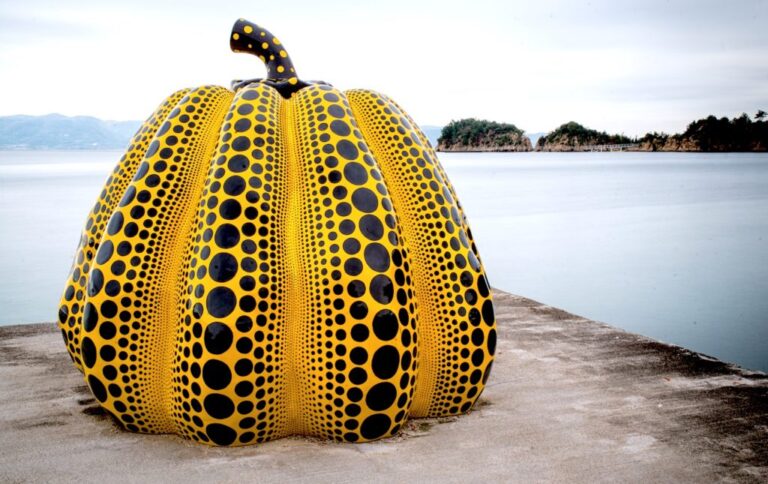
Today, her giant pumpkins stand in front of museums, in parks, in public squares. On the island of Naoshima in Japan’s Inland Sea, a typhoon swept the famous yellow pumpkin into the ocean in 2021. A new one went up in the same spot in 2022.

Inside the Infinity Mirror Room
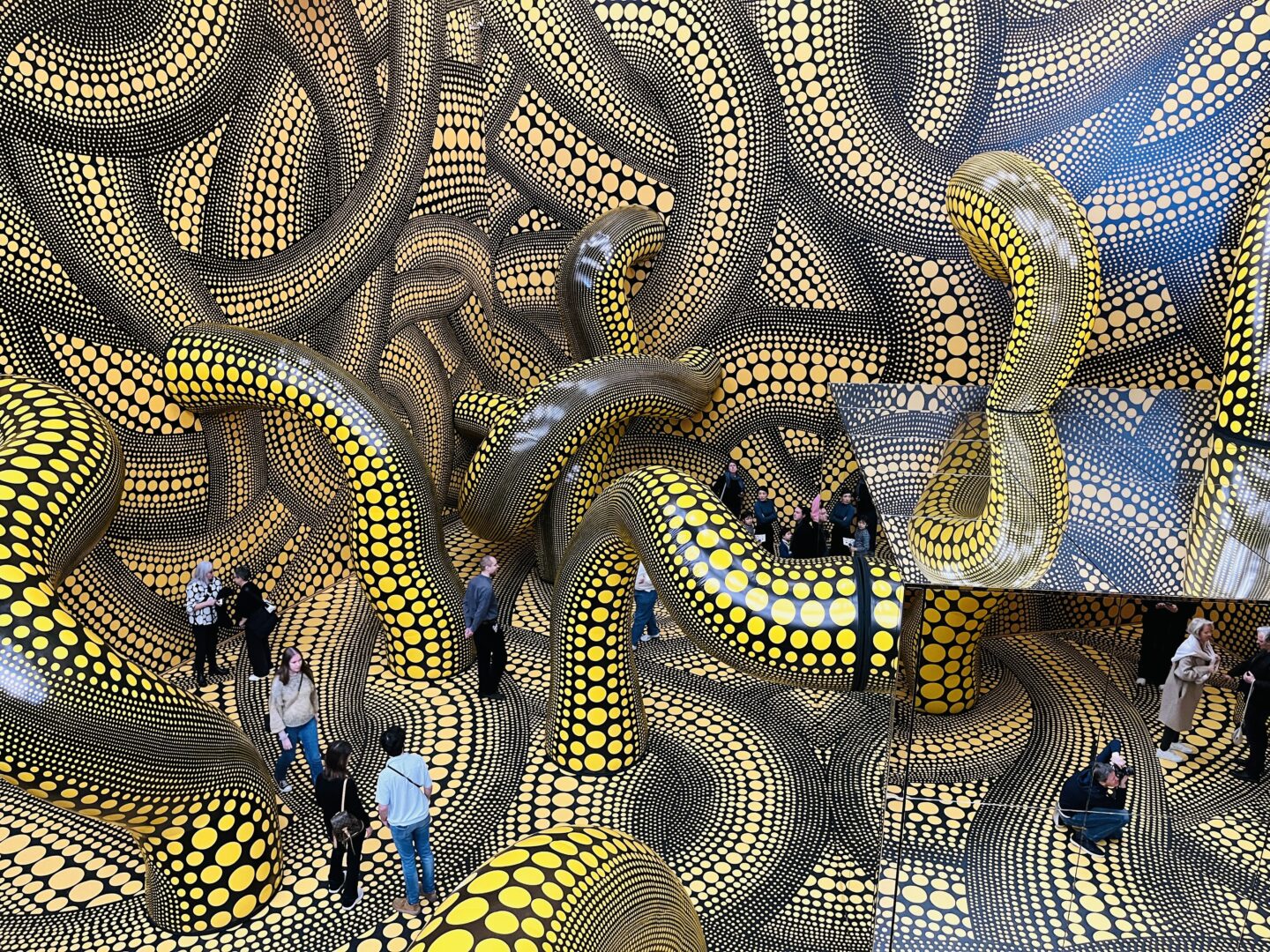
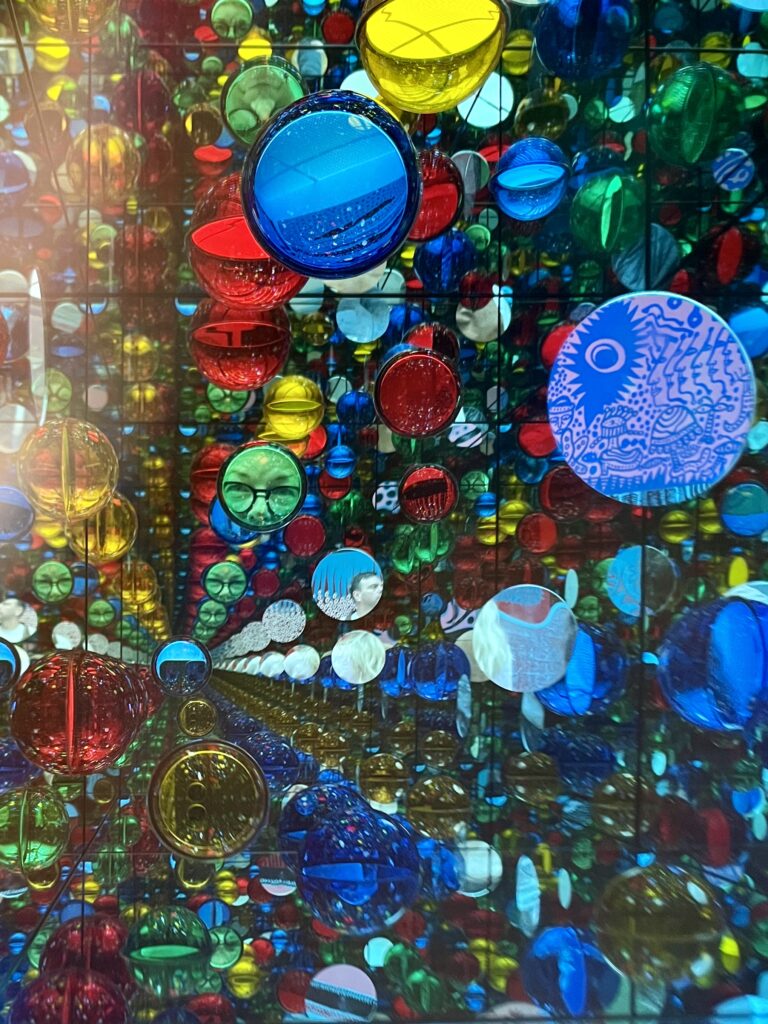
Every Kusama fan knows this selfie hotspot: the Infinity Mirror Room. In Cologne, giant black tentacles with yellow dots sprawl from floor to ceiling. The dotted pattern continues across ceiling and floor, seamlessly, until the boundaries of the room blur. A small mirrored chamber inside the Infinity Room completes the feeling of infinity: a physical experience of repeating yourself smaller and smaller a thousand times over, while also being part of something infinite.
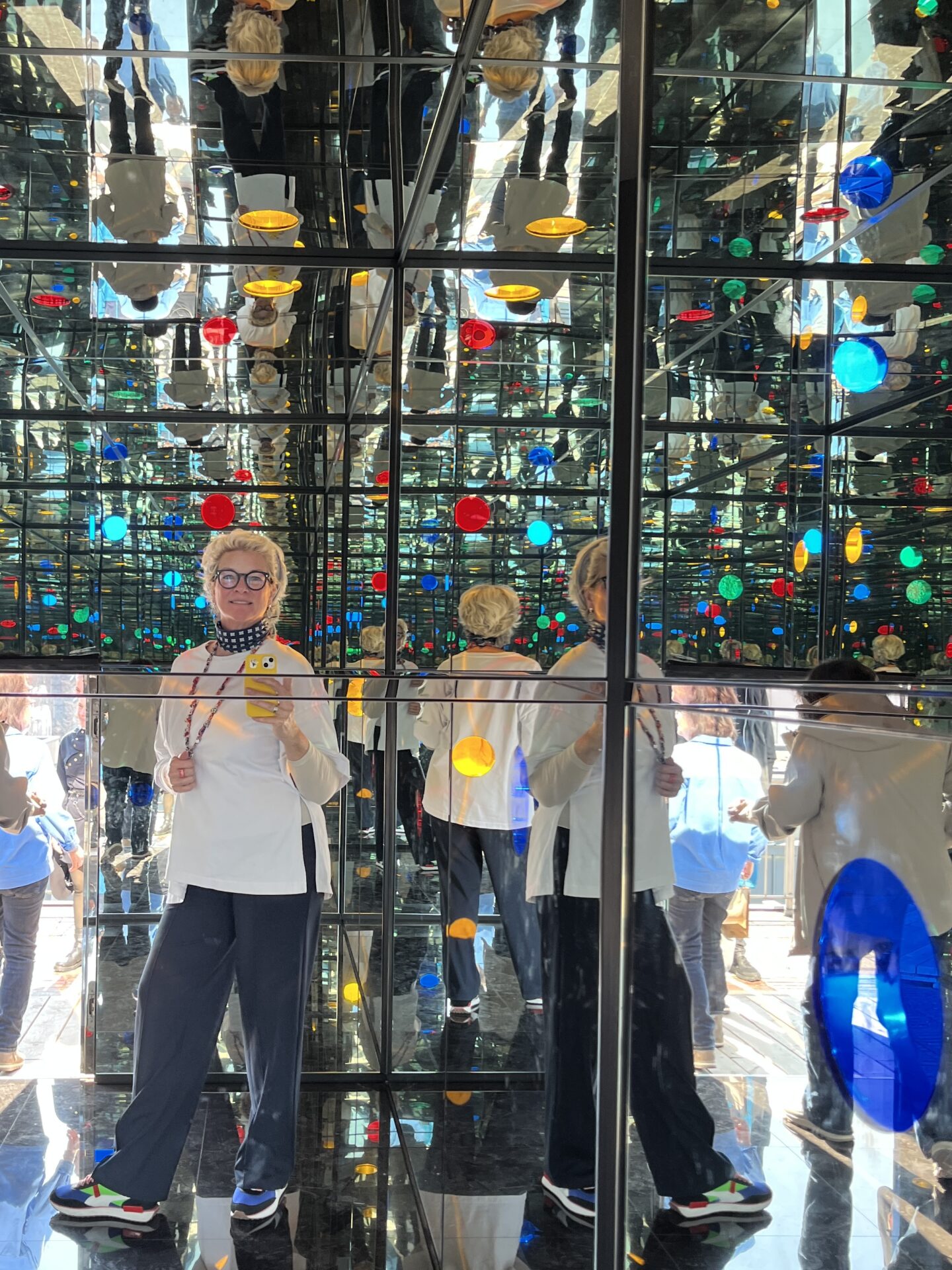
I have to photograph this. You could mourn the selfie as the death of genuine encounters with art. But hasn’t Kusama always insisted that her work dissolves the line between viewer and image? When I pull out my phone to take a picture inside an Infinity Mirror Room, I disappear into the image in my own way, and without meaning to, I fulfill Kusama’s artistic concept.
Kusama and Louis Vuitton
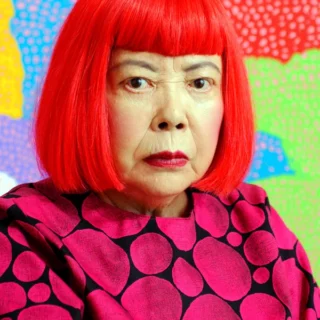
Since 2012, Kusama has regularly partnered with Louis Vuitton: dots on bags and on the facades of flagship stores worldwide. Is this commercialization a betrayal of her own idea? I don’t think so. Yayoi Kusama has always been both artist and brand. On one hand, she disappears, withdrawing into a clinic for decades. On the other, she deliberately stages her own persona, with the bright red bob and the polka-dot dresses.
Her motifs grew out of psychological distress, out of compulsion, out of the attempt to make the world bearable, and now those exact motifs decorate handbags worth several thousand euros. You could read that as a sellout. But you could just as easily see it as a logical continuation: art as a virus that spreads through capitalism, reaching more people in Vuitton shop windows in every city than any museum ever could.
Conclusion: Yayoi Kusama Is More Relevant Than Ever
You could read Kusama as an outsider artist, as someone mentally ill who transformed her symptoms into art, as a feminist, an activist, a marketing genius, or simply the artist with the cheerful colors and dots. Every one of these readings is true, and none of them is enough.
Alongside the joy that Kusama’s wonderful art sparks, I keep coming back to another thought: that someone has been repeating the same truth for seventy years, and we still don’t really take her seriously. We photograph ourselves in the Infinity Mirror Room. We’re amused by the boat covered in phallic shapes. We admire her New York performances. We find the pumpkins cute. And then we leave.
The artist, who died in August 2026 at age 97, is a social media phenomenon: her dotted pumpkins and selfie-ready rooms flood millions of feeds, and her red wig has become a brand in itself. But the shows at the Beyeler Museum, the Ludwig Museum, and the Stedelijk Museum, along with their accompanying texts and catalog, thankfully make something else clear too: beyond the spectacle, this is also about mental health, female subjectivity, and the longing for collective discourse.
Kusama’s art brings together exactly the themes shaping today’s conversations.
Kusama wasn’t the only one experimenting with repetition and pattern in the ’60s: Roy Lichtenstein also revolutionized the art world with his dots.
Dots That never stop: Yayoi Kusama – britta kadolsky
This text was translated into English with the assistance of artificial intelligence.
Diesen Beitrag teilen:
Newsletter
Wenn ihr keinen Beitrag verpassen und über neue Artikel informiert werden möchtet, abonniert meinen Newsletter.
"Was kann Kunst" ist auch auf:
Glasstress 2026: An Art Star Lineup at Berengo That Nobody Sees
am 3.10.2026
Felix Gonzalez-Torres schreibt Liebe in Alltagsdinge ein
britta kadolsky am 14.9.2026
Wie Jenny Saville den Blick auf Frauenkörper sprengt
am 12.8.2026
Brancusi, der moderne Bildhauer
britta kadolsky am 13.7.2026
Venice: A Short Guide for Art Lovers
britta kadolsky am 23.6.2026
Venice Biennale 2026: My Five Favorite Pavilions
am 11.6.2026
Günther Uecker: Nagelkünstler, Weltreisender, stiller Poet
britta kadolsky am 10.5.2026
Why Art Matters: The Political Power of Art and the Russian Pavilion Everyone Is Fighting Over
britta kadolsky am 30.3.2026
Thomas Bayrle erfindet das Große im Kleinen
britta kadolsky am 9.3.2026
Xenia Hausner: Schafft eine Bühne für selbstbestimmte Frauen
britta kadolsky am 16.2.2026
Ikonen der Kunstgeschichte
Saskia Wolf am 21.1.2026
Papier in der Kunst: Papier inspiriert Kunst über Jahrhunderte
britta kadolsky am 22.12.2025
Warum belebt Ophelia Kunst und Popkultur?
britta kadolsky am 17.11.2025
Fünf Graphic Novels, die Kunst neu erzählen
britta kadolsky am 3.11.2025
5 berühmte Künstlerpaare der Kunstgeschichte - Zwischen Passion und Untreue
Saskia Wolf am 18.10.2025
Max Liebermann – Maler des Lichts und des Lebens
britta kadolsky am 26.9.2025
Chaos, Körper, Farben: Die Kunst von Pipilotti Rist
britta kadolsky am 27.8.2025
CIA, Kunst und Kalter Krieg: Die documenta II 1959
britta kadolsky am 17.7.2025
Kunst beim Spazierengehen: 10 Skulpturen in Frankfurt
britta kadolsky am 2.7.2025
David Hockney - Zwischen Licht und Linie
britta kadolsky am 25.5.2025
Im Innern des Papiers – Skulpturen von Angela Glajcar
britta kadolsky am 7.5.2025
April, April: Die Kunst des Täuschens
britta kadolsky am 13.4.2025
Andreas Mühe – Im Banne des Zorns
britta kadolsky am 16.3.2025
Martin Kippenberger - Ein Künstler, der Wettsaufen und Punkmusik liebte
britta kadolsky am 18.2.2025
Die Zahl 100 in der Kunst: Symbolik und Bedeutung
britta kadolsky am 23.1.2025
Frauenpower: Künstlerinnen und Erfinderinnen
Saskia Wolf am 16.12.2024
Hans Haacke: Politische Kunst mit Tiefgang
britta kadolsky am 2.12.2024
Kunst unter Bäumen – der Internationale Waldkunstpfad in Darmstadt
Ruth Fühner am 10.11.2024
Blut, Fleisch, Kot: Ungewöhnliche Materialien in der Kunst:
britta kadolsky am 28.10.2024
Kunst und Kamera: Die vergessene Geschichte der Fotografinnen
britta kadolsky am 1.10.2024