Feminist, Queer and Traditional: Highlights of the Venice Biennale, Part 2
Artists Who Thrilled Me in Venice:
Beyond the national pavilions of the Biennale, the main exhibition and the so-called collateral events in Venice hold real highlights. Here I tell you about the lesser-known artists who touched me most:
Feminist: Paula Rego in the Main Exhibition at the Giardini
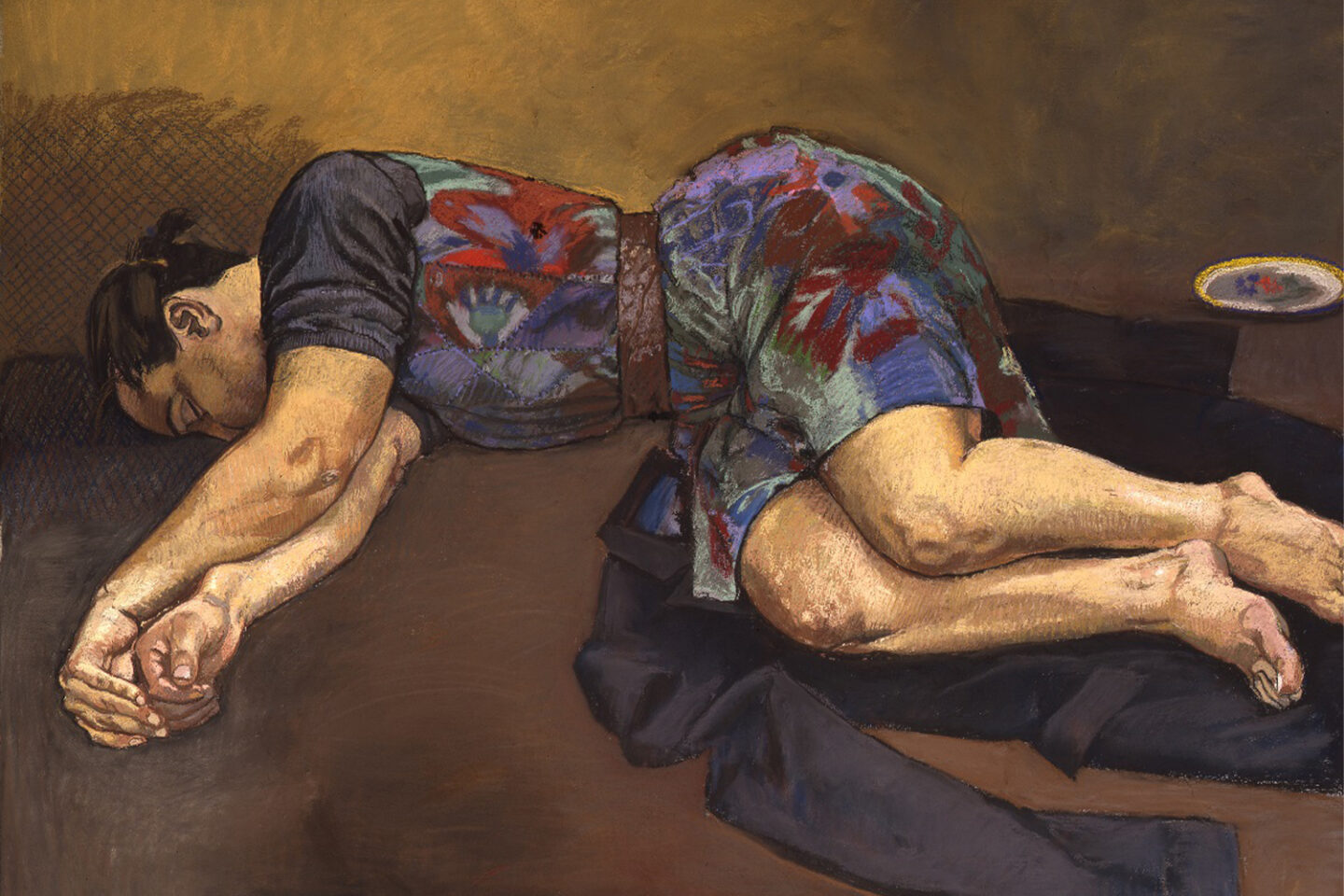
These large, colorful, figurative-realist paintings grab me immediately. A whole room in the main exhibition at the Giardini is devoted to the Portuguese artist. Her subjects are almost always women. She often paints them life-size, in unusual poses that make you look closer: A woman in a flowered, knee-length dress lies on the floor. She lies on her right side as if asleep, her bare arms stretched wide and her knees drawn up. Her lower body rests on a dark men’s jacket. The unconventional pose tells the story of Rego’s husband, who fell ill with multiple sclerosis early on and whom she cared for until his death, for 20 years. Ambivalent feelings such as grief, anger and love shine through in the paintings she made on this theme.
She made all the pictures with pastels, which is unusual for such huge formats. Many recall dark fairy tales.
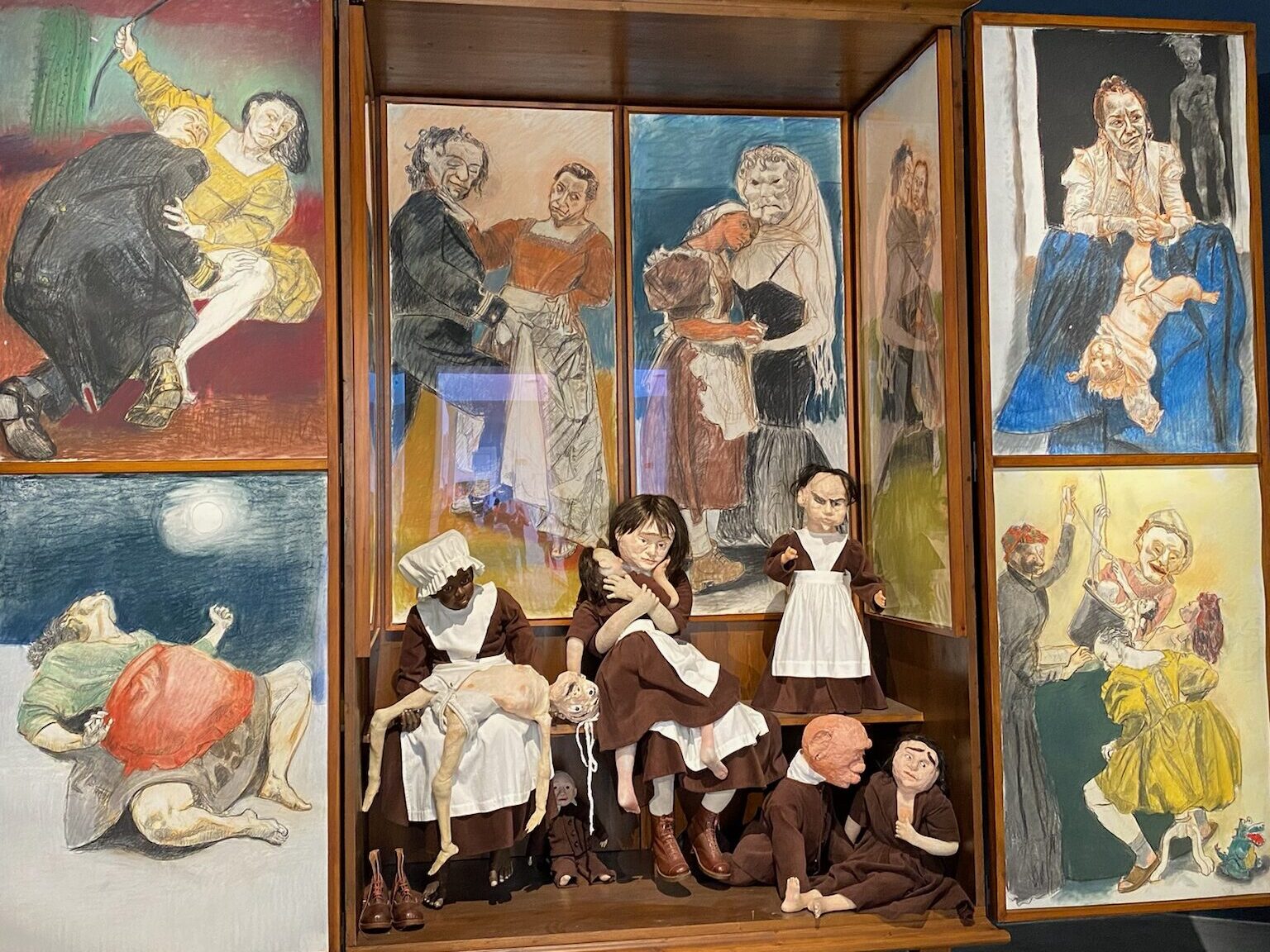
Paula Rego grew up in Portugal under Salazar’s dictatorship, but she also studied and lived in England. Portugal is also the subject of her series The Abortion Pastels: Rego takes on the country’s strict abortion law (in practice almost a ban). She paints women, mostly young ones, who had an illegal abortion, with all the fear, pain, suffering, shame and courage that come with it. Her women are strong, and the stories in her pictures feel psychologically complex: At first and second glance you sense many nuances, but you cannot make them out.
In recent years the artist has added handmade cloth dolls to her painting.
Rego died in June 2022 at age 87.
Queer: Igshaan Adams’s Huge Tapestry in the Main Exhibition at the Arsenale
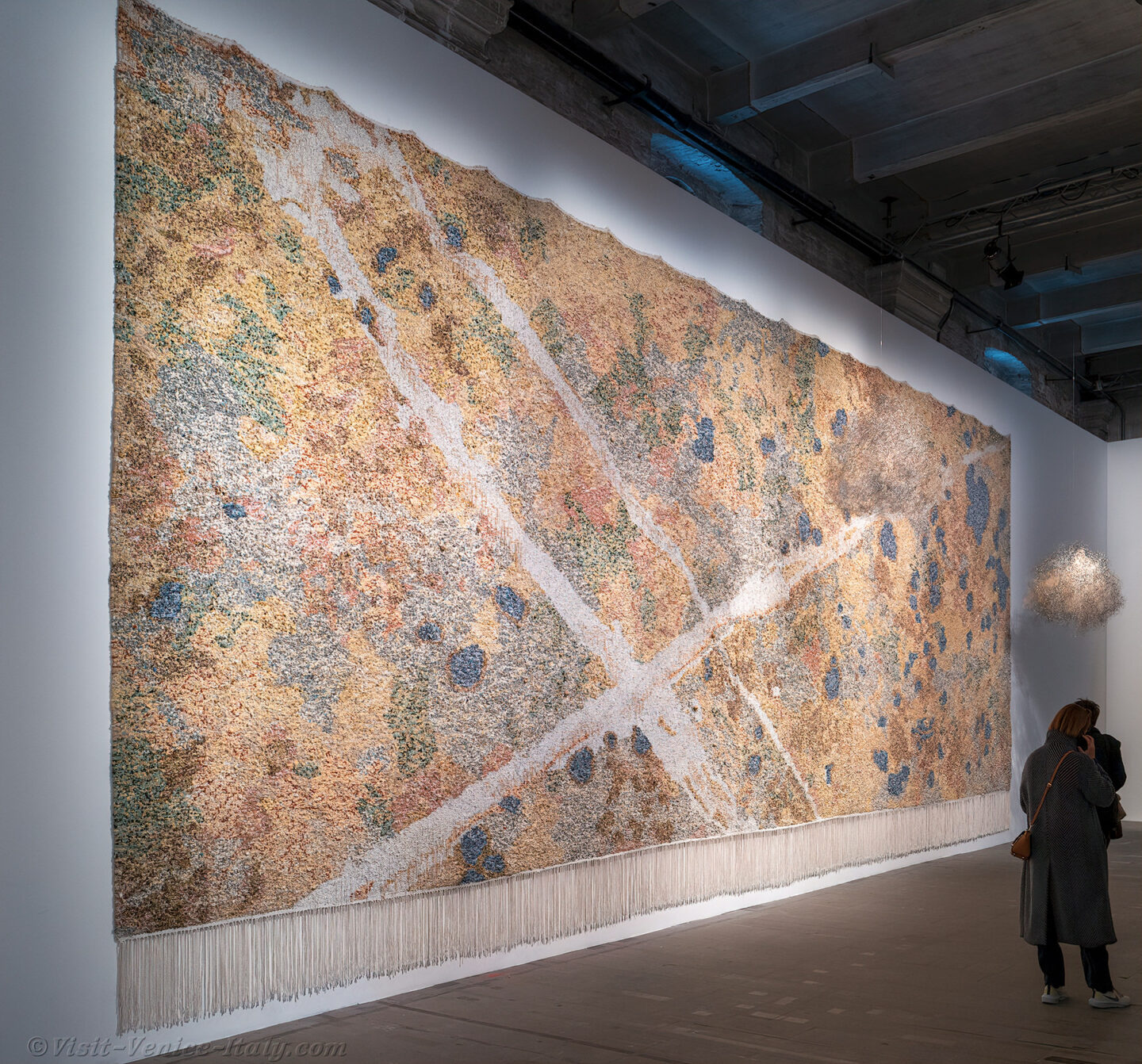
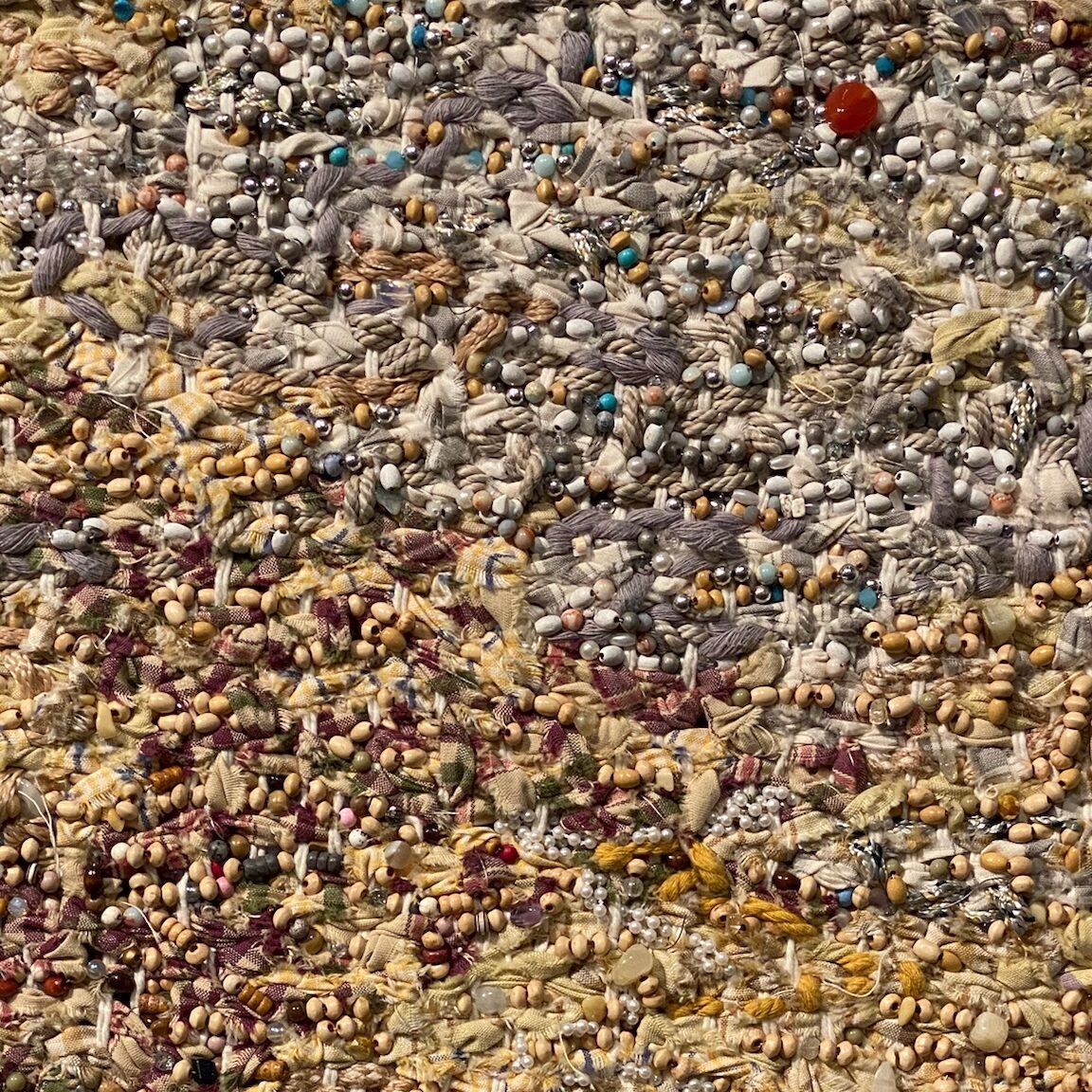
The huge, colorful tapestry Bonteheuwel /Epping hangs on the wall of the Arsenale, nearly twelve meters long and five meters high, and fascinates through sheer size alone. As I step closer, the medley of woven-in materials draws me in even more: wood, plastic, bone, glass beads, shells, nylon rope, cotton ribbons, chains, wire and many more, a chaotic assemblage. Most of the material in this tactile tapestry is trash from the area where Adams grew up: postcolonial waste. Adams was born and raised in the township of Bonteheuwel on the dusty edge of Cape Town. As a Cape Malay, a Muslim and openly queer, he keeps asking about belonging in his art. Under the apartheid regime, authorities classified him as “Coloured” and forced him into a district that white people considered unfit to live in.
The large-format tapestry shows an expressionist-looking pattern in beige and pink tones with a few darker spots. It recalls the linoleum floors in the homes of his friends and relatives in Cape Town, South Africa. Three light diagonal lines also run through the colorful pattern: the so-called “desire lines.” These are footpaths that people wear into the ground over time, far from the official roads and streets. The huge woven work shows a kind of map of Adams’s home area, along with the routes between Bonteheuwel, where he lives, and the industrial zone of Epping, where Black and “Coloured” people in particular worked.
Traditional: Chun Kwang Young at the Palazzo Contarini
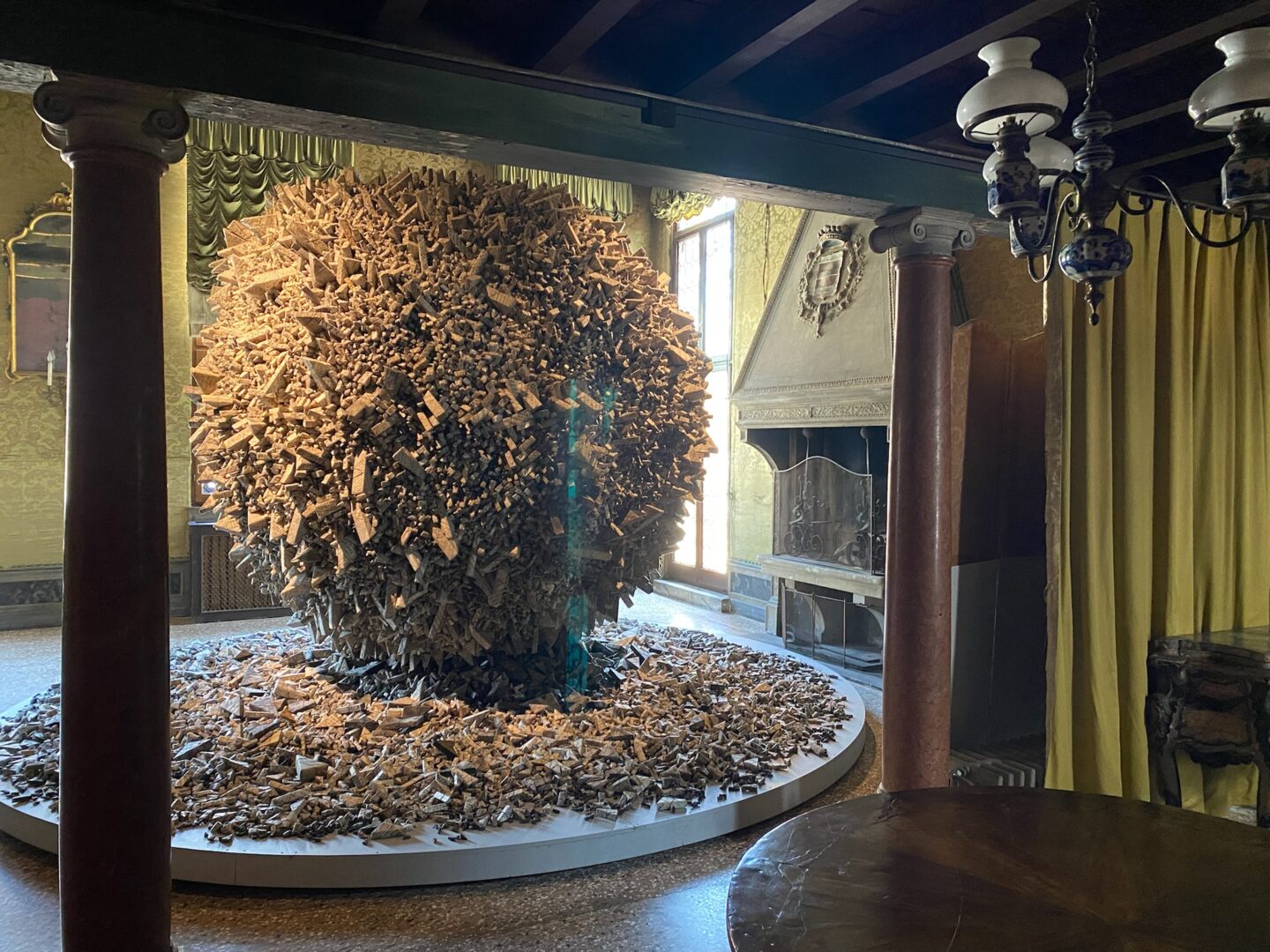
The wonderful thing about the Venice Art Biennale is that it gets you into palazzi that are normally closed to the public. Many so-called Eventi collaterali take place in these stately residences.
One of these accompanying exhibitions is at the Palazzo Contarini Polignac, right on the Grand Canal next to the Accademia Bridge. The early Renaissance palace hosts the exhibition Times Reimagined.
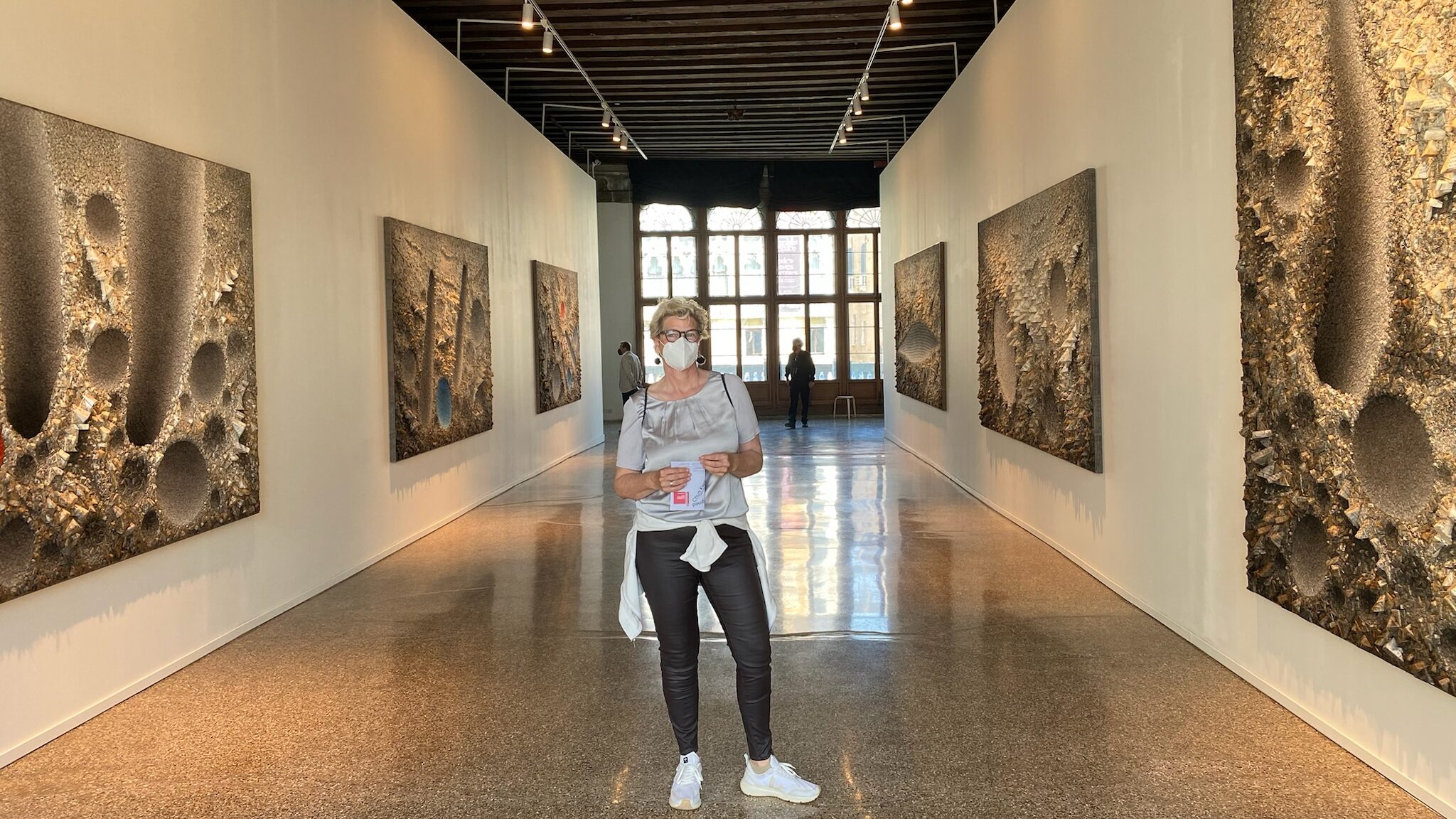
The fascinating paper works of the South Korean artist Chun Kwang Young fill the magnificent rooms.
The sculptures, up to four meters tall, have organic forms with a thorny-looking surface. Looking closer, I see that he has joined thousands of small triangular packets together. The paper carries writing and comes from old book pages. It consists of the inner bark of the mulberry tree. Hanji is what South Koreans call this traditionally made paper.
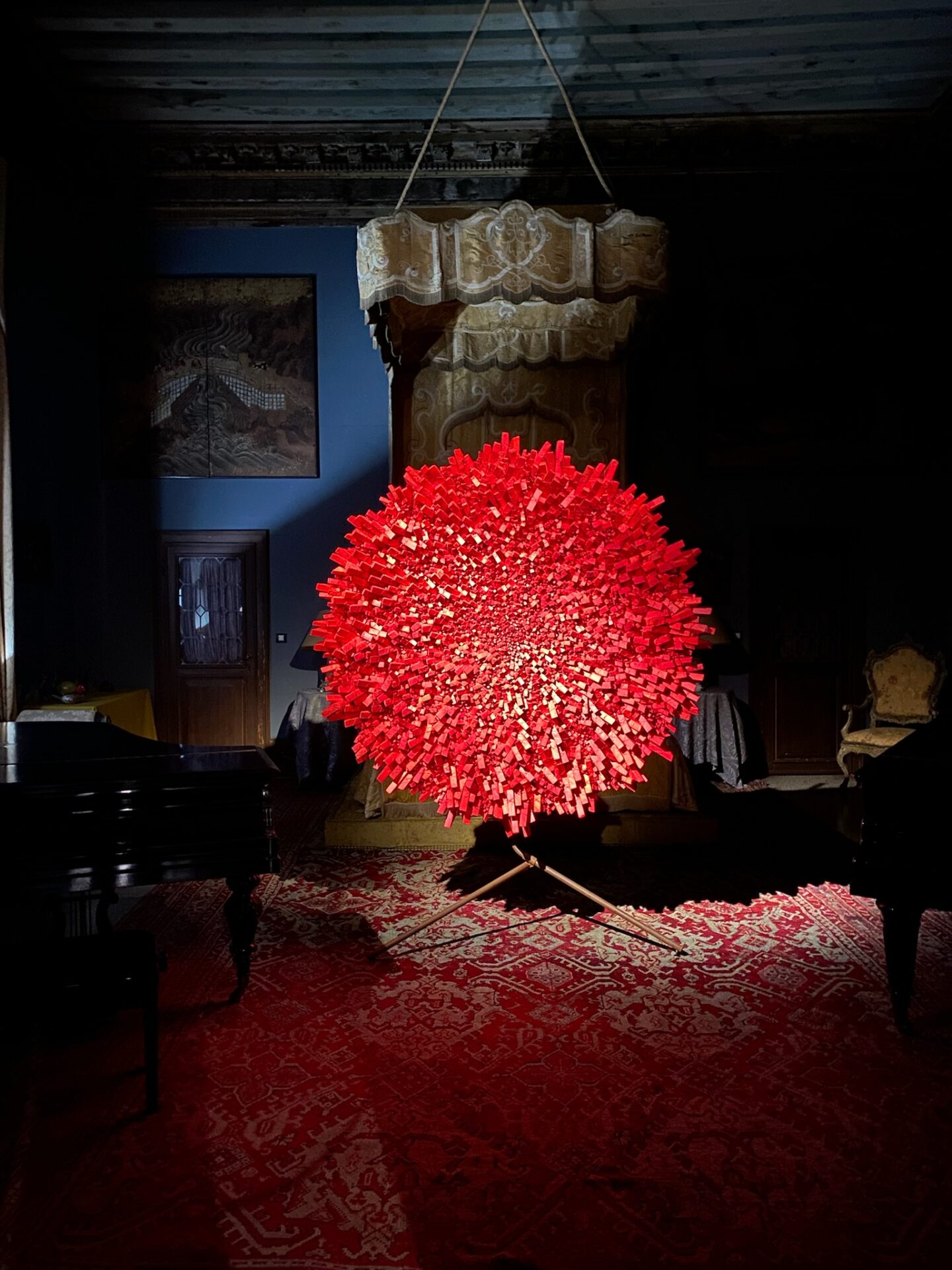
Chun folded his works with endless patience. He wrapped Styrofoam triangles in Hanji and tied a small ribbon around each one. Packets fixed tightly side by side and on top of each other form abstract architectures that evoke a giant mushroom, an oversized virus or a heart. Forty larger-than-life sculptures and reliefs fill the rooms of the palazzo.
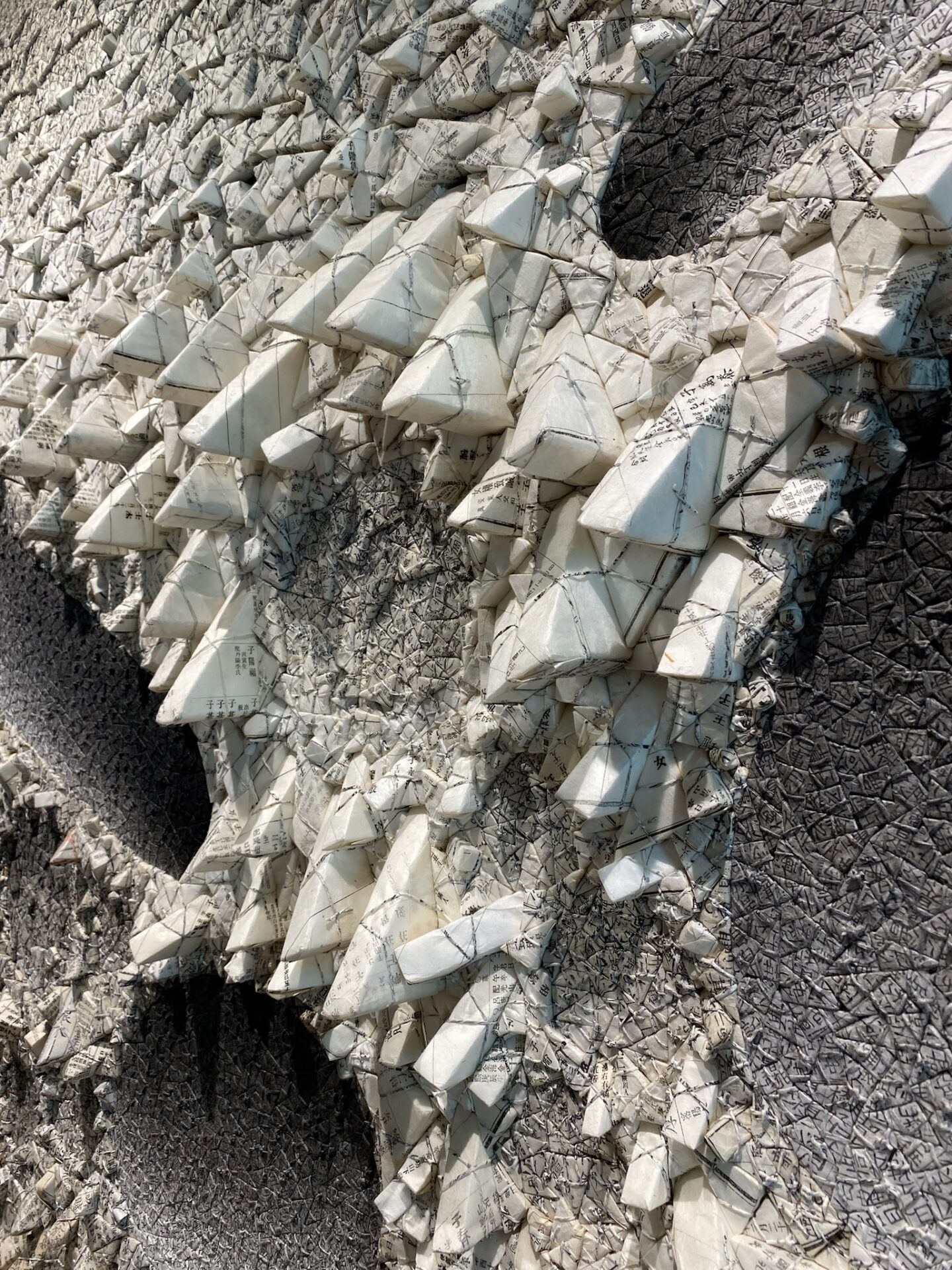
Paper, and the way of folding it into packets, played a big role in the artist’s childhood. Hanji was everywhere in Korea until more modern materials pushed it out. This historical significance of the material matters a lot to Chun and gives his work a political dimension.
Conclusion:
After the German Pavilion and the four national pavilions that also thrilled me, both the Biennale’s main exhibition and the accompanying events offer many highlights. Paula Rego finally reached a wider audience at 87, sadly too late for her. The monumental textile art of the still fairly young, queer South African Adams, made with unusual materials, invites a close look. The huge paper sculptures of the South Korean Chun are just as fascinating, and the palazzo is a feast for the eyes on top.
All three artists described here are absolutely worth seeing!
Feminist, Queer and Traditional: Highlights of the Venice Biennale, Part 2
Diesen Beitrag teilen:
Newsletter
Wenn ihr keinen Beitrag verpassen und über neue Artikel informiert werden möchtet, abonniert meinen Newsletter.
"Was kann Kunst" ist auch auf:
Glasstress 2026: An Art Star Lineup at Berengo That Nobody Sees
am 3.10.2026
Felix Gonzalez-Torres schreibt Liebe in Alltagsdinge ein
britta kadolsky am 14.9.2026
Wie Jenny Saville den Blick auf Frauenkörper sprengt
am 12.8.2026
Brancusi, der moderne Bildhauer
britta kadolsky am 13.7.2026
Venice: A Short Guide for Art Lovers
britta kadolsky am 23.6.2026
Venice Biennale 2026: My Five Favorite Pavilions
am 11.6.2026
Günther Uecker: Nagelkünstler, Weltreisender, stiller Poet
britta kadolsky am 10.5.2026
Yayoi Kusama: Dots That Never Stop
am 19.4.2026
Why Art Matters: The Political Power of Art and the Russian Pavilion Everyone Is Fighting Over
britta kadolsky am 30.3.2026
Thomas Bayrle erfindet das Große im Kleinen
britta kadolsky am 9.3.2026
Xenia Hausner: Schafft eine Bühne für selbstbestimmte Frauen
britta kadolsky am 16.2.2026
Ikonen der Kunstgeschichte
Saskia Wolf am 21.1.2026
Papier in der Kunst: Papier inspiriert Kunst über Jahrhunderte
britta kadolsky am 22.12.2025
Warum belebt Ophelia Kunst und Popkultur?
britta kadolsky am 17.11.2025
Fünf Graphic Novels, die Kunst neu erzählen
britta kadolsky am 3.11.2025
5 berühmte Künstlerpaare der Kunstgeschichte - Zwischen Passion und Untreue
Saskia Wolf am 18.10.2025
Max Liebermann – Maler des Lichts und des Lebens
britta kadolsky am 26.9.2025
Chaos, Körper, Farben: Die Kunst von Pipilotti Rist
britta kadolsky am 27.8.2025
CIA, Kunst und Kalter Krieg: Die documenta II 1959
britta kadolsky am 17.7.2025
Kunst beim Spazierengehen: 10 Skulpturen in Frankfurt
britta kadolsky am 2.7.2025
David Hockney - Zwischen Licht und Linie
britta kadolsky am 25.5.2025
Im Innern des Papiers – Skulpturen von Angela Glajcar
britta kadolsky am 7.5.2025
April, April: Die Kunst des Täuschens
britta kadolsky am 13.4.2025
Andreas Mühe – Im Banne des Zorns
britta kadolsky am 16.3.2025
Martin Kippenberger - Ein Künstler, der Wettsaufen und Punkmusik liebte
britta kadolsky am 18.2.2025
Die Zahl 100 in der Kunst: Symbolik und Bedeutung
britta kadolsky am 23.1.2025
Frauenpower: Künstlerinnen und Erfinderinnen
Saskia Wolf am 16.12.2024
Hans Haacke: Politische Kunst mit Tiefgang
britta kadolsky am 2.12.2024
Kunst unter Bäumen – der Internationale Waldkunstpfad in Darmstadt
Ruth Fühner am 10.11.2024
Blut, Fleisch, Kot: Ungewöhnliche Materialien in der Kunst:
britta kadolsky am 28.10.2024